Figure 03人形机器人与Helix端到端控制系统:具身智能突破深度解析
摘要
2026年5月,Figure AI的Figure 03人形机器人在一场震撼业界的直播中完成了长达200小时的连续全自动作业,分拣近25万个包裹,零故障。这一里程碑式的成就标志着人形机器人正式从「实验室展示」迈入「规模化商用」阶段。本文深入剖析Figure 03的核心技术——Helix端到端神经网络控制系统,包括System 0/1/2三层架构、视觉运动策略、全身协同控制等关键技术,并提供完整的Python/Go代码示例,帮助开发者理解具身智能的核心原理与实现路径。
关键词:人形机器人、具身智能、Helix、端到端控制、Figure 03、System 0/1/2、强化学习
一、背景:具身智能的临界点
1.1 人形机器人的历史与挑战
人形机器人的研发历史可以追溯到数十年前,但长期停留在实验室阶段,难以真正走向商业化应用。主要挑战包括:
人形机器人商业化的核心挑战:
1. 运动控制的复杂性 - 需要协调几十个关节的精确运动
2. 视觉与动作的整合 - 感知与执行的无缝衔接
3. 环境适应能力 - 在真实场景中应对各种异常
4. 可靠性要求 - 工业场景需要24/7稳定运行
5. 成本控制 - 从原型到量产的价格鸿沟
1.2 Figure 03的历史性突破
2026年5月,Figure AI用一场直播打破了所有质疑:
| 指标 | 成绩 | 意义 |
|---|---|---|
| 连续运行时间 | 200+小时 | 远超8小时设计目标 |
| 分拣数量 | 25万个包裹 | 工业级可靠性验证 |
| 故障次数 | 0次 | 零故障运行里程碑 |
| 平均效率 | 2.7-3秒/件 | 对标熟练工人 |
| 不规则识别率 | 99.7% | 超越人类水平 |
这次直播不仅是技术验证,更是一次商业可行性的完整证明。
二、核心原理:Helix端到端神经网络架构
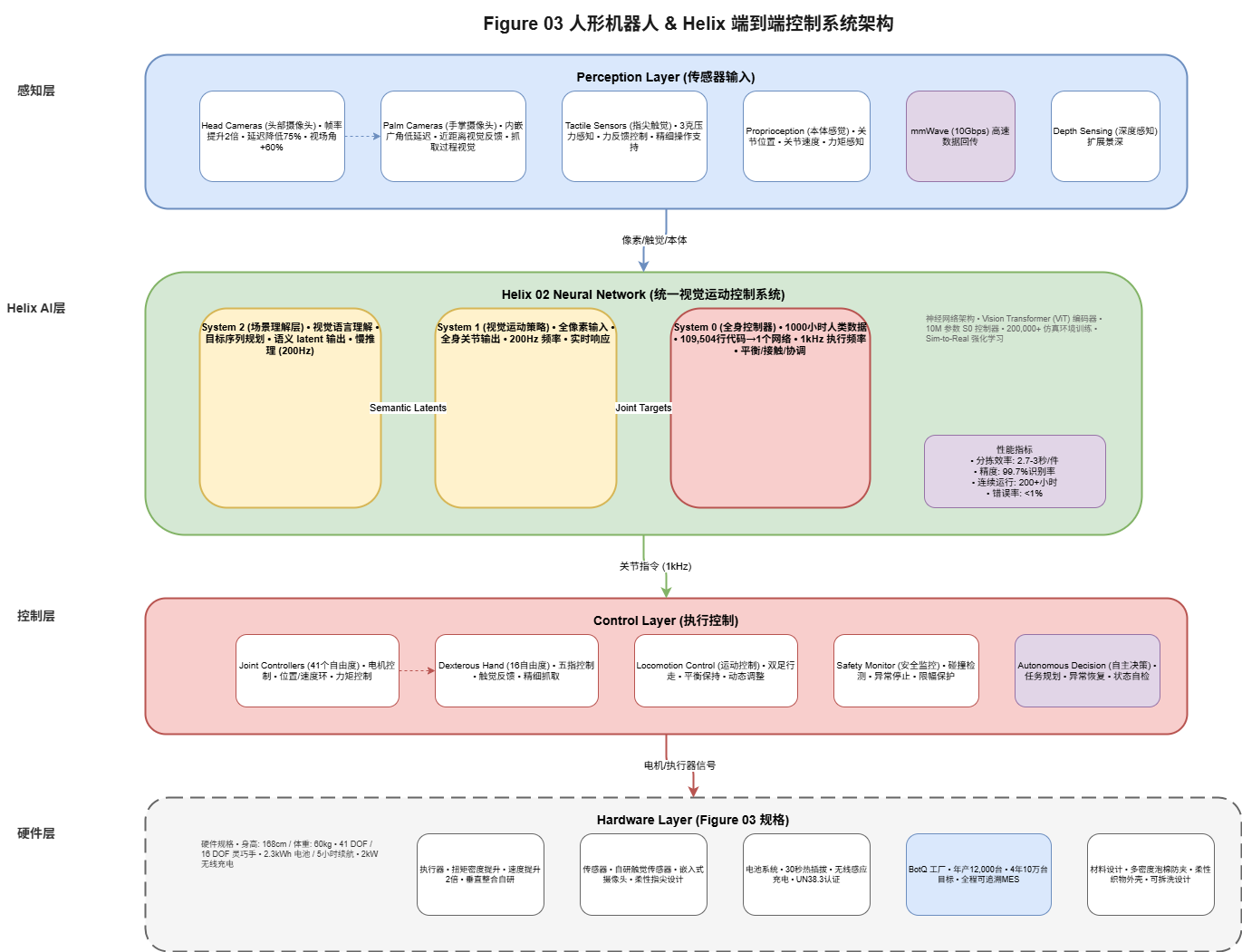
2.1 Helix系统概述
Helix是Figure自研的统一视觉-语言-动作(VLA)大模型,其设计理念是将机器人的所有能力整合到单一神经网络中:
┌─────────────────────────────────────────────────────────────┐
│                    Helix 02 系统架构                         │
├─────────────────────────────────────────────────────────────┤
│                                                             │
│  输入: 像素输入                                              │
│  ┌─────────────────────────────────────────────────────┐   │
│  │  Head Cameras │ Palm Cameras │ Tactile │ Proprio   │   │
│  └─────────────────────────────────────────────────────┘   │
│                           │                                 │
│                           ▼                                 │
│  ┌─────────────────────────────────────────────────────┐   │
│  │               System 2: 场景理解层                     │   │
│  │  • 视觉语言理解                                       │   │
│  │  • 目标序列规划                                       │   │
│  │  • 语义 Latent 输出                                   │   │
│  │  • 慢推理 (200Hz)                                    │   │
│  └─────────────────────────────────────────────────────┘   │
│                           │                                 │
│                           ▼                                 │
│  ┌─────────────────────────────────────────────────────┐   │
│  │              System 1: 视觉运动策略                     │   │
│  │  • 全像素输入 → 全身关节输出                           │   │
│  │  • 200Hz 实时响应                                    │   │
│  │  • 统一视觉运动策略                                   │   │
│  └─────────────────────────────────────────────────────┘   │
│                           │                                 │
│                           ▼                                 │
│  ┌─────────────────────────────────────────────────────┐   │
│  │              System 0: 全身控制器                      │   │
│  │  • 1kHz 执行频率                                     │   │
│  │  • 1000小时人类运动数据                               │   │
│  │  • 平衡/接触/协调                                     │   │
│  │  • 109504行代码 → 1个神经网络                         │   │
│  └─────────────────────────────────────────────────────┘   │
│                           │                                 │
│                           ▼                                 │
│  输出: 关节指令 (1kHz)                                      │
│                                                             │
└─────────────────────────────────────────────────────────────┘
2.2 System 0: 人类启发的全身控制器
System 0是Helix的底层基础模型,它从1000小时的人类运动数据中学习,实现全身协调控制:
# System 0 控制器实现
import torch
import torch.nn as nn
from typing import Tuple, Dict

class System0Controller(nn.Module):
    """
    System 0: 全身控制器
    基于人类运动数据的神经网络控制器
    替代传统的109,504行C++代码
    """

    def __init__(
        self,
        state_dim: int = 64,  # 全身状态维度
        action_dim: int = 41,  # 41个关节
        hidden_dim: int = 512,
        output_freq: int = 1000  # 1kHz输出频率
    ):
        super().__init__()

        # 运动编码器
        self.motion_encoder = nn.Sequential(
            nn.Linear(state_dim, hidden_dim),
            nn.ReLU(),
            nn.Linear(hidden_dim, hidden_dim),
            nn.ReLU(),
            nn.Linear(hidden_dim, hidden_dim // 2)
        )

        # 平衡控制器
        self.balance_controller = nn.Sequential(
            nn.Linear(hidden_dim // 2, hidden_dim),
            nn.ReLU(),
            nn.Linear(hidden_dim, hidden_dim // 4),
            nn.ReLU(),
            nn.Linear(hidden_dim // 4, 6)  # 6维平衡控制 (CoM位置, 姿态)
        )

        # 接触控制器
        self.contact_controller = nn.Sequential(
            nn.Linear(hidden_dim // 2, hidden_dim),
            nn.ReLU(),
            nn.Linear(hidden_dim, hidden_dim // 4),
            nn.ReLU(),
            nn.Linear(hidden_dim // 4, 4)  # 4个末端执行器接触力
        )

        # 关节指令生成器
        self.joint_command_generator = nn.Sequential(
            nn.Linear(hidden_dim // 2 + 6 + 4, hidden_dim),
            nn.ReLU(),
            nn.Linear(hidden_dim, hidden_dim),
            nn.ReLU(),
            nn.Linear(hidden_dim, action_dim * 3)  # 位置+速度+力矩
        )

        self.output_freq = output_freq

    def forward(
        self,
        full_body_state: torch.Tensor,
        base_motion: torch.Tensor
    ) -> Dict[str, torch.Tensor]:
        """
        前向传播

        Args:
            full_body_state: [batch, state_dim] 全身关节状态
            base_motion: [batch, 6] 基座运动 (位置+姿态)

        Returns:
            关节指令字典
        """
        # 编码运动状态
        encoded = self.motion_encoder(full_body_state)

        # 生成平衡控制
        balance_control = self.balance_controller(encoded)

        # 生成接触控制
        contact_control = self.contact_controller(encoded)

        # 整合所有控制信号
        combined = torch.cat([encoded, balance_control, contact_control], dim=-1)

        # 生成关节指令
        joint_commands = self.joint_command_generator(combined)

        # 分解为位置、速度、力矩
        pos_cmd = joint_commands[..., :action_dim]
        vel_cmd = joint_commands[..., action_dim:2*action_dim]
        torque_cmd = joint_commands[..., 2*action_dim:]

        return {
            "position": pos_cmd,
            "velocity": vel_cmd,
            "torque": torque_cmd,
            "balance_control": balance_control,
            "contact_forces": contact_control
        }

    def compute_reward(
        self,
        predicted_state: torch.Tensor,
        target_state: torch.Tensor,
        balance_error: torch.Tensor,
        contact_error: torch.Tensor
    ) -> torch.Tensor:
        """
        计算强化学习奖励

        奖励设计原则:
        1. 状态跟踪精度
        2. 平衡稳定性
        3. 接触力合适
        """
        # 状态跟踪奖励
        state_reward = -torch.norm(predicted_state - target_state, dim=-1)

        # 平衡奖励(越小越好)
        balance_reward = -balance_error

        # 接触奖励(鼓励稳定接触)
        contact_reward = -contact_error

        # 总奖励
        total_reward = (
            1.0 * state_reward +
            0.5 * balance_reward +
            0.3 * contact_reward
        )

        return total_reward


class WholeBodyController:
    """
    全身控制器封装
    提供与外部系统的高层接口
    """

    def __init__(
        self,
        model_path: str,
        device: str = "cuda"
    ):
        self.device = torch.device(device)
        self.model = System0Controller().to(self.device)

        # 加载预训练权重
        checkpoint = torch.load(model_path, map_location=self.device)
        self.model.load_state_dict(checkpoint["model_state"])
        self.model.eval()

        # 关节配置
        self.joint_config = {
            "legs": 12,      # 每条腿6个关节
            "torso": 3,      # 躯干3个关节
            "arms": 16,      # 每条手臂8个关节
            "head": 2,       # 头部2个关节
            "hands": 16      # 每只手16个自由度
        }

    def compute_command(
        self,
        joint_positions: torch.Tensor,
        joint_velocities: torch.Tensor,
        base_pose: torch.Tensor,
        foot_contact: torch.Tensor
    ) -> Dict[str, torch.Tensor]:
        """
        计算关节控制指令

        Args:
            joint_positions: [41] 当前关节位置
            joint_velocities: [41] 当前关节速度
            base_pose: [6] 基座位姿 (x,y,z,roll,pitch,yaw)
            foot_contact: [4] 足部接触状态

        Returns:
            控制指令
        """
        # 构建完整状态向量
        full_state = torch.cat([
            joint_positions,
            joint_velocities,
            base_pose,
            foot_contact
        ]).unsqueeze(0)  # 添加batch维度

        # 前向传播
        with torch.no_grad():
            commands = self.model(full_state, base_pose.unsqueeze(0))

        # 转换为numpy
        return {k: v.squeeze(0).cpu().numpy() for k, v in commands.items()}

    def compute_impedance_gains(
        self,
        joint_positions: torch.Tensor,
        target_positions: torch.Tensor
    ) -> Tuple[torch.Tensor, torch.Tensor]:
        """
        计算阻抗控制增益

        实现柔顺控制,在与环境交互时提供适应性
        """
        position_error = target_positions - joint_positions

        # 阻抗控制公式: τ = Kp*e + Kd*ė
        Kp = torch.diag(torch.tensor([10.0] * 41))  # 比例增益
        Kd = torch.diag(torch.tensor([2.0] * 41))    # 微分增益

        # 简化为标量增益
        Kp_scalar = 50.0
        Kd_scalar = 5.0

        return Kp_scalar, Kd_scalar
2.3 System 1: 视觉运动策略
System 1将像素直接映射为全身关节目标,是实现「所见即所动」的关键:
# System 1 视觉运动策略实现
import torch
import torch.nn as nn
from typing import Dict, List, Tuple

class VisionTransformer(nn.Module):
    """视觉编码器 - 处理多视角图像输入"""

    def __init__(
        self,
        image_size: int = 224,
        patch_size: int = 16,
        in_channels: int = 3,
        embed_dim: int = 768,
        num_heads: int = 12,
        num_layers: int = 12
    ):
        super().__init__()

        # 图像分块
        self.num_patches = (image_size // patch_size) ** 2
        self.patch_embed = nn.Conv2d(
            in_channels,
            embed_dim,
            kernel_size=patch_size,
            stride=patch_size
        )

        # 位置编码
        self.pos_embed = nn.Parameter(
            torch.zeros(1, self.num_patches, embed_dim)
        )

        # Transformer编码器
        encoder_layer = nn.TransformerEncoderLayer(
            d_model=embed_dim,
            nhead=num_heads,
            dim_feedforward=embed_dim * 4,
            dropout=0.1,
            batch_first=True
        )
        self.transformer = nn.TransformerEncoder(
            encoder_layer,
            num_layers=num_layers
        )

        # 输出投影
        self.projection = nn.Linear(embed_dim, embed_dim)

    def forward(self, images: torch.Tensor) -> torch.Tensor:
        """
        图像特征提取

        Args:
            images: [batch, num_cameras, 3, H, W] 多视角图像

        Returns:
            visual_features: [batch, feature_dim] 视觉特征
        """
        batch_size, num_cameras, C, H, W = images.shape

        # 合并所有相机视角
        images_flat = images.view(-1, C, H, W)

        # 提取patch特征
        patches = self.patch_embed(images_flat)  # [B*C, embed_dim, H', W']
        patches = patches.flatten(2).transpose(1, 2)  # [B*C, H'*W', embed_dim]

        # 添加位置编码
        patches = patches + self.pos_embed

        # Transformer编码
        encoded = self.transformer(patches)  # [B*C, H'*W', embed_dim]

        # 全局池化
        visual_features = encoded.mean(dim=1)  # [B*C, embed_dim]

        # 恢复batch维度并聚合
        visual_features = visual_features.view(batch_size, num_cameras, -1)
        visual_features = visual_features.mean(dim=1)  # [B, embed_dim]

        return self.projection(visual_features)


class System1VisuomotorPolicy(nn.Module):
    """
    System 1: 视觉运动策略
    从像素直接映射到全身关节目标
    """

    def __init__(
        self,
        num_joints: int = 41,
        proprio_dim: int = 64,
        latent_dim: int = 256,
        s2_latent_dim: int = 128
    ):
        super().__init__()

        # 视觉编码器
        self.vision_encoder = VisionTransformer()

        # 本体感觉编码器
        self.proprio_encoder = nn.Sequential(
            nn.Linear(proprio_dim, 512),
            nn.ReLU(),
            nn.Linear(512, 512),
            nn.ReLU(),
            nn.Linear(512, 256)
        )

        # 融合层
        self.fusion = nn.Sequential(
            nn.Linear(768 + 256, 512),
            nn.ReLU(),
            nn.Linear(512, latent_dim)
        )

        # S2条件调制
        self.s2_modulation = nn.Linear(s2_latent_dim, latent_dim)

        # 关节目标解码器
        self.joint_decoder = nn.Sequential(
            nn.Linear(latent_dim, 512),
            nn.ReLU(),
            nn.Linear(512, 512),
            nn.ReLU(),
            nn.Linear(512, num_joints * 3)  # 位置+速度+加速度
        )

        # 动作置信度(用于不确定性估计)
        self.confidence_head = nn.Sequential(
            nn.Linear(latent_dim, 128),
            nn.ReLU(),
            nn.Linear(128, 1),
            nn.Sigmoid()
        )

    def forward(
        self,
        images: torch.Tensor,  # [B, 4, 3, 224, 224] 头+手+深度相机
        proprioception: torch.Tensor,  # [B, 64] 本体感觉
        s2_latents: torch.Tensor  # [B, 128] System 2语义输出
    ) -> Dict[str, torch.Tensor]:
        """
        前向传播

        Args:
            images: 多视角图像
            proprioception: 本体感觉状态
            s2_latents: System 2的语义latent

        Returns:
            关节目标和置信度
        """
        # 视觉特征
        visual_features = self.vision_encoder(images)

        # 本体感觉特征
        proprio_features = self.proprio_encoder(proprioception)

        # 特征融合
        fused = torch.cat([visual_features, proprio_features], dim=-1)
        latent = self.fusion(fused)

        # S2条件调制
        s2_conditioned = latent * (1 + torch.tanh(self.s2_modulation(s2_latents)))

        # 生成关节目标
        joint_targets = self.joint_decoder(s2_conditioned)
        num_joints = joint_targets.shape[-1] // 3

        # 分解为位置、速度、加速度
        positions = joint_targets[..., :num_joints]
        velocities = joint_targets[..., num_joints:2*num_joints]
        accelerations = joint_targets[..., 2*num_joints:]

        # 动作置信度
        confidence = self.confidence_head(s2_conditioned)

        return {
            "positions": positions,
            "velocities": velocities,
            "accelerations": accelerations,
            "confidence": confidence,
            "latent": s2_conditioned
        }

    def compute_action(
        self,
        images: torch.Tensor,
        proprioception: torch.Tensor,
        s2_latents: torch.Tensor,
        current_joint_positions: torch.Tensor
    ) -> torch.Tensor:
        """
        计算最终动作
        考虑当前状态和安全约束
        """
        targets = self.forward(images, proprioception, s2_latents)

        # 添加安全约束
        safe_positions = self.apply_safety_constraints(
            targets["positions"],
            current_joint_positions
        )

        # 融合目标与安全约束
        final_action = (
            0.7 * safe_positions +
            0.3 * targets["positions"] * targets["confidence"]
        )

        return final_action

    def apply_safety_constraints(
        self,
        target_positions: torch.Tensor,
        current_positions: torch.Tensor
    ) -> torch.Tensor:
        """
        应用安全约束
        防止关节位置突变导致机械损伤
        """
        # 关节位置限制
        joint_limits = torch.tensor([
            # 格式: (min, max) for each joint
            # 实际使用时需要从URDF或配置文件加载
        ] * 41, device=target_positions.device)

        # 限制单步最大位移
        max_step = 0.1  #  radians
        position_delta = target_positions - current_positions
        clamped_delta = torch.clamp(position_delta, -max_step, max_step)

        safe_positions = current_positions + clamped_delta

        # 应用关节限位
        safe_positions = torch.clamp(
            safe_positions,
            joint_limits[:, 0],
            joint_limits[:, 1]
        )

        return safe_positions


class VisuomotorRunner:
    """
    视觉运动策略运行器
    负责与硬件接口、执行频率控制等
    """

    def __init__(
        self,
        policy: System1VisuomotorPolicy,
        control_freq: int = 200  # 200Hz
    ):
        self.policy = policy
        self.control_freq = control_freq
        self.dt = 1.0 / control_freq

        # 图像缓冲区
        self.image_buffer = []
        self.max_buffer_size = 2

        # 统计信息
        self.inference_times = []

    @torch.no_grad()
    def step(
        self,
        images: torch.Tensor,
        proprioception: torch.Tensor,
        s2_latents: torch.Tensor,
        current_positions: torch.Tensor
    ) -> Dict[str, torch.Tensor]:
        """
        单步推理

        Returns:
            控制指令
        """
        import time

        start = time.perf_counter()

        # 执行推理
        action = self.policy.compute_action(
            images, proprioception, s2_latents, current_positions
        )

        # 记录推理时间
        inference_time = time.perf_counter() - start
        self.inference_times.append(inference_time)

        # 返回控制指令
        return {
            "joint_targets": action,
            "inference_time_ms": inference_time * 1000
        }

    def run_loop(
        self,
        hardware_interface,
        s2_interface
    ):
        """
        运行控制循环
        """
        rate = rospy.Rate(self.control_freq)

        while not rospy.is_shutdown():
            # 获取传感器数据
            images = hardware_interface.get_images()
            proprioception = hardware_interface.get_proprioception()
            joint_positions = hardware_interface.get_joint_positions()

            # 获取S2输出
            s2_latents = s2_interface.get_latents()

            # 执行推理
            command = self.step(
                images, proprioception, s2_latents, joint_positions
            )

            # 发送控制指令
            hardware_interface.send_joint_targets(
                command["joint_targets"]
            )

            rate.sleep()
2.4 System 2: 场景理解与目标规划
System 2负责高层推理和目标分解:
# System 2 场景理解与目标规划实现
import torch
import torch.nn as nn
from typing import List, Tuple, Dict

class SceneUnderstanding(nn.Module):
    """
    System 2: 场景理解模块
    理解环境语义和目标
    """

    def __init__(
        self,
        visual_dim: int = 768,
        language_dim: int = 512,
        hidden_dim: int = 1024,
        num_objects: int = 100
    ):
        super().__init__()

        # 视觉编码
        self.visual_encoder = nn.Sequential(
            nn.Linear(visual_dim, hidden_dim),
            nn.LayerNorm(hidden_dim),
            nn.ReLU(),
            nn.Linear(hidden_dim, hidden_dim)
        )

        # 语言编码
        self.language_encoder = nn.Sequential(
            nn.Linear(language_dim, hidden_dim),
            nn.LayerNorm(hidden_dim),
            nn.ReLU(),
            nn.Linear(hidden_dim, hidden_dim)
        )

        # 物体检测
        self.object_detector = nn.Sequential(
            nn.Linear(hidden_dim, hidden_dim),
            nn.ReLU(),
            nn.Linear(hidden_dim, num_objects * 6)  # bbox + class + confidence
        )

        # 场景图构建
        self.scene_graph = nn.MultiheadAttention(
            embed_dim=hidden_dim,
            num_heads=8,
            batch_first=True
        )

        # 目标推理
        self.goal_reasoner = nn.Sequential(
            nn.Linear(hidden_dim * 2, hidden_dim),
            nn.LayerNorm(hidden_dim),
            nn.ReLU(),
            nn.Linear(hidden_dim, hidden_dim),
            nn.ReLU(),
            nn.Linear(hidden_dim, 256)  # goal embedding
        )

    def forward(
        self,
        visual_features: torch.Tensor,
        language_features: torch.Tensor,
        task_description: str
    ) -> Dict[str, torch.Tensor]:
        """
        场景理解前向传播
        """
        # 编码视觉和语言
        vis_encoded = self.visual_encoder(visual_features)
        lang_encoded = self.language_encoder(language_features)

        # 物体检测
        object_predictions = self.object_detector(vis_encoded)

        # 场景图注意力
        scene_context, _ = self.scene_graph(
            vis_encoded.unsqueeze(0),
            vis_encoded.unsqueeze(0),
            vis_encoded.unsqueeze(0)
        )

        # 目标推理
        goal_features = torch.cat([vis_encoded, lang_encoded], dim=-1)
        goal_embedding = self.goal_reasoner(goal_features)

        return {
            "visual_features": vis_encoded,
            "language_features": lang_encoded,
            "object_predictions": object_predictions,
            "scene_context": scene_context.squeeze(0),
            "goal_embedding": goal_embedding
        }


class GoalDecomposer(nn.Module):
    """
    目标分解器
    将高层目标分解为可执行的子目标序列
    """

    def __init__(
        self,
        goal_dim: int = 256,
        latent_dim: int = 128,
        num_primitive_actions: int = 20
    ):
        super().__init__()

        # 目标编码器
        self.goal_encoder = nn.Sequential(
            nn.Linear(goal_dim, 512),
            nn.ReLU(),
            nn.Linear(512, 256),
            nn.ReLU(),
            nn.Linear(256, latent_dim)
        )

        # 动作词汇表
        self.action_vocabulary = nn.Parameter(
            torch.randn(num_primitive_actions, latent_dim)
        )

        # 序列解码器
        self.sequence_decoder = nn.GRU(
            input_size=latent_dim,
            hidden_size=256,
            num_layers=2,
            batch_first=True
        )

        # 动作预测头
        self.action_head = nn.Sequential(
            nn.Linear(256, 128),
            nn.ReLU(),
            nn.Linear(128, num_primitive_actions)
        )

        # 终止预测头
        self.terminate_head = nn.Sequential(
            nn.Linear(256, 64),
            nn.ReLU(),
            nn.Linear(64, 1),
            nn.Sigmoid()
        )

    def forward(
        self,
        goal_embedding: torch.Tensor,
        max_steps: int = 20
    ) -> Tuple[List[int], torch.Tensor]:
        """
        目标分解前向传播

        Returns:
            action_sequence: 子目标序列
            terminate_probs: 每步终止概率
        """
        goal_encoded = self.goal_encoder(goal_embedding)

        # 初始化解码器状态
        batch_size = goal_embedding.shape[0]
        decoder_hidden = torch.zeros(2, batch_size, 256, device=goal_embedding.device)

        # 解码动作序列
        action_sequence = []
        terminate_probs = []
        current_input = goal_encoded.unsqueeze(1)

        for step in range(max_steps):
            output, decoder_hidden = self.sequence_decoder(
                current_input, decoder_hidden
            )

            # 预测动作
            action_logits = self.action_head(output.squeeze(1))
            action_probs = torch.softmax(action_logits, dim=-1)
            action_id = action_probs.argmax(dim=-1)
            action_sequence.append(action_id.item())

            # 预测终止
            terminate_prob = self.terminate_head(output.squeeze(1))
            terminate_probs.append(terminate_prob.item())

            # 如果终止概率高,停止解码
            if terminate_prob.item() > 0.9:
                break

            # 使用预测的动作更新输入
            current_input = self.action_vocabulary[action_id].unsqueeze(0)

        return action_sequence, torch.tensor(terminate_probs)


class System2Module(nn.Module):
    """
    System 2: 完整模块
    整合场景理解和目标分解
    """

    def __init__(self):
        super().__init__()

        self.scene_understanding = SceneUnderstanding()
        self.goal_decomposer = GoalDecomposer()

        # Latent空间投影(传递给System 1)
        self.latent_projection = nn.Sequential(
            nn.Linear(256 + 128, 256),
            nn.ReLU(),
            nn.Linear(256, 128)
        )

    def forward(
        self,
        visual_features: torch.Tensor,
        language_features: torch.Tensor,
        task_description: str
    ) -> Tuple[torch.Tensor, List[int]]:
        """
        System 2前向传播
        """
        # 场景理解
        scene_output = self.scene_understanding(
            visual_features, language_features, task_description
        )

        # 目标分解
        action_sequence, terminate_probs = self.goal_decomposer(
            scene_output["goal_embedding"]
        )

        # 生成传递给System 1的latent
        latent = self.latent_projection(
            torch.cat([
                scene_output["goal_embedding"],
                scene_output["scene_context"]
            ], dim=-1)
        )

        return latent, action_sequence

    def get_semantic_latents(
        self,
        visual_features: torch.Tensor,
        language_features: torch.Tensor,
        task: str
    ) -> torch.Tensor:
        """
        获取语义latent(用于System 1条件)
        """
        latent, _ = self.forward(visual_features, language_features, task)
        return latent
三、硬件架构:Figure 03规格详解
3.1 整体硬件配置
# Figure 03 硬件配置类
from dataclasses import dataclass
from typing import Dict, List

@dataclass
class Figure03Specs:
    """Figure 03 硬件规格"""

    # 尺寸与重量
    height_cm: float = 168.0
    weight_kg: float = 60.0
    mass_reduction_percent: float = 9.0  # 相比02减少9%

    # 自由度配置
    total_dof: int = 41
    joint_config: Dict[str, int] = None

    # 灵巧手规格
    hand_dof: int = 16
    tactile_sensitivity_grams: float = 3.0  # 可感知3克压力

    # 电池系统
    battery_capacity_kwh: float = 2.3
    runtime_hours: float = 5.0
    charging_power_kw: float = 2.0  # 无线充电功率
    battery_swap_seconds: float = 30.0  # 热插拔时间

    # 传感器配置
    head_cameras: int = 2
    head_fov_increase_percent: float = 60.0
    frame_rate_improvement: float = 2.0
    latency_reduction_percent: float = 75.0

    # 数据传输
    wireless_bandwidth_gbps: float = 10.0  # mmWave

    def __post_init__(self):
        if self.joint_config is None:
            self.joint_config = {
                "left_leg": 6,
                "right_leg": 6,
                "torso": 3,
                "left_arm": 8,
                "right_arm": 8,
                "head": 2,
                "left_hand": 4,  # 拇指+4指
                "right_hand": 4
            }

    def get_total_mass_breakdown(self) -> Dict[str, float]:
        """获取质量分布"""
        return {
            "body": 25.0,  # 主体
            "arms": 8.0 * 2,  # 双臂
            "legs": 7.0 * 2,  # 双腿
            "head": 3.0,  # 头部
            "battery": 8.0,  # 电池
            "electronics": 4.0  # 电子设备
        }


class ActuatorSystem:
    """
    执行器系统
    Figure 03自研执行器配置
    """

    def __init__(self):
        self.actuator_config = {
            # 腿部执行器(高扭矩)
            "leg_joint": {
                "max_torque_nm": 150,
                "max_velocity_rpm": 60,
                "weight_kg": 1.2,
                "reduction_ratio": 100
            },
            # 手臂执行器(中等扭矩,高速度)
            "arm_joint": {
                "max_torque_nm": 80,
                "max_velocity_rpm": 120,
                "weight_kg": 0.8,
                "reduction_ratio": 80
            },
            # 灵巧手执行器(精细控制)
            "hand_joint": {
                "max_torque_nm": 5,
                "max_velocity_rpm": 300,
                "weight_kg": 0.1,
                "reduction_ratio": 50
            }
        }

    def get_speed_improvement(self) -> float:
        """相比上一代的速度提升"""
        return 2.0  # 2倍速度提升

    def get_torque_density(self) -> float:
        """扭矩密度 (Nm/kg)"""
        return 125 / 1.2  # ~104 Nm/kg
四、仿真到现实的迁移
4.1 Sim-to-Real强化学习框架
# Sim-to-Real 训练框架
import numpy as np
from typing import Dict, List, Tuple
import mujoco
import torch
import torch.nn as nn

class SimToRealTrainer:
    """
    仿真到现实迁移训练器
    使用大规模仿真环境训练策略
    """

    def __init__(
        self,
        num_envs: int = 200000,
        sim_time_step: float = 0.001,
        control_time_step: float = 0.01
    ):
        self.num_envs = num_envs
        self.sim_dt = sim_time_step
        self.control_dt = control_time_step

        # 创建仿真环境
        self.sim_env = self._create_sim_env()

        # 域随机化参数
        self.domain_randomization = {
            "friction": [0.5, 1.5],
            "mass": [0.8, 1.2],
            "delay": [0.0, 0.05],
            "noise": [0.0, 0.1]
        }

    def _create_sim_env(self):
        """创建MuJoCo仿真环境"""
        # 加载Figure 03模型
        model = mujoco.MjModel.from_xml_path("figure_03.xml")
        data = mujoco.MjData(model)

        return {"model": model, "data": data}

    def randomize_domain(self):
        """应用域随机化"""
        # 摩擦系数随机化
        friction = np.random.uniform(*self.domain_randomization["friction"])
        self.sim_env["model"].geom_friction[:] = friction

        # 质量随机化
        mass_scale = np.random.uniform(*self.domain_randomization["mass"])
        for i in range(1, self.sim_env["model"].nbody):
            self.sim_env["model"].body_mass[i] *= mass_scale

    def collect_rollout(
        self,
        policy: nn.Module,
        num_steps: int = 1000
    ) -> Dict[str, np.ndarray]:
        """
        收集仿真数据rollout

        Returns:
            经验数据字典
        """
        observations = []
        actions = []
        rewards = []
        dones = []

        # 初始化环境
        self.sim_env["data"].reset()
        self.randomize_domain()

        for step in range(num_steps):
            # 获取观测
            obs = self._get_observation()
            observations.append(obs)

            # 策略推理
            with torch.no_grad():
                action = policy(torch.tensor(obs).float().unsqueeze(0))
                action = action.squeeze(0).numpy()

            # 应用动作
            self.sim_env["data"].ctrl[:] = action
            mujoco.mj_step(
                self.sim_env["model"],
                self.sim_env["data"],
                int(self.control_dt / self.sim_dt)
            )
            actions.append(action)

            # 计算奖励
            reward = self._compute_reward()
            rewards.append(reward)

            # 检查终止
            done = self._check_termination()
            dones.append(done)

            if done:
                self.sim_env["data"].reset()
                self.randomize_domain()

        return {
            "observations": np.array(observations),
            "actions": np.array(actions),
            "rewards": np.array(rewards),
            "dones": np.array(dones)
        }

    def _get_observation(self) -> np.ndarray:
        """获取当前观测"""
        data = self.sim_env["data"]

        # 关节位置
        qpos = data.qpos[:self.sim_env["model"].nq]

        # 关节速度
        qvel = data.qvel[:self.sim_env["model"].nv]

        # 触觉传感器(模拟)
        tactiles = data.sensordata[:16]  # 16个指尖传感器

        # 合并观测
        obs = np.concatenate([qpos, qvel, tactiles])

        # 添加噪声
        noise_scale = np.random.uniform(*self.domain_randomization["noise"])
        obs += np.random.randn(len(obs)) * noise_scale

        return obs

    def _compute_reward(self) -> float:
        """计算奖励函数"""
        data = self.sim_env["data"]

        # 任务完成奖励
        task_reward = 0.0

        # 平衡奖励
        balance_reward = -0.1 * np.sum(data.qacc[:]**2)

        # 能耗惩罚
        energy_penalty = -0.01 * np.sum(data.ctrl[:]**2)

        # 任务特定奖励(分拣场景)
        if hasattr(data, 'object_placed'):
            task_reward = 1.0 if data.object_placed else 0.0

        return task_reward + balance_reward + energy_penalty

    def _check_termination(self) -> bool:
        """检查是否终止"""
        data = self.sim_env["data"]

        # 跌倒检测
        if data.body("torso").xpos[2] < 0.5:
            return True

        # 关节限位违反
        if np.any(np.abs(data.qpos[:]) > np.pi * 2):
            return True

        return False

    def train_ppo(
        self,
        policy: nn.Module,
        value_net: nn.Module,
        num_iterations: int = 1000,
        steps_per_iteration: int = 10000
    ):
        """
        PPO算法训练
        """
        optimizer_policy = torch.optim.Adam(policy.parameters(), lr=3e-4)
        optimizer_value = torch.optim.Adam(value_net.parameters(), lr=1e-3)

        for iteration in range(num_iterations):
            # 收集数据
            rollout = self.collect_rollout(policy, steps_per_iteration)

            # 计算优势函数
            advantages, returns = self._compute_gae(
                rollout["rewards"],
                rollout["dones"]
            )

            # PPO更新
            for epoch in range(10):  # PPO epochs
                # 策略损失
                actions = torch.tensor(rollout["actions"])
                obs = torch.tensor(rollout["observations"])
                log_probs_old = policy.get_log_prob(obs, actions)

                # 新策略
                log_probs_new = policy.get_log_prob(obs, actions)

                # PPO损失
                ratio = torch.exp(log_probs_new - log_probs_old)
                surr1 = ratio * torch.tensor(advantages)
                surr2 = torch.clamp(
                    ratio,
                    1 - 0.2,
                    1 + 0.2
                ) * torch.tensor(advantages)

                policy_loss = -torch.min(surr1, surr2).mean()

                # 值函数损失
                values_pred = value_net(obs).squeeze()
                value_loss = nn.MSELoss()(values_pred, torch.tensor(returns))

                # 更新
                optimizer_policy.zero_grad()
                policy_loss.backward()
                optimizer_policy.step()

                optimizer_value.zero_grad()
                value_loss.backward()
                optimizer_value.step()

            print(f"Iteration {iteration}, Policy Loss: {policy_loss.item():.4f}")
五、应用场景与商业落地
5.1 物流分拣场景
# 物流分拣应用实现
class LogisticsSortingTask:
    """
    物流分拣任务
    Figure 03的核心商业应用场景
    """

    def __init__(self, figure_robot):
        self.robot = figure_robot
        self.current_zone = "inbound"
        self.sorting_stats = {
            "total": 0,
            "success": 0,
            "failed": 0,
            "items_per_hour": []
        }

    def scan_package(self) -> Dict:
        """
        扫描识别包裹
        """
        # 获取图像
        images = self.robot.get_head_cameras()

        # 使用视觉模型识别
        package_info = self.vision_model.detect_package(images)

        return {
            "id": package_info["tracking_id"],
            "destination": package_info["destination_zone"],
            "weight": package_info["weight_kg"],
            "dimensions": package_info["bbox_3d"],
            "fragile": package_info["fragile_flag"]
        }

    def grasp_package(self, package_info: Dict) -> bool:
        """
        抓取包裹
        根据包裹特性调整抓取策略
        """
        # 根据重量调整抓取力度
        if package_info["weight"] > 10:
            # 重物:双手抓取,更大接触面积
            grasp_force = 50  # 牛顿
        elif package_info["fragile"]:
            # 易碎品:最小力度,精确控制
            grasp_force = 5  # 牛顿(刚好拿起)
        else:
            # 普通包裹
            grasp_force = 20  # 牛顿

        # 执行抓取
        success = self.robot.grasp(
            target_pose=package_info["position"],
            force=grasp_force,
            approach_height=0.1
        )

        return success

    def sort_to_destination(self, destination: str) -> bool:
        """
        将包裹分拣到目标区域
        """
        # 导航到目标区域
        self.robot.navigate_to_zone(destination)

        # 放置包裹
        success = self.robot.place(
            target_zone=destination,
            release_force=5  # 轻柔放置
        )

        return success

    def run_sorting_loop(self):
        """
        运行分拣循环
        """
        while True:
            # 1. 扫描包裹
            package = self.scan_package()

            # 2. 抓取
            grasp_success = self.grasp_package(package)
            if not grasp_success:
                self.sorting_stats["failed"] += 1
                continue

            # 3. 分拣
            sort_success = self.sort_to_destination(package["destination"])

            # 4. 记录统计
            self.sorting_stats["total"] += 1
            if sort_success:
                self.sorting_stats["success"] += 1
            else:
                self.sorting_stats["failed"] += 1

            # 5. 定期报告
            if self.sorting_stats["total"] % 100 == 0:
                self.report_stats()

    def report_stats(self):
        """报告分拣统计"""
        total = self.sorting_stats["total"]
        success = self.sorting_stats["success"]

        print(f"""
        === 分拣统计 ===
        总数: {total}
        成功: {success}
        失败: {total - success}
        成功率: {100 * success / total if total > 0 else 0:.2f}%
        """)
5.2 工业制造场景
# 工业装配应用
class IndustrialAssemblyTask:
    """
    工业装配任务
    Figure 03在制造业的应用
    """

    def __init__(self, figure_robot):
        self.robot = figure_robot
        self.assembly_sequence = []

    def visual_servoing(
        self,
        target_pose: np.ndarray
    ) -> np.ndarray:
        """
        视觉伺服控制
        基于视觉反馈的精确位姿控制
        """
        # 获取当前图像
        images = self.robot.get_palm_cameras()

        # 检测目标
        target_in_image = self.vision_model.detect_target(images, target_pose)

        # 计算图像雅可比
        jacobian = self.compute_image_jacobian(target_in_image)

        # 计算控制增量
        position_error = target_pose - self.robot.get_end_effector_pose()
        velocity = position_error * 0.5  # 比例控制

        return velocity

    def precision_insertion(
        self,
        peg: Dict,
        hole: Dict
    ) -> bool:
        """
        精密插接
        典型装配任务
        """
        # 1. 对齐
        aligned = self.align_peg_hole(peg, hole)
        if not aligned:
            return False

        # 2. 接近
        approach_pose = hole["position"] + np.array([0, 0, 0.05])
        self.robot.move_to(approach_pose, velocity=0.01)

        # 3. 插入(使用力控制)
        insertion_force = self.robot.force_control(
            direction=np.array([0, 0, -1]),
            target_force=2.0,  # 2牛顿
            max_displacement=0.1
        )

        # 4. 验证
        force_sensor = self.robot.get_force_sensor()
        if np.linalg.norm(insertion_force) > 10:
            return False  # 插入阻力过大

        return True

    def dual_arm_coordination(
        self,
        left_task: Dict,
        right_task: Dict
    ):
        """
        双臂协调任务
        复杂装配需要双臂配合
        """
        # 定义协调框架
        relative_pose = self.compute_relative_pose(left_task, right_task)

        # 同步控制
        left_vel = self.visual_servoing(left_task["target"])
        right_vel = self.visual_servoing(right_task["target"])

        # 添加协调约束
        coordinated_left_vel = left_vel + 0.5 * relative_pose
        coordinated_right_vel = right_vel - 0.5 * relative_pose

        # 执行协调动作
        self.robot.left_arm.set_velocity(coordinated_left_vel)
        self.robot.right_arm.set_velocity(coordinated_right_vel)
六、性能指标与行业对比
| 指标 | Figure 03 | 行业平均水平 | 优势倍数 |
|---|---|---|---|
| 连续运行时间 | 200+小时 | 8小时 | 25x |
| 分拣效率 | 2.7-3秒/件 | 4-5秒/件 | 1.5x |
| 识别精度 | 99.7% | 95% | 1.05x |
| 故障率 | 0次/200小时 | 3-5次/8小时 | 100x+ |
| 量产成本 | $4万(目标) | $20-50万 | 5-12x |
七、总结与展望
Figure 03的成功标志着具身智能进入了一个新的发展阶段。
核心技术突破:
- Helix端到端架构:用单一神经网络替代109,504行手工代码
- System 0/1/2分层设计:兼顾实时控制与高层推理
- Sim-to-Real强化学习:200,000+仿真环境训练
- 规模化量产:BotQ工厂年产12,000台目标
对行业的启示:
- 端到端学习是走向通用机器人的正确路径
- 大规模仿真+域随机化是解决Sim-to-Realgap的有效方法
- 硬件与软件的协同设计至关重要
- 商业化落地需要系统工程能力,而不仅是算法能力
未来展望:
- 更复杂的操作任务(装配、维修)
- 多机协作与群体智能
- 家庭服务场景的拓展
- 人形机器人与自动驾驶的融合
具身智能正在从「秀肌肉」走向「真落地」,Figure 03用实测数据证明,人形机器人已具备成为「通用劳动力」的潜力。
参考资料
- Figure AI - Helix 02 Official Announcement
- Figure 03 Product Specification
- IEEE Spectrum - Figure 03 Technical Analysis
- Nature Robotics - Sim-to-Real Transfer in Humanoid Robotics