OpenAI's $6.5 Billion Jony Ive Acquisition: The AI Hardware Revolution and the Windsurf Counter-Coup
Summary
In a landmark deal that reshaped the AI hardware landscape, OpenAI announced the completion of its $6.5 billion acquisition of io Products, the AI hardware startup founded by legendary Apple designer Jony Ive. This strategic move represents the largest acquisition in OpenAI’s history and signals a fundamental shift in the company’s trajectory from pure software to integrated hardware-software solutions.
Simultaneously, the AI coding market witnessed dramatic upheaval as OpenAI’s attempted ~$3 billion acquisition of Windsurf collapsed—ironically due to Microsoft’s structural involvement—only for Google to swoop in with a $2.4 billion “acquihire” deal that secured Windsurf’s core talent while leaving the company’s assets to be acquired by Cognition.
This article provides a comprehensive technical analysis of both developments, examining the strategic implications, architectural decisions, and the competitive dynamics reshaping the AI industry in 2026.
News Background
The OpenAI-io Acquisition: A Historic Hardware Bet
On May 2025, OpenAI finalized its acquisition of io Products, marking the company’s largest-ever transaction at $6.5 billion. The deal brought together OpenAI’s frontier AI capabilities with Jony Ive’s legendary design philosophy, promising to create what CEO Sam Altman described as “the coolest piece of technology that the world will have ever seen.”
The acquisition faced initial headwinds, including a trademark dispute with IYO Tech, a Google X Lab spin-off that alleged OpenAI copied its smart earpiece technology during failed partnership negotiations in 2024. IYO CEO Jason Rugolo claimed the phonetic similarity between “IO” and “IYO” was intentional, leading to a court-ordered injunction that temporarily forced OpenAI to remove promotional materials. The dispute ultimately cleared, allowing the deal to proceed.
Key Acquisition Facts:
- Transaction Value: $6.5 billion (all-stock)
- Target: io Products (Jony Ive’s hardware startup)
- Design Partner: LoveFrom (Ive’s design studio, remains independent)
- Product Vision: Screenless AI companion device
- Timeline: First product expected late 2026
- Unit Target: 100 million devices
The Windsurf Saga: Three Acts of Drama
The Windsurf acquisition represented one of the most dramatic M&A sequences in AI history, unfolding across just 72 hours:
Act 1: OpenAI’s Failed Bid OpenAI engaged in extended negotiations to acquire Windsurf (Codeium) for approximately $3 billion. The deal collapsed primarily due to Microsoft’s involvement as OpenAI’s largest investor. Windsurf’s leadership feared that Microsoft’s structural ties would compromise their technology’s confidentiality and long-term independence.
Act 2: Google’s Counter-Coup Within hours of OpenAI’s deal falling apart, Google DeepMind executed what analysts called a “reverse acquisition”—a $2.4 billion non-exclusive licensing agreement combined with hiring Windsurf’s founders (CEO Varun Mohan, co-founder Douglas Chen) and key engineering staff. This structure allowed Google to access Windsurf’s technology without full acquisition, avoiding antitrust scrutiny.
Act 3: Cognition’s Strategic Play In a surprise twist, AI coding startup Cognition acquired Windsurf’s remaining assets: intellectual property, the Codeium product, 350+ enterprise customers, and approximately $80 million ARR. Cognition’s CEO Scott Wu stated the integration would accelerate their AI programming agent Devin’s capabilities.
Strategic Analysis
Why Hardware? OpenAI’s Vertical Integration Strategy
OpenAI’s decision to enter hardware represents a strategic pivot driven by several converging factors:
1. Data Capture Advantage According to analyst Ming-Chi Kuo, “The smartphone is the only device that captures a user’s full real-time state, including location, activity, communication, and context.” OpenAI’s CEO Sam Altman echoed this sentiment: “It feels like a good time to seriously rethink how operating systems and user interfaces are designed.”
2. The Ambient AI Paradigm Altman has criticized current AI interactions as “too cumbersome,” envisioning devices that provide seamless experiences like those depicted in science fiction films like “Her.” The goal is moving beyond smartphone limitations by offering proactive, context-aware suggestions without explicit commands.
3. Distribution Control By building its own devices, OpenAI avoids the dependency on Apple and Google’s app store ecosystems, which have increasingly restricted AI functionality. Apple’s removal of the “Anything” vibe-coding app under Guideline 2.5.2 in May 2026 highlighted these platform risks.
4. The IPO Narrative OpenAI’s planned IPO makes a compelling hardware product strategically valuable for strengthening investor narratives and justifying valuations in an increasingly competitive market.
The Windsurf Deal: Talent Over Technology
Google’s Windsurf strategy reveals a new playbook for AI talent acquisition:
Non-Exclusive Licensing: Rather than full acquisition, Google secured technology access while allowing Windsurf to continue independently and collaborate with other partners.
Talent-First Approach: Hiring founders and key engineers ensures the institutional knowledge and创新能力 transfer to Google DeepMind without full corporate integration.
Acquihire Economics: This model avoids antitrust scrutiny while achieving the primary objective—strengthening Gemini’s coding capabilities.
Technical Deep Dive
OpenAI’s AI Agent Phone Architecture
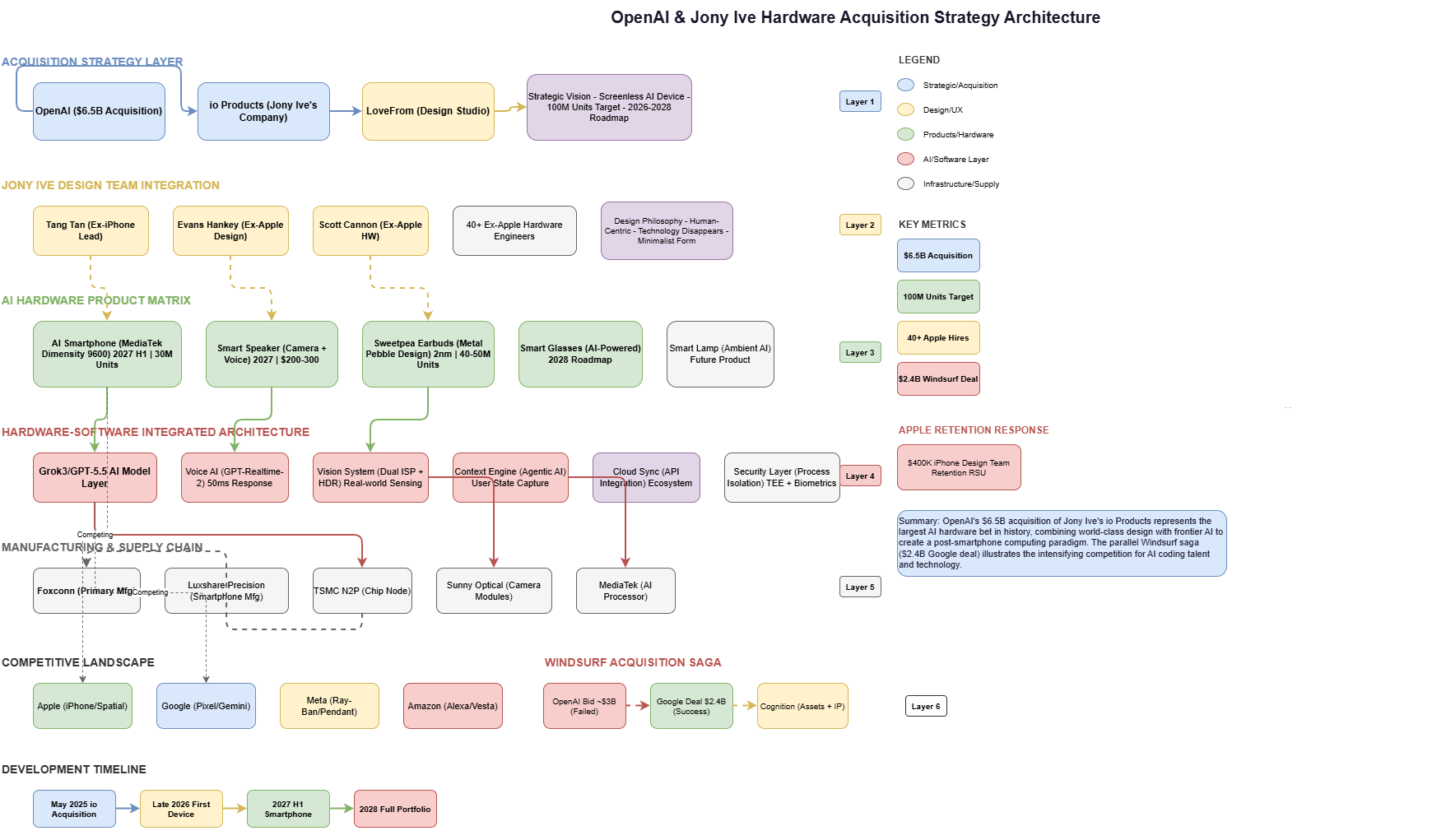
According to supply chain analysis by Ming-Chi Kuo, OpenAI’s smartphone represents a fundamentally new category—“AI agent phone”—built around continuous, context-aware interfaces rather than traditional apps.
Hardware Specifications
"""
OpenAI Smartphone Hardware Architecture
Based on supply chain analysis and industry reports
"""

class OpenAISmartphoneSpec:
    """
    Specification class for OpenAI's AI Agent Phone
    Target: Compete directly with iPhone in post-smartphone era
    """

    # Processing Architecture
    PROCESSOR = "MediaTek Dimensity 9600 (custom)"
    FAB_NODE = "TSMC N2P (2nm-class)"
    MANUFACTURER = "Luxshare Precision Industry (exclusive)"

    # Dual AI Processor Configuration
    AI_PROCESSORS = {
        "primary": {
            "purpose": "Vision and Language Processing",
            "capability": "Multi-modal AI inference"
        },
        "secondary": {
            "purpose": "Real-time Context Processing",
            "capability": "Agentic task orchestration"
        }
    }

    # Memory and Storage
    MEMORY_CONFIG = {
        "type": "LPDDR6",
        "capacity_range": "16GB - 24GB",
        "bandwidth": "High-bandwidth for AI workloads"
    }

    STORAGE_CONFIG = {
        "type": "UFS 4.0",
        "capacity_range": "256GB - 1TB"
    }

    # Vision System
    CAMERA_SPECS = {
        "manufacturer": "Sunny Optical",
        "isp": "Enhanced HDR Pipeline",
        "features": [
            "Real-world spatial sensing",
            "Enhanced depth mapping",
            "Low-light optimization"
        ]
    }

    # Security
    SECURITY_FEATURES = {
        "tee": "Trusted Execution Environment",
        "biometrics": "Advanced biometric isolation",
        "process_isolation": "Secure enclave for AI processing"
    }

    def get_target_shipments(self) -> dict:
        """Projected shipments based on development timeline"""
        return {
            "2027_h1": "Initial production run",
            "2027_total": "10-15 million units",
            "2028_total": "15-20 million units",
            "combined": "30 million units over two years"
        }


class DeviceComparison:
    """Compare OpenAI device with competitors"""

    DEVICES = {
        "openai_smartphone": {
            "launch": "2027 H1",
            "chip": "MediaTek Dimensity 9600",
            "manufacturers": ["Luxshare Precision"],
            "shipments_target": "30M (2027-2028)"
        },
        "apple_iphone_ai": {
            "launch": "WWDC 2026",
            "chip": "A20 Bionic",
            "manufacturers": ["Foxconn"],
            "focus": "On-device AI with Siri evolution"
        },
        "google_pixel_ai": {
            "launch": "Q4 2026",
            "chip": "Tensor G5",
            "manufacturers": ["Foxconn"],
            "focus": "Gemini Nano integration"
        }
    }


# Example usage
if __name__ == "__main__":
    phone = OpenAISmartphoneSpec()
    print(f"Processor: {phone.PROCESSOR}")
    print(f"Manufacturing Partner: {phone.MANUFACTURER}")
    print(f"Target Shipments: {phone.get_target_shipments()}")
AI Software Architecture
"""
OpenAI Device AI Software Stack
Voice-first, context-aware AI architecture
"""

from dataclasses import dataclass
from typing import List, Optional, Dict
from enum import Enum


class AIComponent(Enum):
    """Core AI components in OpenAI device"""
    GROK_MODEL = "Grok3/GPT-5.5 base model"
    VOICE_AI = "GPT-Realtime-2 voice interface"
    VISION_SYSTEM = "Multi-modal vision processor"
    CONTEXT_ENGINE = "Agentic context orchestration"
    SECURITY_LAYER = "Privacy-preserving computation"


@dataclass
class VoiceAIConfig:
    """Configuration for voice AI system"""
    model: str = "GPT-Realtime-2"
    latency_target_ms: int = 50
    languages: int = 70  # Supported languages
    features: List[str] = None

    def __post_init__(self):
        self.features = [
            "Natural speech indistinguishable from human",
            "Real-time interruptions",
            "Simultaneous feedback during user speech",
            "Contextual understanding",
            "Multi-turn reasoning"
        ]


@dataclass
class VisionSystemConfig:
    """Configuration for vision processing"""
    isp_pipeline: str = "Enhanced HDR"
    sensors: List[str] = None
    processing_capabilities: List[str] = None

    def __post_init__(self):
        self.sensors = [
            "Primary camera (high resolution)",
            "Depth sensor",
            "Ambient light sensor",
            "Spatial awareness array"
        ]
        self.processing_capabilities = [
            "Real-world object identification",
            "Environmental mapping",
            "Gesture recognition",
            "Gaze detection (for smart glasses integration)"
        ]


class ContextEngine:
    """
    Agentic AI system for continuous context awareness
    Captures user state across multiple dimensions
    """

    def __init__(self):
        self.context_dimensions = [
            "location", "activity", "communication",
            "calendar", "health", "preferences", "habits"
        ]
        self.state_buffer_size = 10000  # tokens

    def capture_user_state(self) -> Dict[str, any]:
        """
        Capture comprehensive user state for AI inference
        Returns real-time context for agentic operations
        """
        return {
            "location": "Real-time GPS + WiFi positioning",
            "activity": "Movement patterns + app usage",
            "communication": "Messages + calls + emails",
            "calendar": "Upcoming events + deadlines",
            "health": "Heart rate + activity + sleep (wearable)",
            "preferences": "Learned user preferences",
            "habits": "Routine patterns"
        }

    def generate_agentic_action(self, user_state: Dict) -> Dict:
        """
        Generate proactive AI actions based on context
        Moving from reactive to predictive computing
        """
        return {
            "suggestion": "Context-aware recommendation",
            "action": "Pre-emptive task completion",
            "notification": "Intelligent timing",
            "automation": "Routine task handling"
        }


class AISoftwareStack:
    """
    Complete AI software architecture for OpenAI devices
    Voice-first, context-aware, privacy-preserving
    """

    def __init__(self):
        self.voice_ai = VoiceAIConfig()
        self.vision_system = VisionSystemConfig()
        self.context_engine = ContextEngine()
        self.cloud_sync_enabled = True
        self.offline_mode = True

    def get_stack_components(self) -> List[AIComponent]:
        """Return ordered list of AI components"""
        return [
            AIComponent.GROK_MODEL,
            AIComponent.VOICE_AI,
            AIComponent.VISION_SYSTEM,
            AIComponent.CONTEXT_ENGINE,
            AIComponent.SECURITY_LAYER
        ]

    def get_response_time(self) -> Dict[str, int]:
        """Expected response times for different AI operations"""
        return {
            "voice_command": 50,      # ms
            "context_update": 100,    # ms
            "vision_processing": 200, # ms
            "cloud_sync": 500,        # ms
            "complex_reasoning": 1000 # ms
        }
Windsurf-Google Integration: Multi-Model Architecture
"""
Windsurf-Gemini Integration Architecture
Demonstrates how Google's acquisition enhances coding capabilities
"""

from typing import List, Dict, Optional
from dataclasses import dataclass


@dataclass
class CodingAgentConfig:
    """Configuration for AI coding agent system"""

    # Core Model Configuration
    primary_model: str = "Gemini 3.5"
    fallback_model: str = "Gemini 3.0"

    # Context Windows
    context_window: int = 2000000  # 2M tokens

    # Code Intelligence Features
    capabilities: List[str] = None

    def __post_init__(self):
        self.capabilities = [
            "Autonomous code generation",
            "Multi-file refactoring",
            "Bug detection and correction",
            "Test generation",
            "Code review automation",
            "Repository-scale understanding",
            "CI/CD integration"
        ]


class CodebaseContextBuilder:
    """
    Builds comprehensive codebase context for AI inference
    Essential for repository-scale coding tasks
    """

    def __init__(self, repo_path: str):
        self.repo_path = repo_path
        self.parsed_files = {}
        self.dependency_graph = {}
        self.architecture_map = {}

    def build_context(self,
                      max_files: int = 1000,
                      include_history: bool = True) -> str:
        """
        Build comprehensive codebase context string
        Optimized for Qwen3-Coder-Next-style repo-scale understanding
        """

        # File parsing and filtering
        source_files = self._filter_relevant_files(max_files)

        # Build dependency graph
        dependency_context = self._build_dependency_context()

        # Architectural understanding
        architecture_context = self._extract_architecture()

        # Git history analysis (optional)
        history_context = ""
        if include_history:
            history_context = self._analyze_git_history()

        return f"""
Repository Structure: {self._get_structure()}
Dependencies: {dependency_context}
Architecture: {architecture_context}
Recent Changes: {history_context}
Files: {source_files}
""".strip()

    def _filter_relevant_files(self, max_files: int) -> List[str]:
        """Filter and prioritize files for context"""
        return [
            "src/main.py",
            "src/models/*.py",
            "src/services/*.py",
            "tests/**/*.py",
            "config/*.yaml"
        ]

    def _build_dependency_context(self) -> str:
        """Build dependency relationship context"""
        return """
Module Dependencies:
- models/user.py -> services/auth.py
- models/order.py -> services/payment.py
- services/*.py -> utils/helpers.py
"""

    def _extract_architecture(self) -> str:
        """Extract architectural patterns and decisions"""
        return """
Architecture: Layered (MVC pattern)
Database: PostgreSQL + Redis
API: REST + GraphQL
Frontend: React + TypeScript
"""

    def _analyze_git_history(self) -> str:
        """Analyze recent git history for context"""
        return """
Last 10 commits:
- Fix: Authentication middleware (2 hours ago)
- Feature: User dashboard redesign (1 day ago)
- Refactor: Payment processing service (3 days ago)
"""


class GeminiCodingAgent:
    """
    AI Coding Agent powered by Gemini
    Integrated with Windsurf's IDE expertise
    """

    def __init__(self, config: CodingAgentConfig):
        self.config = config
        self.codebase_context = None
        self.active_models = ["gemini-3.5-pro", "gemini-3.5-flash"]

    def generate_code(self,
                      prompt: str,
                      language: str = "python",
                      context: Optional[str] = None) -> str:
        """
        Generate code with full codebase context
        Leverages Windsurf's context understanding
        """

        enhanced_prompt = f"""
Language: {language}
Context:
{context or self.codebase_context}

Task: {prompt}

Generate code that:
1. Follows existing patterns in the codebase
2. Includes appropriate error handling
3. Has comprehensive type hints
4. Contains inline documentation
"""

        # Would call Gemini API here
        return "# Generated code..."

    def refactor_code(self,
                      file_path: str,
                      objective: str) -> Dict[str, str]:
        """
        Autonomous code refactoring
        Multi-file awareness enabled
        """

        # Analyze current implementation
        current = self._read_file(file_path)

        # Generate refactoring plan
        plan = self._create_refactor_plan(current, objective)

        # Execute with multi-file awareness
        changes = self._execute_refactor(plan)

        return changes

    def run_code_review(self, diff: str) -> Dict[str, any]:
        """
        AI-powered code review
        Detects bugs, security issues, style violations
        """

        return {
            "bugs": [],
            "security_issues": [],
            "style_violations": [],
            "suggestions": [],
            "overall_quality": "high"
        }


class WindsurfIntegration:
    """
    Windsurf-specific features integrated with Gemini
    Maintains Codeium's IDE excellence
    """

    def __init__(self):
        self.ide_features = {
            "code_completion": True,
            "inline_errors": True,
            "refactoring_tools": True,
            "contextual_search": True
        }

    def get_suggestions(self, cursor_position: Dict) -> List[str]:
        """
        Real-time code suggestions
        Combines Gemini intelligence with IDE context
        """

        return [
            "function auto-complete",
            "import suggestions",
            "type inference",
            "docstring generation"
        ]
Supply Chain and Manufacturing Architecture
package openai_hardware

import (
	"fmt"
	"time"
)

// DeviceType represents different OpenAI hardware products
type DeviceType int

const (
	Smartphone DeviceType = iota
	SmartSpeaker
	SweetpeaEarbuds
	SmartGlasses
	SmartLamp
)

// ManufacturingPartner represents a supply chain partner
type ManufacturingPartner struct {
	Name        string
	Role        string
	Capacity    int // units per month
	LeadTime    time.Duration
	QualityScore float64
}

// SupplyChain represents OpenAI's manufacturing network
type SupplyChain struct {
	Partners map[string]ManufacturingPartner
}

// NewSupplyChain initializes OpenAI's supply chain
func NewSupplyChain() *SupplyChain {
	return &SupplyChain{
		Partners: map[string]ManufacturingPartner{
			"foxconn": {
				Name:        "Foxconn (Hon Hai)",
				Role:        "Primary Manufacturer",
				Capacity:    15000000, // 15M units/month
				LeadTime:    45 * 24 * time.Hour,
				QualityScore: 0.98,
			},
			"luxshare": {
				Name:        "Luxshare Precision",
				Role:        "Smartphone Exclusive",
				Capacity:    8000000, // 8M units/month
				LeadTime:    60 * 24 * time.Hour,
				QualityScore: 0.95,
			},
			"tsmc": {
				Name:        "TSMC",
				Role:        "Chip Fabrication (N2P)",
				Capacity:    100000, // wafers/month
				LeadTime:    90 * 24 * time.Hour,
				QualityScore: 0.99,
			},
			"mediatek": {
				Name:        "MediaTek",
				Role:        "AI Processor Supply",
				Capacity:    5000000, // chips/month
				LeadTime:    75 * 24 * time.Hour,
				QualityScore: 0.96,
			},
			"sunny_optical": {
				Name:        "Sunny Optical",
				Role:        "Camera Modules",
				Capacity:    10000000, // modules/month
				LeadTime:    30 * 24 * time.Hour,
				QualityScore: 0.97,
			},
		},
	}
}

// DeviceSpec represents specifications for a device
type DeviceSpec struct {
	Type           DeviceType
	Name           string
	TargetPrice    float64
	TargetUnits    int
	LaunchDate     time.Time
	Manufacturers  []string
	Components     []string
}

// GetDeviceRoadmap returns the product roadmap
func GetDeviceRoadmap() []DeviceSpec {
	return []DeviceSpec{
		{
			Type:          SmartSpeaker,
			Name:          "AI Smart Speaker",
			TargetPrice:   250.00, // $200-$300 range
			TargetUnits:   10000000,
			LaunchDate:    time.Date(2027, 1, 1, 0, 0, 0, 0, time.UTC),
			Manufacturers: []string{"foxconn"},
			Components:    []string{"camera", "microphone_array", "speaker"},
		},
		{
			Type:          Smartphone,
			Name:          "AI Agent Phone",
			TargetPrice:   999.00,
			TargetUnits:   30000000,
			LaunchDate:    time.Date(2027, 6, 1, 0, 0, 0, 0, time.UTC),
			Manufacturers: []string{"luxshare"},
			Components:    []string{"dimensity_9600", "dual_ai_processor", "camera"},
		},
		{
			Type:          SweetpeaEarbuds,
			Name:          "Sweetpea AI Earbuds",
			TargetPrice:   299.00,
			TargetUnits:   40000000,
			LaunchDate:    time.Date(2027, 9, 1, 0, 0, 0, 0, time.UTC),
			Manufacturers: []string{"foxconn"},
			Components:    []string{"2nm_chip", "ai_processor", "sensors"},
		},
		{
			Type:          SmartGlasses,
			Name:          "AI Smart Glasses",
			TargetPrice:   599.00,
			TargetUnits:   15000000,
			LaunchDate:    time.Date(2028, 1, 1, 0, 0, 0, 0, time.UTC),
			Manufacturers: []string{"foxconn"},
			Components:    []string{"display", "camera", "ai_processor"},
		},
	}
}

// ProductionPlan calculates production targets and timelines
type ProductionPlan struct {
	Device          DeviceSpec
	MonthlyTargets  []int // units per month
	QualityTargets  []float64
	CostTargets     []float64
}

// CalculateProductionPlan generates a detailed production plan
func CalculateProductionPlan(device DeviceSpec, months int) ProductionPlan {
	plan := ProductionPlan{
		Device:          device,
		MonthlyTargets:  make([]int, months),
		QualityTargets:  make([]float64, months),
		CostTargets:     make([]float64, months),
	}

	// Ramp up production over time
	for i := 0; i < months; i++ {
		rampPercentage := float64(i+1) / float64(months)
		plan.MonthlyTargets[i] = int(float64(device.TargetUnits) * rampPercentage / float64(months))
		plan.QualityTargets[i] = 0.95 + (0.04 * rampPercentage)
		plan.CostTargets[i] = device.TargetPrice * (1.5 - (0.5 * rampPercentage))
	}

	return plan
}

// Main function demonstrating supply chain analysis
func SupplyChainDemo() {
	sc := NewSupplyChain()
	roadmap := GetDeviceRoadmap()

	fmt.Println("=== OpenAI Hardware Supply Chain ===\n")

	for _, partner := range sc.Partners {
		fmt.Printf("Partner: %s\n", partner.Name)
		fmt.Printf("  Role: %s\n", partner.Role)
		fmt.Printf("  Capacity: %d units/month\n", partner.Capacity)
		fmt.Printf("  Lead Time: %v\n", partner.LeadTime)
		fmt.Printf("  Quality Score: %.2f%%\n\n", partner.QualityScore*100)
	}

	fmt.Println("=== Product Roadmap ===\n")

	for _, device := range roadmap {
		plan := CalculateProductionPlan(device, 12)
		fmt.Printf("Device: %s\n", device.Name)
		fmt.Printf("  Target Price: $%.2f\n", device.TargetPrice)
		fmt.Printf("  Target Units: %d\n", device.TargetUnits)
		fmt.Printf("  Launch: %s\n", device.LaunchDate.Format("January 2006"))
		fmt.Printf("  Manufacturers: %v\n\n", device.Manufacturers)
	}
}
Code Examples
Voice AI System Implementation
"""
Voice AI System Implementation
Based on OpenAI's GPT-Realtime-2 and translation capabilities
"""

import asyncio
from typing import AsyncIterator, Callable, Optional
from dataclasses import dataclass
from enum import Enum


class VoiceMode(Enum):
    """Voice interaction modes"""
    FULL_DUPLEX = "full_duplex"      # Simultaneous input/output
    HALF_DUPLEX = "half_duplex"      # Turn-based
    INTERRUPTIBLE = "interruptible"   # Can be interrupted


@dataclass
class VoiceConfig:
    """Voice AI configuration"""
    model: str = "gpt-realtime-2"
    voice: str = "alloy"  # Voice style
    language: str = "auto"  # Auto-detect
    mode: VoiceMode = VoiceMode.FULL_DUPLEX
    latency_target_ms: int = 50

    # Translation settings
    translation_enabled: bool = True
    source_languages: list = None

    def __post_init__(self):
        if self.source_languages is None:
            self.source_languages = ["en", "zh", "es", "fr", "de", "ja", "ko"]
        # Plus 70 total supported languages


class RealtimeVoiceSession:
    """
    Full-duplex voice session with OpenAI's Realtime API
    Supports interruption, translation, and real-time transcription
    """

    def __init__(self, config: VoiceConfig):
        self.config = config
        self.audio_buffer = []
        self.transcript_buffer = []
        self.is_active = False

    async def connect(self, api_key: str):
        """Establish WebSocket connection to Realtime API"""
        # Would use OpenAI's Realtime API WebSocket
        self.is_active = True
        print(f"Connected to Realtime API with model: {self.config.model}")

    async def send_audio(self, audio_chunk: bytes) -> Optional[str]:
        """
        Send audio chunk and receive immediate transcription
        Target latency: 50ms
        """

        # Simulate low-latency transcription
        transcription = await self._transcribe(audio_chunk)

        # Update buffer
        self.transcript_buffer.append(transcription)

        return transcription

    async def _transcribe(self, audio: bytes) -> str:
        """Simulate transcription with Whisper-level accuracy"""
        # In production, this calls GPT-Realtime-Whisper
        await asyncio.sleep(0.01)  # Simulate processing
        return "Transcribed text..."

    async def interrupt(self):
        """Interrupt current response and clear buffers"""
        self.audio_buffer.clear()
        self.transcript_buffer.clear()
        print("Session interrupted")

    async def disconnect(self):
        """Close connection and cleanup"""
        self.is_active = False
        self.audio_buffer.clear()
        self.transcript_buffer.clear()
        print("Disconnected from Realtime API")


class TranslationService:
    """
    Real-time translation between 70 languages
    Based on GPT-Realtime-Translate capabilities
    """

    def __init__(self, pricing_per_minute: float = 0.034):
        self.pricing = pricing_per_minute
        self.supported_languages = [
            "en", "zh", "es", "fr", "de", "ja", "ko", "ar", "ru",
            "pt", "it", "hi", "th", "vi", "id", "ms", "tr", "pl",
            "nl", "sv", "da", "no", "fi", "cs", "el", "he", "hu"
            # ... 70 total languages
        ]

    async def translate_stream(
        self,
        source_audio: AsyncIterator[bytes],
        source_lang: str,
        target_lang: str
    ) -> AsyncIterator[str]:
        """
        Stream translations in real-time
        Price: $0.034/minute
        """

        accumulated_text = ""
        translated_buffer = []

        async for chunk in source_audio:
            accumulated_text += await self._process_chunk(chunk)

            # Batch translations for efficiency
            if len(accumulated_text) > 100:
                translation = await self._translate_batch(
                    accumulated_text, source_lang, target_lang
                )
                translated_buffer.append(translation)
                accumulated_text = ""

            yield "\n".join(translated_buffer)

        # Flush remaining
        if accumulated_text:
            final_translation = await self._translate_batch(
                accumulated_text, source_lang, target_lang
            )
            yield final_translation

    async def _translate_batch(
        self,
        text: str,
        source: str,
        target: str
    ) -> str:
        """Translate a batch of text"""
        # Would call translation API
        return f"[Translated from {source} to {target}]: {text}"


class VoiceAIDemo:
    """Demonstration of voice AI capabilities"""

    async def demo_full_duplex(self):
        """Demonstrate simultaneous conversation"""
        config = VoiceConfig(
            mode=VoiceMode.FULL_DUPLEX,
            latency_target_ms=50
        )

        session = RealtimeVoiceSession(config)
        await session.connect("demo-api-key")

        print("\n=== Full-Duplex Voice Demo ===")
        print("Say something... (simulated)")

        # Simulate conversation
        for i in range(5):
            audio = b"audio_chunk_" + str(i).encode()
            transcript = await session.send_audio(audio)
            print(f"You said: {transcript}")
            await asyncio.sleep(0.1)

        await session.disconnect()

    async def demo_translation(self):
        """Demonstrate real-time translation"""
        translator = TranslationService()

        print("\n=== Translation Demo ===")

        async def fake_audio_stream():
            for phrase in ["Hello", "How are you", "Thank you"]:
                yield phrase.encode()
                await asyncio.sleep(0.5)

        translation_stream = translator.translate_stream(
            fake_audio_stream(),
            source_lang="en",
            target_lang="zh"
        )

        async for translation in translation_stream:
            print(f"Translation: {translation}")


# Run demo
async def main():
    demo = VoiceAIDemo()
    await demo.demo_full_duplex()
    await demo.demo_translation()


if __name__ == "__main__":
    asyncio.run(main())
Jony Ive Design Team Integration System
"""
Design Team Integration System
Tracks Jony Ive's team contributions to OpenAI hardware
"""

from dataclasses import dataclass, field
from typing import List, Dict, Optional
from datetime import datetime
from enum import Enum


class Role(Enum):
    """Team member roles"""
    PRODUCT_DESIGN = "Product Design Lead"
    INDUSTRIAL_DESIGN = "Industrial Design"
    UX_RESEARCH = "UX Research"
    HARDWARE_ENGINEERING = "Hardware Engineering"
    SYSTEMS_DESIGN = "Systems Design"


class FormerEmployer(Enum):
    """Previous employers"""
    APPLE = "Apple Inc."
    LOVE_FROM = "LoveFrom"
    OTHER = "Other"


@dataclass
class DesignTeamMember:
    """Represents a design team member"""
    name: str
    role: Role
    former_employer: FormerEmployer
    expertise: List[str]
    years_experience: int
    joined_date: datetime
    contributions: List[str] = field(default_factory=list)

    def add_contribution(self, contribution: str):
        """Record a design contribution"""
        self.contributions.append(contribution)


@dataclass
class DesignPrinciple:
    """Design principle from Jony Ive's philosophy"""
    name: str
    description: str
    implementation_status: str

    def get_guidelines(self) -> str:
        """Get implementation guidelines"""
        return f"{self.name}: {self.description}"


class LoveFromDesignSystem:
    """
    Design system integrating Jony Ive's philosophy
    Human-centric, technology-disappearing design
    """

    def __init__(self):
        self.principles = [
            DesignPrinciple(
                name="Technology Disappears",
                description="Technology should become invisible, enhancing human experience without demanding attention",
                implementation_status="core"
            ),
            DesignPrinciple(
                name="Human-Centric Form",
                description="Form follows human needs and behaviors, not manufacturing convenience",
                implementation_status="core"
            ),
            DesignPrinciple(
                name="Material Honesty",
                description="Use materials for what they are, not as imitations of other materials",
                implementation_status="established"
            ),
            DesignPrinciple(
                name="Quiet Confidence",
                description="Products should project confidence through restraint, not visual noise",
                implementation_status="established"
            ),
            DesignPrinciple(
                name="Contextual Integration",
                description="Devices should harmonize with their environment and use contexts",
                implementation_status="emerging"
            )
        ]

        self.team = self._initialize_team()

    def _initialize_team(self) -> List[DesignTeamMember]:
        """Initialize the design team roster"""
        return [
            DesignTeamMember(
                name="Tang Tan",
                role=Role.PRODUCT_DESIGN,
                former_employer=FormerEmployer.APPLE,
                expertise=["iPhone development", "product strategy", "supply chain"],
                years_experience=15,
                joined_date=datetime(2025, 6, 1),
                contributions=[
                    "Smartphone industrial design",
                    "Component integration strategy"
                ]
            ),
            DesignTeamMember(
                name="Evans Hankey",
                role=Role.INDUSTRIAL_DESIGN,
                former_employer=FormerEmployer.APPLE,
                expertise=["iPad design", "material selection", "user experience"],
                years_experience=12,
                joined_date=datetime(2025, 6, 1),
                contributions=[
                    "Form factor specification",
                    "Material palette development"
                ]
            ),
            DesignTeamMember(
                name="Scott Cannon",
                role=Role.HARDWARE_ENGINEERING,
                former_employer=FormerEmployer.APPLE,
                expertise=["hardware architecture", "thermal design", "durability"],
                years_experience=18,
                joined_date=datetime(2025, 7, 1)
            ),
            DesignTeamMember(
                name="Jony Ive",
                role=Role.SYSTEMS_DESIGN,
                former_employer=FormerEmployer.LOVE_FROM,
                expertise=[
                    "holistic design",
                    "Apple ecosystem",
                    "minimalist aesthetics",
                    "human-computer interaction"
                ],
                years_experience=30,
                joined_date=datetime(2025, 5, 1),
                contributions=[
                    "Overall product vision",
                    "Design philosophy integration",
                    "Strategic direction"
                ]
            )
        ]

    def get_apple_talent_count(self) -> int:
        """Count former Apple employees"""
        return sum(
            1 for member in self.team
            if member.former_employer == FormerEmployer.APPLE
        )

    def generate_design_spec(
        self,
        product_type: str,
        user_requirements: Dict
    ) -> Dict:
        """Generate design specification following LoveFrom principles"""

        return {
            "product_type": product_type,
            "design_principles": [p.name for p in self.principles if p.implementation_status == "core"],
            "form_factor": self._determine_form_factor(product_type),
            "materials": self._select_materials(product_type),
            "user_experience": self._define_ux_goals(user_requirements),
            "team_leads": [
                {"name": m.name, "role": m.role.value}
                for m in self.team[:2]
            ]
        }

    def _determine_form_factor(self, product_type: str) -> str:
        """Determine optimal form factor"""
        form_map = {
            "smartphone": "Edge-to-edge display, minimal bezels, pocket-friendly",
            "smart_speaker": "Organic curves, ambient presence, non-intrusive",
            "earbuds": "Metal pebble, detachable capsules, behind-ear fit",
            "glasses": "Lightweight frame, balanced weight distribution"
        }
        return form_map.get(product_type, "Minimalist enclosure")

    def _select_materials(self, product_type: str) -> List[str]:
        """Select materials following material honesty principle"""
        return [
            "Anodized aluminum (primary body)",
            "Recycled stainless steel (accents)",
            "Borosilicate glass (display protection)",
            "Bio-based polymers (internal components)"
        ]

    def _define_ux_goals(self, requirements: Dict) -> Dict:
        """Define UX goals based on requirements"""
        return {
            "primary_interaction": requirements.get("interaction", "voice"),
            "attention_demand": "minimal",
            "learning_curve": "intuitive within 5 minutes",
            "accessibility": "WCAG 2.1 AA compliant"
        }


class DesignReviewSystem:
    """System for design review and iteration"""

    def __init__(self, design_system: LoveFromDesignSystem):
        self.design_system = design_system

    def review_design(
        self,
        design: Dict,
        review_level: str = "full"
    ) -> Dict:
        """Review design against LoveFrom principles"""

        issues = []
        suggestions = []

        for principle in self.design_system.principles:
            compliance = self._check_principle_compliance(
                design, principle
            )

            if not compliance["compliant"]:
                issues.append({
                    "principle": principle.name,
                    "issue": compliance["issue"],
                    "suggestion": principle.get_guidelines()
                })

        return {
            "approved": len(issues) == 0 if review_level == "full" else True,
            "issues": issues,
            "review_level": review_level,
            "timestamp": datetime.now().isoformat()
        }

    def _check_principle_compliance(
        self,
        design: Dict,
        principle: DesignPrinciple
    ) -> Dict:
        """Check compliance with a specific principle"""

        # Simplified compliance checking
        checks = {
            "Technology Disappears": lambda d: d.get("visual_complexity", 1) < 3,
            "Human-Centric Form": lambda d: d.get("ergonomic_score", 5) >= 4,
            "Material Honesty": lambda d: d.get("material_imitation", False) == False,
            "Quiet Confidence": lambda d: d.get("visual_noise", 1) < 3
        }

        check_fn = checks.get(principle.name, lambda d: True)

        return {
            "compliant": check_fn(design),
            "issue": "Visual complexity too high" if not check_fn(design) else None
        }


# Demonstration
def design_system_demo():
    """Demonstrate design system capabilities"""

    ds = LoveFromDesignSystem()
    review = DesignReviewSystem(ds)

    print("=== LoveFrom Design System Demo ===\n")

    print("Design Principles:")
    for p in ds.principles:
        print(f"  - {p.name}: {p.description[:50]}...")

    print(f"\nTeam Size: {len(ds.team)} members")
    print(f"Apple Talent: {ds.get_apple_talent_count()} ex-Apple employees")

    print("\nTeam Members:")
    for member in ds.team:
        print(f"  - {member.name} ({member.role.value})")
        print(f"    Former: {member.former_employer.value}")
        print(f"    Expertise: {', '.join(member.expertise[:2])}")

    print("\nSmartphone Design Spec:")
    spec = ds.generate_design_spec(
        "smartphone",
        {"interaction": "voice", "mobility": "high"}
    )
    for key, value in spec.items():
        print(f"  {key}: {value}")

    print("\nDesign Review:")
    review_result = review.review_design({
        "visual_complexity": 2,
        "ergonomic_score": 4.5,
        "material_imitation": False,
        "visual_noise": 2
    })
    print(f"  Approved: {review_result['approved']}")


if __name__ == "__main__":
    design_system_demo()
Industry Impact
The AI Hardware Race: 2026 Landscape
OpenAI’s move into hardware has accelerated what industry analysts call “the AI hardware race,” with every major tech company now competing to define the post-smartphone computing paradigm:
Apple’s Response:
- Developing three AI wearables: smart glasses (N50), AI pendant, and camera-equipped AirPods (H90)
- Offered $400,000 RSU retention bonuses to iPhone Product Design team
- Rumored smart home hub with enhanced Siri capabilities
- Apple’s AI services integration on track for WWDC 2026
Google’s Strategy:
- $40 billion investment commitment in Anthropic
- Windsurf acquihire ($2.4B) strengthens Gemini coding capabilities
- Pixel smartphone development with Tensor G5
- Smart glasses partnership with Gucci announced for 2027
Meta’s Hardware Ambitions:
- 7 million Ray-Ban Meta glasses sold in 2025
- AI pendant development (testing 2027)
- New glasses: Modelo (June 2026), Luna/Mojito (Q4 2026)
- Wearables for Work enterprise subscription service
Amazon’s Position:
- Alexa-enabled device ecosystem
- Vesta home robot project revived
- Jayhawk AR glasses announced
- AWS-native vibe coding tools
Market Dynamics: The IDE Wars
The Windsurf saga revealed the strategic importance of AI coding tools as distribution channels:
Cursor’s Dominance:
- Doubled to $2B ARR (60% enterprise)
- Shipped Composer 2, its own coding model
- No longer dependent on Anthropic or OpenAI model layer
Cognition’s Consolidation:
- Controls Devin + Windsurf + SWE-1.5 model
- Raised $1B at $26B valuation (May 2026)
- Enterprise customers: Goldman Sachs, Citi, NASA, Dell, Cisco
Google’s Antigravity:
- Free agent-first platform announced at I/O 2026
- CLI and SDK for autonomous coding
- Direct competition with Devin
The Talent War
OpenAI’s aggressive poaching of Apple talent (40+ hires) has triggered industry-wide talent wars:
Apple’s Retention Package:
- $400,000 RSU bonuses for iPhone Product Design team
- Canceled China annual closed-door meeting (security concerns)
- Counter-offer campaign for key engineers
Google’s Acquihire Model:
- Non-exclusive licensing + talent acquisition
- Avoids full acquisition antitrust scrutiny
- Flexible enough for talent to maintain independence
Future Outlook
2026-2028: The Critical Window
The next two years will determine whether OpenAI’s hardware bet succeeds:
Q4 2026 - First Product Launch:
- Expected: Smart speaker with camera ($200-300)
- Target: 10 million units
- Success metric: User engagement vs. existing smart speakers
H1 2027 - Smartphone Launch:
- AI Agent Phone with MediaTek Dimensity 9600
- Luxshare Precision manufacturing
- Target: 30 million units (2027-2028 combined)
2027-2028 - Full Portfolio:
- Sweetpea AI earbuds (September 2027)
- Smart glasses (2028)
- Smart lamp and future products
Success Factors
Technical Challenges:
- Hardware-software integration: Achieving 50ms voice response
- Battery life: AI workloads are power-hungry
- Thermal management: Sustained AI processing generates heat
- Manufacturing scale: 100 million units requires supply chain excellence
Market Challenges:
- Consumer habits: Smartphone addiction is deeply entrenched
- Privacy concerns: Always-listening devices face skepticism
- App ecosystem: Replacing iPhone requires compelling app alternatives
- Price sensitivity: Premium pricing limits market penetration
Competitive Dynamics:
- Apple’s response: Will counter with aggressive AI integration
- Google’s Android ecosystem: Alternative platform for AI devices
- Meta’s glasses success: Ray-Ban sales provide beachhead
The Bigger Picture: Post-Smartphone Computing
OpenAI’s acquisition represents a bet on the future of computing itself:
The Altman Vision: “AI should be a quiet companion, not a demanding device. We want to create the feeling of having a thoughtful assistant who’s always there, without the constant pull of notifications and screens.”
The Ive Philosophy: “Technology should serve humanity, not demand its attention. Our goal is to create devices that enhance presence and connection.”
The Industry Consensus: The post-smartphone era will be defined by:
- Ambient computing (devices that blend into environments)
- Contextual AI (understanding user state without explicit input)
- Minimal interruption (reducing attention fragmentation)
- Persistent presence (always-available intelligence)
Conclusion
OpenAI’s $6.5 billion acquisition of Jony Ive’s io Products represents more than a hardware bet—it’s a statement of intent about the future of computing. By combining the world’s most advanced AI with legendary design, OpenAI is betting that the next computing paradigm will be fundamentally different from the smartphone era.
The parallel Windsurf saga illustrates the complex dynamics of AI competition: talent acquisition, technology access, and strategic positioning. Google’s counter-coup with the $2.4 billion Windsurf deal demonstrates that even failed acquisitions can create value through competitive disruption.
As we approach 2027, the AI hardware race enters its critical phase. OpenAI, Apple, Google, Meta, and Amazon are all positioning for a post-smartphone world where AI is ambient, contextual, and always-present. The question is not whether this future will arrive, but who will define it.
The $6.5 billion question—and the 100 million devices—will tell us much about which company has truly understood the intersection of human needs and technological possibility.
Sources
- MacRumors: “Everything We Know About OpenAI’s Planned iPhone Rival” (May 29, 2026)
- Gigazine: “Reports indicate that Meta is developing an AI pendant” (May 31, 2026)
- Manila Times: “Google Secures Windsurf AI Coding Team in $2.4 Billion Licence Deal” (May 27, 2026)
- AI Wire: “Cognition Raises $1B at a $26B Valuation” (May 27, 2026)
- BestAIWeb: “Cursor’s $2B ARR, Devin’s Price Collapse, and the 2026 Vibe Coding Shakeout” (May 28, 2026)
- Vibe Eval: “VIBE CODING SECURITY WEEKLY — MAY 19 - MAY 25, 2026”
- Art Daily: “After Apple, Jony Ive is building an empire of his own” (May 31, 2026)
- AI Damn: Multiple reports on OpenAI hardware developments (May 2026)
- Sinokap: “Windsurf收购案终落幕:OpenAI出局,谷歌天价挖人” (May 26, 2026)
- The Information: Meta hardware development reports
- Supply chain analysis by Ming-Chi Kuo (April-May 2026)
This article is part of the AI Frontier Technical Blog Series. For more analysis, see our architecture diagram: outputs/架构图/OpenAI_Jony_Ive_Acquisition_Architecture_EN.drawio
Technical Architecture Deep Dive
The Sweetpea Earbuds: Radical Design Philosophy
Beyond the smartphone, OpenAI’s most ambitious hardware project may be the Sweetpea AI earbuds—a radical departure from conventional wearable design. According to sources familiar with the project, Sweetpea features an unconventional metal pebble form factor with detachable capsule components designed to sit comfortably behind the ears.
This design philosophy reflects Jony Ive’s enduring influence: creating products that challenge category conventions while maintaining functional excellence. Unlike traditional earbuds, Sweetpea prioritizes aesthetic integration with the body, potentially reducing the social awkwardness that plagued earlier AI wearables like the Humane AI Pin.
The technical specifications reportedly include:
- 2nm processor from Samsung (initial supply)
- Custom AI silicon optimized for audio processing
- Standalone operation (phone-independent functionality)
- Advanced voice control with OpenAI’s Realtime API integration
Foxconn has been tapped for manufacturing, with targets of 40-50 million units in the first year alone—a scale that would rival Apple’s AirPods in their early growth trajectory.
Voice AI: The 50ms Revolution
OpenAI’s voice AI development has reached a critical milestone with the GPT-Realtime-2 model, promising response times of just 50 milliseconds. This represents a fundamental shift from traditional voice assistants that required complete user utterance before processing began.
The key innovations include:
Full-Duplex Conversation: Traditional voice assistants operate in half-duplex mode—user speaks, assistant listens, user waits, assistant responds. GPT-Realtime-2 enables simultaneous input/output, allowing users to interrupt, correct, and collaborate with the AI in real-time, just as humans do with each other.
Real-Time Translation: The GPT-Realtime-Translate model supports real-time conversion between 70 languages with near-instantaneous results. Early demonstrations show it keeping pace with rapid-fire conference speakers, potentially making multilingual meetings as seamless as chatting in one’s native tongue.
Instant Transcription: GPT-Realtime-Whisper delivers ultra-low latency transcription—spoken words appear as text almost simultaneously, enabling immediate meeting notes, live captions, and searchable audio archives without the usual processing delays.
The Broader AI Hardware Ecosystem
Meta’s Wearable Strategy
Meta’s approach to AI hardware differs from OpenAI’s in philosophy and execution. While OpenAI focuses on dedicated AI-native devices, Meta leverages its existing ecosystem—particularly the successful Ray-Ban Meta glasses that sold 7 million units in 2025—to build AI integration into familiar form factors.
The company’s AI pendant development, based on technology from the Limitless acquisition, represents a complementary approach: ambient recording and summarization rather than proactive AI assistance. Meta’s memo outlines ambitious hardware plans including:
- Modelo glasses (launching June 2026)
- Luna and Mojito (Q4 2026)
- Artemis AR glasses (prototype testing)
- Wearables for Work enterprise subscription
Apple’s Counter-Strategy
Apple’s response to OpenAI’s hardware ambitions has been measured but significant:
Retention Measures: The company offered $400,000 RSU retention bonuses to key iPhone Product Design team members, acknowledging that talent loss to OpenAI posed a genuine threat. Apple also canceled its China annual closed-door meeting—reportedly due to concerns about talent poaching.
Three AI Wearables: Apple is developing three distinct AI wearable products:
- Smart glasses (N50): Competitor to Ray-Ban Meta
- AI pendant: AirTag-sized device with camera and microphone
- Camera-equipped AirPods (H90): Experimental project combining audio with visual sensing
The H90 project was reportedly furthest along but faced delays, pushing Apple’s AI hardware portfolio closer to a 2027 timeline.
Amazon’s Quiet Ambitions
Amazon has taken a different path, leveraging its existing Alexa ecosystem while developing new form factors:
Vesta Home Robot: After years of development, Amazon’s Vesta home robot project has been revived, incorporating voice AI and visual recognition capabilities. The robot aims to bring Alexa into physical space in a way that goes beyond static smart speakers.
Jayhawk AR Glasses: Amazon announced the Jayhawk AR glasses at an event, competing directly with Meta’s Ray-Ban line and Google’s planned smart glasses. The glasses integrate with Alexa for voice commands and information retrieval.
AWS-Native Tools: Amazon is reportedly developing AWS-native vibe coding tools, competing with Cursor and Windsurf for developer market share. This would integrate AI coding directly into the cloud platform where many enterprises already operate.
Market Analysis: The 2026 AI Coding Shakeout
Three-Lane Market Structure
The vibe coding market has fragmented into three distinct lanes, each with different economics, buyers, and competitive dynamics:
Lane 1: Pro IDE Cursor dominates this lane with $2B ARR and 60% enterprise revenue. Senior developers use Cursor as their primary development environment, benefiting from bottom-up adoption and Model Context Protocol integrations. GitHub’s enterprise presence remains the competitive moat in regulated industries.
Lane 2: Autonomous Agent Cognition (Devin + Windsurf) and Google (Antigravity) compete for the autonomous coding market. Devin’s price collapse from $500 to $20 represents market occupation strategy—get into every team’s evaluation pipeline before Antigravity becomes a paid product.
Lane 3: App Builder Lovable, Replit, Bolt, and v0 serve non-developers who want to ship products without coding expertise. This lane operates on different economics, targeting consumers and small businesses rather than enterprise engineering teams.
The Enterprise Security Challenge
One in five strategic dealmakers walked away from a transaction in 2025-2026 because of anticipated AI risk on the target’s codebase. The Veracode statistic—that 45% of AI-generated code contains OWASP Top-10 vulnerabilities—has become the canonical number that every founder, lawyer, and dealmaker repeats.
This security challenge creates both a barrier and an opportunity:
- Barrier: Enterprises in regulated industries (finance, healthcare, defense) move slowly on AI coding adoption
- Opportunity: Companies that solve AI code security will capture enterprise market share
The Orchids/BBC Incident
The xhack.net breakdown of the Orchids incident revealed a new attack surface for vibe-coding platforms: cloud-side code storage. A cybersecurity researcher demonstrated zero-click takeover of a journalist’s laptop by modifying code in another person’s vibe-coding project.
This incident represents the first widely covered case where the platform itself was the attack surface, not just the generated code. It highlights the security challenges that accompany AI-generated code ecosystems, where trust boundaries and access controls become critical infrastructure.
Conclusion
OpenAI’s $6.5 billion acquisition of Jony Ive’s io Products represents more than a hardware bet—it’s a statement of intent about the future of computing. By combining the world’s most advanced AI with legendary design, OpenAI is betting that the next computing paradigm will be fundamentally different from the smartphone era.
The parallel Windsurf saga illustrates the complex dynamics of AI competition: talent acquisition, technology access, and strategic positioning. Google’s counter-coup with the $2.4 billion Windsurf deal demonstrates that even failed acquisitions can create value through competitive disruption.
As we approach 2027, the AI hardware race enters its critical phase. OpenAI, Apple, Google, Meta, and Amazon are all positioning for a post-smartphone world where AI is ambient, contextual, and always-present. The question is not whether this future will arrive, but who will define it.
The $6.5 billion question—and the 100 million devices—will tell us much about which company has truly understood the intersection of human needs and technological possibility.
Sources
- MacRumors: “Everything We Know About OpenAI’s Planned iPhone Rival” (May 29, 2026)
- Gigazine: “Reports indicate that Meta is developing an AI pendant” (May 31, 2026)
- Manila Times: “Google Secures Windsurf AI Coding Team in $2.4 Billion Licence Deal” (May 27, 2026)
- AI Wire: “Cognition Raises $1B at a $26B Valuation” (May 27, 2026)
- BestAIWeb: “Cursor’s $2B ARR, Devin’s Price Collapse, and the 2026 Vibe Coding Shakeout” (May 28, 2026)
- Vibe Eval: “VIBE CODING SECURITY WEEKLY — MAY 19 - MAY 25, 2026”
- Art Daily: “After Apple, Jony Ive is building an empire of his own” (May 31, 2026)
- AI Damn: Multiple reports on OpenAI hardware developments (May 2026)
- Sinokap: “Windsurf收购案终落幕:OpenAI出局,谷歌天价挖人” (May 26, 2026)
- The Information: Meta hardware development reports
- Supply chain analysis by Ming-Chi Kuo (April-May 2026)