Figure 03 Humanoid Robot and Helix End-to-End Control System: In-Depth Analysis of Embodied Intelligence Breakthrough
Abstract
In May 2026, Figure AI’s Figure 03 humanoid robot completed a historic 200-hour continuous fully autonomous operation in an industry-shocking livestream, sorting nearly 250,000 packages with zero failures. This milestone marks humanoid robots officially transitioning from “lab demonstrations” to “large-scale commercial deployment”. This article provides an in-depth analysis of Figure 03’s core technology—the Helix end-to-end neural network control system—including System 0/1/2 three-tier architecture, visuomotor policy, whole-body coordination control, and other key technologies, with complete Python/Go code examples to help developers understand the core principles and implementation paths of embodied intelligence.
Keywords: Humanoid Robot, Embodied Intelligence, Helix, End-to-End Control, Figure 03, System 0/1/2, Reinforcement Learning
1. Background: The Inflection Point of Embodied Intelligence
1.1 History and Challenges of Humanoid Robots
The development history of humanoid robots dates back decades, but they have long remained at the laboratory stage, struggling to achieve true commercialization. The main challenges include:
Core Challenges for Humanoid Robot Commercialization:
1. Complexity of Motion Control - Requires precise coordination of dozens of joints
2. Integration of Vision and Action - Seamless connection between perception and execution
3. Environmental Adaptability - Handling various anomalies in real scenarios
4. Reliability Requirements - Industrial scenarios require 24/7 stable operation
5. Cost Control - The price gap from prototype to mass production
1.2 Figure 03’s Historic Breakthrough
In May 2026, Figure AI broke all doubts with a livestream:
| Metric | Result | Significance |
|---|---|---|
| Continuous Operation Time | 200+ hours | Far exceeds 8-hour design target |
| Packages Sorted | 250,000 | Industrial-grade reliability verification |
| Failures | 0 | Zero-failure operation milestone |
| Average Efficiency | 2.7-3 sec/item | On par with skilled workers |
| Irregular Recognition Rate | 99.7% | Surpasses human level |
This livestream was not just a technical validation, but a complete demonstration of commercial viability.
2. Core Principles: Helix End-to-End Neural Network Architecture
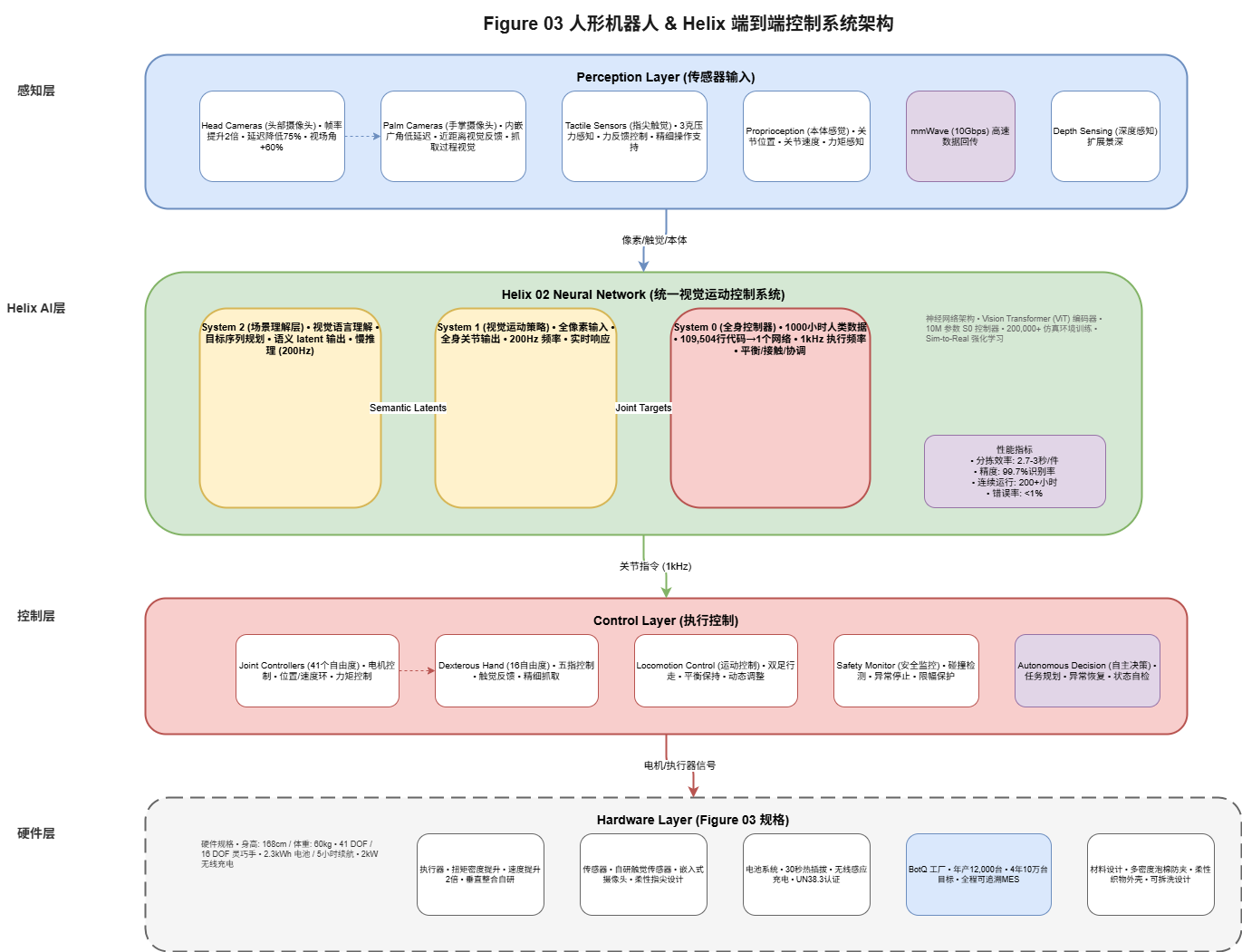
2.1 Helix System Overview
Helix is Figure’s proprietary unified Vision-Language-Action (VLA) large model. Its design philosophy is to integrate all robot capabilities into a single neural network:
┌─────────────────────────────────────────────────────────────┐
│                    Helix 02 System Architecture              │
├─────────────────────────────────────────────────────────────┤
│                                                             │
│  Input: Pixel Input                                         │
│  ┌─────────────────────────────────────────────────────┐   │
│  │  Head Cameras │ Palm Cameras │ Tactile │ Proprio    │   │
│  └─────────────────────────────────────────────────────┘   │
│                           │                                 │
│                           ▼                                 │
│  ┌─────────────────────────────────────────────────────┐   │
│  │               System 2: Scene Understanding Layer    │   │
│  │  • Vision-language understanding                      │   │
│  │  • Goal sequence planning                            │   │
│  │  • Semantic Latent output                            │   │
│  │  • Slow reasoning (200Hz)                           │   │
│  └─────────────────────────────────────────────────────┘   │
│                           │                                 │
│                           ▼                                 │
│  ┌─────────────────────────────────────────────────────┐   │
│  │              System 1: Visuomotor Policy              │   │
│  │  • Full pixel input → Whole-body joint output        │   │
│  │  • 200Hz real-time response                         │   │
│  │  • Unified visuomotor policy                         │   │
│  └─────────────────────────────────────────────────────┘   │
│                           │                                 │
│                           ▼                                 │
│  ┌─────────────────────────────────────────────────────┐   │
│  │              System 0: Whole-Body Controller         │   │
│  │  • 1kHz execution frequency                          │   │
│  │  • 1000 hours of human motion data                   │   │
│  │  • Balance/contact/coordination                      │   │
│  │  • 109,504 lines of code → 1 neural network          │   │
│  └─────────────────────────────────────────────────────┘   │
│                           │                                 │
│                           ▼                                 │
│  Output: Joint Commands (1kHz)                              │
│                                                             │
└─────────────────────────────────────────────────────────────┘
2.2 System 0: Human-Inspired Whole-Body Controller
System 0 is Helix’s foundational model that learns from 1000 hours of human motion data to achieve whole-body coordinated control:
# System 0 Controller Implementation
import torch
import torch.nn as nn
from typing import Tuple, Dict

class System0Controller(nn.Module):
    """
    System 0: Whole-Body Controller
    Neural network controller based on human motion data
    Replaces traditional 109,504 lines of C++ code
    """

    def __init__(
        self,
        state_dim: int = 64,  # Whole-body state dimension
        action_dim: int = 41,  # 41 joints
        hidden_dim: int = 512,
        output_freq: int = 1000  # 1kHz output frequency
    ):
        super().__init__()

        # Motion encoder
        self.motion_encoder = nn.Sequential(
            nn.Linear(state_dim, hidden_dim),
            nn.ReLU(),
            nn.Linear(hidden_dim, hidden_dim),
            nn.ReLU(),
            nn.Linear(hidden_dim, hidden_dim // 2)
        )

        # Balance controller
        self.balance_controller = nn.Sequential(
            nn.Linear(hidden_dim // 2, hidden_dim),
            nn.ReLU(),
            nn.Linear(hidden_dim, hidden_dim // 4),
            nn.ReLU(),
            nn.Linear(hidden_dim // 4, 6)  # 6D balance control (CoM position, orientation)
        )

        # Contact controller
        self.contact_controller = nn.Sequential(
            nn.Linear(hidden_dim // 2, hidden_dim),
            nn.ReLU(),
            nn.Linear(hidden_dim, hidden_dim // 4),
            nn.ReLU(),
            nn.Linear(hidden_dim // 4, 4)  # 4 end-effector contact forces
        )

        # Joint command generator
        self.joint_command_generator = nn.Sequential(
            nn.Linear(hidden_dim // 2 + 6 + 4, hidden_dim),
            nn.ReLU(),
            nn.Linear(hidden_dim, hidden_dim),
            nn.ReLU(),
            nn.Linear(hidden_dim, action_dim * 3)  # position + velocity + torque
        )

        self.output_freq = output_freq

    def forward(
        self,
        full_body_state: torch.Tensor,
        base_motion: torch.Tensor
    ) -> Dict[str, torch.Tensor]:
        """
        Forward pass

        Args:
            full_body_state: [batch, state_dim] Whole-body joint state
            base_motion: [batch, 6] Base motion (position + orientation)

        Returns:
            Joint command dictionary
        """
        # Encode motion state
        encoded = self.motion_encoder(full_body_state)

        # Generate balance control
        balance_control = self.balance_controller(encoded)

        # Generate contact control
        contact_control = self.contact_controller(encoded)

        # Combine all control signals
        combined = torch.cat([encoded, balance_control, contact_control], dim=-1)

        # Generate joint commands
        joint_commands = self.joint_command_generator(combined)

        # Decompose into position, velocity, torque
        pos_cmd = joint_commands[..., :action_dim]
        vel_cmd = joint_commands[..., action_dim:2*action_dim]
        torque_cmd = joint_commands[..., 2*action_dim:]

        return {
            "position": pos_cmd,
            "velocity": vel_cmd,
            "torque": torque_cmd,
            "balance_control": balance_control,
            "contact_forces": contact_control
        }

    def compute_reward(
        self,
        predicted_state: torch.Tensor,
        target_state: torch.Tensor,
        balance_error: torch.Tensor,
        contact_error: torch.Tensor
    ) -> torch.Tensor:
        """
        Compute reinforcement learning reward

        Reward design principles:
        1. State tracking accuracy
        2. Balance stability
        3. Appropriate contact forces
        """
        # State tracking reward
        state_reward = -torch.norm(predicted_state - target_state, dim=-1)

        # Balance reward (lower is better)
        balance_reward = -balance_error

        # Contact reward (encourage stable contact)
        contact_reward = -contact_error

        # Total reward
        total_reward = (
            1.0 * state_reward +
            0.5 * balance_reward +
            0.3 * contact_reward
        )

        return total_reward


class WholeBodyController:
    """
    Whole-body controller wrapper
    Provides high-level interface to external systems
    """

    def __init__(
        self,
        model_path: str,
        device: str = "cuda"
    ):
        self.device = torch.device(device)
        self.model = System0Controller().to(self.device)

        # Load pretrained weights
        checkpoint = torch.load(model_path, map_location=self.device)
        self.model.load_state_dict(checkpoint["model_state"])
        self.model.eval()

        # Joint configuration
        self.joint_config = {
            "legs": 12,      # 6 joints per leg
            "torso": 3,      # 3 torso joints
            "arms": 16,      # 8 joints per arm
            "head": 2,       # 2 head joints
            "hands": 16      # 16 hand DOF
        }

    def compute_command(
        self,
        joint_positions: torch.Tensor,
        joint_velocities: torch.Tensor,
        base_pose: torch.Tensor,
        foot_contact: torch.Tensor
    ) -> Dict[str, torch.Tensor]:
        """
        Compute joint control commands

        Args:
            joint_positions: [41] Current joint positions
            joint_velocities: [41] Current joint velocities
            base_pose: [6] Base pose (x,y,z,roll,pitch,yaw)
            foot_contact: [4] Foot contact state

        Returns:
            Control commands
        """
        # Construct full state vector
        full_state = torch.cat([
            joint_positions,
            joint_velocities,
            base_pose,
            foot_contact
        ]).unsqueeze(0)  # Add batch dimension

        # Forward pass
        with torch.no_grad():
            commands = self.model(full_state, base_pose.unsqueeze(0))

        # Convert to numpy
        return {k: v.squeeze(0).cpu().numpy() for k, v in commands.items()}

    def compute_impedance_gains(
        self,
        joint_positions: torch.Tensor,
        target_positions: torch.Tensor
    ) -> Tuple[torch.Tensor, torch.Tensor]:
        """
        Compute impedance control gains

        Implement compliant control for environmental interaction adaptability
        """
        position_error = target_positions - joint_positions

        # Impedance control: τ = Kp*e + Kd*ė
        Kp_scalar = 50.0
        Kd_scalar = 5.0

        return Kp_scalar, Kd_scalar
2.3 System 1: Visuomotor Policy
System 1 maps pixels directly to whole-body joint targets, which is key to achieving “what you see is what you do”:
# System 1 Visuomotor Policy Implementation
import torch
import torch.nn as nn
from typing import Dict, List, Tuple

class VisionTransformer(nn.Module):
    """Vision Encoder - Process multi-view image input"""

    def __init__(
        self,
        image_size: int = 224,
        patch_size: int = 16,
        in_channels: int = 3,
        embed_dim: int = 768,
        num_heads: int = 12,
        num_layers: int = 12
    ):
        super().__init__()

        # Image patching
        self.num_patches = (image_size // patch_size) ** 2
        self.patch_embed = nn.Conv2d(
            in_channels,
            embed_dim,
            kernel_size=patch_size,
            stride=patch_size
        )

        # Position embedding
        self.pos_embed = nn.Parameter(
            torch.zeros(1, self.num_patches, embed_dim)
        )

        # Transformer encoder
        encoder_layer = nn.TransformerEncoderLayer(
            d_model=embed_dim,
            nhead=num_heads,
            dim_feedforward=embed_dim * 4,
            dropout=0.1,
            batch_first=True
        )
        self.transformer = nn.TransformerEncoder(
            encoder_layer,
            num_layers=num_layers
        )

        # Output projection
        self.projection = nn.Linear(embed_dim, embed_dim)

    def forward(self, images: torch.Tensor) -> torch.Tensor:
        """
        Image feature extraction

        Args:
            images: [batch, num_cameras, 3, H, W] Multi-view images

        Returns:
            visual_features: [batch, feature_dim] Visual features
        """
        batch_size, num_cameras, C, H, W = images.shape

        # Merge all camera views
        images_flat = images.view(-1, C, H, W)

        # Extract patch features
        patches = self.patch_embed(images_flat)  # [B*C, embed_dim, H', W']
        patches = patches.flatten(2).transpose(1, 2)  # [B*C, H'*W', embed_dim]

        # Add position encoding
        patches = patches + self.pos_embed

        # Transformer encoding
        encoded = self.transformer(patches)  # [B*C, H'*W', embed_dim]

        # Global pooling
        visual_features = encoded.mean(dim=1)  # [B*C, embed_dim]

        # Restore batch dimension and aggregate
        visual_features = visual_features.view(batch_size, num_cameras, -1)
        visual_features = visual_features.mean(dim=1)  # [B, embed_dim]

        return self.projection(visual_features)


class System1VisuomotorPolicy(nn.Module):
    """
    System 1: Visuomotor Policy
    Maps pixels directly to whole-body joint targets
    """

    def __init__(
        self,
        num_joints: int = 41,
        proprio_dim: int = 64,
        latent_dim: int = 256,
        s2_latent_dim: int = 128
    ):
        super().__init__()

        # Vision encoder
        self.vision_encoder = VisionTransformer()

        # Proprioception encoder
        self.proprio_encoder = nn.Sequential(
            nn.Linear(proprio_dim, 512),
            nn.ReLU(),
            nn.Linear(512, 512),
            nn.ReLU(),
            nn.Linear(512, 256)
        )

        # Fusion layer
        self.fusion = nn.Sequential(
            nn.Linear(768 + 256, 512),
            nn.ReLU(),
            nn.Linear(512, latent_dim)
        )

        # S2 conditioning modulation
        self.s2_modulation = nn.Linear(s2_latent_dim, latent_dim)

        # Joint target decoder
        self.joint_decoder = nn.Sequential(
            nn.Linear(latent_dim, 512),
            nn.ReLU(),
            nn.Linear(512, 512),
            nn.ReLU(),
            nn.Linear(512, num_joints * 3)  # position + velocity + acceleration
        )

        # Action confidence (for uncertainty estimation)
        self.confidence_head = nn.Sequential(
            nn.Linear(latent_dim, 128),
            nn.ReLU(),
            nn.Linear(128, 1),
            nn.Sigmoid()
        )

    def forward(
        self,
        images: torch.Tensor,  # [B, 4, 3, 224, 224] head + hands + depth cameras
        proprioception: torch.Tensor,  # [B, 64] Proprioception
        s2_latents: torch.Tensor  # [B, 128] System 2 semantic output
    ) -> Dict[str, torch.Tensor]:
        """
        Forward pass

        Args:
            images: Multi-view images
            proprioception: Proprioception state
            s2_latents: System 2 semantic latent

        Returns:
            Joint targets and confidence
        """
        # Visual features
        visual_features = self.vision_encoder(images)

        # Proprioception features
        proprio_features = self.proprio_encoder(proprioception)

        # Feature fusion
        fused = torch.cat([visual_features, proprio_features], dim=-1)
        latent = self.fusion(fused)

        # S2 conditioning
        s2_conditioned = latent * (1 + torch.tanh(self.s2_modulation(s2_latents)))

        # Generate joint targets
        joint_targets = self.joint_decoder(s2_conditioned)
        num_joints = joint_targets.shape[-1] // 3

        # Decompose into position, velocity, acceleration
        positions = joint_targets[..., :num_joints]
        velocities = joint_targets[..., num_joints:2*num_joints]
        accelerations = joint_targets[..., 2*num_joints:]

        # Action confidence
        confidence = self.confidence_head(s2_conditioned)

        return {
            "positions": positions,
            "velocities": velocities,
            "accelerations": accelerations,
            "confidence": confidence,
            "latent": s2_conditioned
        }

    def compute_action(
        self,
        images: torch.Tensor,
        proprioception: torch.Tensor,
        s2_latents: torch.Tensor,
        current_joint_positions: torch.Tensor
    ) -> torch.Tensor:
        """
        Compute final action
        Consider current state and safety constraints
        """
        targets = self.forward(images, proprioception, s2_latents)

        # Apply safety constraints
        safe_positions = self.apply_safety_constraints(
            targets["positions"],
            current_joint_positions
        )

        # Blend target with safety constraints
        final_action = (
            0.7 * safe_positions +
            0.3 * targets["positions"] * targets["confidence"]
        )

        return final_action

    def apply_safety_constraints(
        self,
        target_positions: torch.Tensor,
        current_positions: torch.Tensor
    ) -> torch.Tensor:
        """
        Apply safety constraints
        Prevent joint position sudden changes causing mechanical damage
        """
        # Joint position limits
        joint_limits = torch.tensor([
            # Format: (min, max) for each joint
            # Should be loaded from URDF or config file in actual use
        ] * 41, device=target_positions.device)

        # Limit maximum single-step displacement
        max_step = 0.1  # radians
        position_delta = target_positions - current_positions
        clamped_delta = torch.clamp(position_delta, -max_step, max_step)

        safe_positions = current_positions + clamped_delta

        # Apply joint limits
        safe_positions = torch.clamp(
            safe_positions,
            joint_limits[:, 0],
            joint_limits[:, 1]
        )

        return safe_positions


class VisuomotorRunner:
    """
    Visuomotor policy runner
    Responsible for hardware interface and execution frequency control
    """

    def __init__(
        self,
        policy: System1VisuomotorPolicy,
        control_freq: int = 200  # 200Hz
    ):
        self.policy = policy
        self.control_freq = control_freq
        self.dt = 1.0 / control_freq

        # Image buffer
        self.image_buffer = []
        self.max_buffer_size = 2

        # Statistics
        self.inference_times = []

    @torch.no_grad()
    def step(
        self,
        images: torch.Tensor,
        proprioception: torch.Tensor,
        s2_latents: torch.Tensor,
        current_positions: torch.Tensor
    ) -> Dict[str, torch.Tensor]:
        """
        Single-step inference

        Returns:
            Control commands
        """
        import time

        start = time.perf_counter()

        # Execute inference
        action = self.policy.compute_action(
            images, proprioception, s2_latents, current_positions
        )

        # Record inference time
        inference_time = time.perf_counter() - start
        self.inference_times.append(inference_time)

        # Return control commands
        return {
            "joint_targets": action,
            "inference_time_ms": inference_time * 1000
        }
2.4 System 2: Scene Understanding and Goal Planning
System 2 is responsible for high-level reasoning and goal decomposition:
# System 2 Scene Understanding and Goal Planning Implementation
import torch
import torch.nn as nn
from typing import List, Tuple, Dict

class SceneUnderstanding(nn.Module):
    """
    System 2: Scene Understanding Module
    Understand environmental semantics and goals
    """

    def __init__(
        self,
        visual_dim: int = 768,
        language_dim: int = 512,
        hidden_dim: int = 1024,
        num_objects: int = 100
    ):
        super().__init__()

        # Visual encoder
        self.visual_encoder = nn.Sequential(
            nn.Linear(visual_dim, hidden_dim),
            nn.LayerNorm(hidden_dim),
            nn.ReLU(),
            nn.Linear(hidden_dim, hidden_dim)
        )

        # Language encoder
        self.language_encoder = nn.Sequential(
            nn.Linear(language_dim, hidden_dim),
            nn.LayerNorm(hidden_dim),
            nn.ReLU(),
            nn.Linear(hidden_dim, hidden_dim)
        )

        # Object detection
        self.object_detector = nn.Sequential(
            nn.Linear(hidden_dim, hidden_dim),
            nn.ReLU(),
            nn.Linear(hidden_dim, num_objects * 6)  # bbox + class + confidence
        )

        # Scene graph construction
        self.scene_graph = nn.MultiheadAttention(
            embed_dim=hidden_dim,
            num_heads=8,
            batch_first=True
        )

        # Goal reasoning
        self.goal_reasoner = nn.Sequential(
            nn.Linear(hidden_dim * 2, hidden_dim),
            nn.LayerNorm(hidden_dim),
            nn.ReLU(),
            nn.Linear(hidden_dim, hidden_dim),
            nn.ReLU(),
            nn.Linear(hidden_dim, 256)  # goal embedding
        )

    def forward(
        self,
        visual_features: torch.Tensor,
        language_features: torch.Tensor,
        task_description: str
    ) -> Dict[str, torch.Tensor]:
        """
        Scene understanding forward pass
        """
        # Encode vision and language
        vis_encoded = self.visual_encoder(visual_features)
        lang_encoded = self.language_encoder(language_features)

        # Object detection
        object_predictions = self.object_detector(vis_encoded)

        # Scene graph attention
        scene_context, _ = self.scene_graph(
            vis_encoded.unsqueeze(0),
            vis_encoded.unsqueeze(0),
            vis_encoded.unsqueeze(0)
        )

        # Goal reasoning
        goal_features = torch.cat([vis_encoded, lang_encoded], dim=-1)
        goal_embedding = self.goal_reasoner(goal_features)

        return {
            "visual_features": vis_encoded,
            "language_features": lang_encoded,
            "object_predictions": object_predictions,
            "scene_context": scene_context.squeeze(0),
            "goal_embedding": goal_embedding
        }


class GoalDecomposer(nn.Module):
    """
    Goal Decomposer
    Decomposes high-level goals into executable sub-goal sequences
    """

    def __init__(
        self,
        goal_dim: int = 256,
        latent_dim: int = 128,
        num_primitive_actions: int = 20
    ):
        super().__init__()

        # Goal encoder
        self.goal_encoder = nn.Sequential(
            nn.Linear(goal_dim, 512),
            nn.ReLU(),
            nn.Linear(512, 256),
            nn.ReLU(),
            nn.Linear(256, latent_dim)
        )

        # Action vocabulary
        self.action_vocabulary = nn.Parameter(
            torch.randn(num_primitive_actions, latent_dim)
        )

        # Sequence decoder
        self.sequence_decoder = nn.GRU(
            input_size=latent_dim,
            hidden_size=256,
            num_layers=2,
            batch_first=True
        )

        # Action prediction head
        self.action_head = nn.Sequential(
            nn.Linear(256, 128),
            nn.ReLU(),
            nn.Linear(128, num_primitive_actions)
        )

        # Termination prediction head
        self.terminate_head = nn.Sequential(
            nn.Linear(256, 64),
            nn.ReLU(),
            nn.Linear(64, 1),
            nn.Sigmoid()
        )

    def forward(
        self,
        goal_embedding: torch.Tensor,
        max_steps: int = 20
    ) -> Tuple[List[int], torch.Tensor]:
        """
        Goal decomposition forward pass

        Returns:
            action_sequence: Sub-goal sequence
            terminate_probs: Termination probability at each step
        """
        goal_encoded = self.goal_encoder(goal_embedding)

        # Initialize decoder state
        batch_size = goal_embedding.shape[0]
        decoder_hidden = torch.zeros(2, batch_size, 256, device=goal_embedding.device)

        # Decode action sequence
        action_sequence = []
        terminate_probs = []
        current_input = goal_encoded.unsqueeze(1)

        for step in range(max_steps):
            output, decoder_hidden = self.sequence_decoder(
                current_input, decoder_hidden
            )

            # Predict action
            action_logits = self.action_head(output.squeeze(1))
            action_probs = torch.softmax(action_logits, dim=-1)
            action_id = action_probs.argmax(dim=-1)
            action_sequence.append(action_id.item())

            # Predict termination
            terminate_prob = self.terminate_head(output.squeeze(1))
            terminate_probs.append(terminate_prob.item())

            # Stop decoding if termination probability is high
            if terminate_prob.item() > 0.9:
                break

            # Update input using predicted action
            current_input = self.action_vocabulary[action_id].unsqueeze(0)

        return action_sequence, torch.tensor(terminate_probs)


class System2Module(nn.Module):
    """
    System 2: Complete Module
    Integrates scene understanding and goal decomposition
    """

    def __init__(self):
        super().__init__()

        self.scene_understanding = SceneUnderstanding()
        self.goal_decomposer = GoalDecomposer()

        # Latent space projection (passed to System 1)
        self.latent_projection = nn.Sequential(
            nn.Linear(256 + 128, 256),
            nn.ReLU(),
            nn.Linear(256, 128)
        )

    def forward(
        self,
        visual_features: torch.Tensor,
        language_features: torch.Tensor,
        task_description: str
    ) -> Tuple[torch.Tensor, List[int]]:
        """
        System 2 forward pass
        """
        # Scene understanding
        scene_output = self.scene_understanding(
            visual_features, language_features, task_description
        )

        # Goal decomposition
        action_sequence, terminate_probs = self.goal_decomposer(
            scene_output["goal_embedding"]
        )

        # Generate latent to pass to System 1
        latent = self.latent_projection(
            torch.cat([
                scene_output["goal_embedding"],
                scene_output["scene_context"]
            ], dim=-1)
        )

        return latent, action_sequence

    def get_semantic_latents(
        self,
        visual_features: torch.Tensor,
        language_features: torch.Tensor,
        task: str
    ) -> torch.Tensor:
        """
        Get semantic latents (for System 1 conditioning)
        """
        latent, _ = self.forward(visual_features, language_features, task)
        return latent
3. Hardware Architecture: Figure 03 Specifications
3.1 Overall Hardware Configuration
# Figure 03 Hardware Configuration Class
from dataclasses import dataclass
from typing import Dict, List

@dataclass
class Figure03Specs:
    """Figure 03 Hardware Specifications"""

    # Size and Weight
    height_cm: float = 168.0
    weight_kg: float = 60.0
    mass_reduction_percent: float = 9.0  # 9% reduction vs 02

    # DOF Configuration
    total_dof: int = 41
    joint_config: Dict[str, int] = None

    # Dexterous Hand Specifications
    hand_dof: int = 16
    tactile_sensitivity_grams: float = 3.0  # Can detect 3-gram pressure

    # Battery System
    battery_capacity_kwh: float = 2.3
    runtime_hours: float = 5.0
    charging_power_kw: float = 2.0  # Wireless charging power
    battery_swap_seconds: float = 30.0  # Hot-swap time

    # Sensor Configuration
    head_cameras: int = 2
    head_fov_increase_percent: float = 60.0
    frame_rate_improvement: float = 2.0
    latency_reduction_percent: float = 75.0

    # Data Transmission
    wireless_bandwidth_gbps: float = 10.0  # mmWave

    def __post_init__(self):
        if self.joint_config is None:
            self.joint_config = {
                "left_leg": 6,
                "right_leg": 6,
                "torso": 3,
                "left_arm": 8,
                "right_arm": 8,
                "head": 2,
                "left_hand": 4,  # thumb + 4 fingers
                "right_hand": 4
            }

    def get_total_mass_breakdown(self) -> Dict[str, float]:
        """Get mass distribution"""
        return {
            "body": 25.0,  # Main body
            "arms": 8.0 * 2,  # Both arms
            "legs": 7.0 * 2,  # Both legs
            "head": 3.0,  # Head
            "battery": 8.0,  # Battery
            "electronics": 4.0  # Electronics
        }


class ActuatorSystem:
    """
    Actuator System
    Figure 03 proprietary actuator configuration
    """

    def __init__(self):
        self.actuator_config = {
            # Leg actuators (high torque)
            "leg_joint": {
                "max_torque_nm": 150,
                "max_velocity_rpm": 60,
                "weight_kg": 1.2,
                "reduction_ratio": 100
            },
            # Arm actuators (medium torque, high speed)
            "arm_joint": {
                "max_torque_nm": 80,
                "max_velocity_rpm": 120,
                "weight_kg": 0.8,
                "reduction_ratio": 80
            },
            # Dexterous hand actuators (fine control)
            "hand_joint": {
                "max_torque_nm": 5,
                "max_velocity_rpm": 300,
                "weight_kg": 0.1,
                "reduction_ratio": 50
            }
        }

    def get_speed_improvement(self) -> float:
        """Speed improvement vs previous generation"""
        return 2.0  # 2x speed improvement

    def get_torque_density(self) -> float:
        """Torque density (Nm/kg)"""
        return 125 / 1.2  # ~104 Nm/kg
4. Simulation-to-Reality Transfer
4.1 Sim-to-Real Reinforcement Learning Framework
# Sim-to-Real Training Framework
import numpy as np
from typing import Dict, List, Tuple
import mujoco
import torch
import torch.nn as nn

class SimToRealTrainer:
    """
    Simulation-to-Reality Transfer Trainer
    Train policies using large-scale simulation environments
    """

    def __init__(
        self,
        num_envs: int = 200000,
        sim_time_step: float = 0.001,
        control_time_step: float = 0.01
    ):
        self.num_envs = num_envs
        self.sim_dt = sim_time_step
        self.control_dt = control_time_step

        # Create simulation environment
        self.sim_env = self._create_sim_env()

        # Domain randomization parameters
        self.domain_randomization = {
            "friction": [0.5, 1.5],
            "mass": [0.8, 1.2],
            "delay": [0.0, 0.05],
            "noise": [0.0, 0.1]
        }

    def _create_sim_env(self):
        """Create MuJoCo simulation environment"""
        # Load Figure 03 model
        model = mujoco.MjModel.from_xml_path("figure_03.xml")
        data = mujoco.MjData(model)

        return {"model": model, "data": data}

    def randomize_domain(self):
        """Apply domain randomization"""
        # Friction randomization
        friction = np.random.uniform(*self.domain_randomization["friction"])
        self.sim_env["model"].geom_friction[:] = friction

        # Mass randomization
        mass_scale = np.random.uniform(*self.domain_randomization["mass"])
        for i in range(1, self.sim_env["model"].nbody):
            self.sim_env["model"].body_mass[i] *= mass_scale

    def collect_rollout(
        self,
        policy: nn.Module,
        num_steps: int = 1000
    ) -> Dict[str, np.ndarray]:
        """
        Collect simulation data rollout

        Returns:
            Experience data dictionary
        """
        observations = []
        actions = []
        rewards = []
        dones = []

        # Initialize environment
        self.sim_env["data"].reset()
        self.randomize_domain()

        for step in range(num_steps):
            # Get observation
            obs = self._get_observation()
            observations.append(obs)

            # Policy inference
            with torch.no_grad():
                action = policy(torch.tensor(obs).float().unsqueeze(0))
                action = action.squeeze(0).numpy()

            # Apply action
            self.sim_env["data"].ctrl[:] = action
            mujoco.mj_step(
                self.sim_env["model"],
                self.sim_env["data"],
                int(self.control_dt / self.sim_dt)
            )
            actions.append(action)

            # Compute reward
            reward = self._compute_reward()
            rewards.append(reward)

            # Check termination
            done = self._check_termination()
            dones.append(done)

            if done:
                self.sim_env["data"].reset()
                self.randomize_domain()

        return {
            "observations": np.array(observations),
            "actions": np.array(actions),
            "rewards": np.array(rewards),
            "dones": np.array(dones)
        }

    def _get_observation(self) -> np.ndarray:
        """Get current observation"""
        data = self.sim_env["data"]

        # Joint positions
        qpos = data.qpos[:self.sim_env["model"].nq]

        # Joint velocities
        qvel = data.qvel[:self.sim_env["model"].nv]

        # Tactile sensors (simulated)
        tactiles = data.sensordata[:16]  # 16 fingertip sensors

        # Merge observation
        obs = np.concatenate([qpos, qvel, tactiles])

        # Add noise
        noise_scale = np.random.uniform(*self.domain_randomization["noise"])
        obs += np.random.randn(len(obs)) * noise_scale

        return obs

    def _compute_reward(self) -> float:
        """Compute reward function"""
        data = self.sim_env["data"]

        # Task completion reward
        task_reward = 0.0

        # Balance reward
        balance_reward = -0.1 * np.sum(data.qacc[:]**2)

        # Energy penalty
        energy_penalty = -0.01 * np.sum(data.ctrl[:]**2)

        # Task-specific reward (sorting scenario)
        if hasattr(data, 'object_placed'):
            task_reward = 1.0 if data.object_placed else 0.0

        return task_reward + balance_reward + energy_penalty

    def _check_termination(self) -> bool:
        """Check if terminated"""
        data = self.sim_env["data"]

        # Fall detection
        if data.body("torso").xpos[2] < 0.5:
            return True

        # Joint limit violation
        if np.any(np.abs(data.qpos[:]) > np.pi * 2):
            return True

        return False

    def train_ppo(
        self,
        policy: nn.Module,
        value_net: nn.Module,
        num_iterations: int = 1000,
        steps_per_iteration: int = 10000
    ):
        """
        PPO algorithm training
        """
        optimizer_policy = torch.optim.Adam(policy.parameters(), lr=3e-4)
        optimizer_value = torch.optim.Adam(value_net.parameters(), lr=1e-3)

        for iteration in range(num_iterations):
            # Collect data
            rollout = self.collect_rollout(policy, steps_per_iteration)

            # Compute advantage function
            advantages, returns = self._compute_gae(
                rollout["rewards"],
                rollout["dones"]
            )

            # PPO update
            for epoch in range(10):  # PPO epochs
                # Policy loss
                actions = torch.tensor(rollout["actions"])
                obs = torch.tensor(rollout["observations"])
                log_probs_old = policy.get_log_prob(obs, actions)

                # New policy
                log_probs_new = policy.get_log_prob(obs, actions)

                # PPO loss
                ratio = torch.exp(log_probs_new - log_probs_old)
                surr1 = ratio * torch.tensor(advantages)
                surr2 = torch.clamp(
                    ratio,
                    1 - 0.2,
                    1 + 0.2
                ) * torch.tensor(advantages)

                policy_loss = -torch.min(surr1, surr2).mean()

                # Value function loss
                values_pred = value_net(obs).squeeze()
                value_loss = nn.MSELoss()(values_pred, torch.tensor(returns))

                # Update
                optimizer_policy.zero_grad()
                policy_loss.backward()
                optimizer_policy.step()

                optimizer_value.zero_grad()
                value_loss.backward()
                optimizer_value.step()

            print(f"Iteration {iteration}, Policy Loss: {policy_loss.item():.4f}")
5. Application Scenarios and Commercial Deployment
5.1 Logistics Sorting Scenario
# Logistics Sorting Application Implementation
class LogisticsSortingTask:
    """
    Logistics Sorting Task
    Figure 03's core commercial application scenario
    """

    def __init__(self, figure_robot):
        self.robot = figure_robot
        self.current_zone = "inbound"
        self.sorting_stats = {
            "total": 0,
            "success": 0,
            "failed": 0,
            "items_per_hour": []
        }

    def scan_package(self) -> Dict:
        """
        Scan and identify package
        """
        # Get images
        images = self.robot.get_head_cameras()

        # Use vision model to identify
        package_info = self.vision_model.detect_package(images)

        return {
            "id": package_info["tracking_id"],
            "destination": package_info["destination_zone"],
            "weight": package_info["weight_kg"],
            "dimensions": package_info["bbox_3d"],
            "fragile": package_info["fragile_flag"]
        }

    def grasp_package(self, package_info: Dict) -> bool:
        """
        Grasp package
        Adjust grasping strategy based on package characteristics
        """
        # Adjust grasping force based on weight
        if package_info["weight"] > 10:
            # Heavy items: two-hand grasp, larger contact area
            grasp_force = 50  # Newtons
        elif package_info["fragile"]:
            # Fragile items: minimum force, precise control
            grasp_force = 5  # Newtons (just enough to lift)
        else:
            # Normal packages
            grasp_force = 20  # Newtons

        # Execute grasp
        success = self.robot.grasp(
            target_pose=package_info["position"],
            force=grasp_force,
            approach_height=0.1
        )

        return success

    def sort_to_destination(self, destination: str) -> bool:
        """
        Sort package to destination
        """
        # Navigate to destination zone
        self.robot.navigate_to_zone(destination)

        # Place package
        success = self.robot.place(
            target_zone=destination,
            release_force=5  # Gentle placement
        )

        return success

    def run_sorting_loop(self):
        """
        Run sorting loop
        """
        while True:
            # 1. Scan package
            package = self.scan_package()

            # 2. Grasp
            grasp_success = self.grasp_package(package)
            if not grasp_success:
                self.sorting_stats["failed"] += 1
                continue

            # 3. Sort
            sort_success = self.sort_to_destination(package["destination"])

            # 4. Record statistics
            self.sorting_stats["total"] += 1
            if sort_success:
                self.sorting_stats["success"] += 1
            else:
                self.sorting_stats["failed"] += 1

            # 5. Periodic report
            if self.sorting_stats["total"] % 100 == 0:
                self.report_stats()

    def report_stats(self):
        """Report sorting statistics"""
        total = self.sorting_stats["total"]
        success = self.sorting_stats["success"]

        print(f"""
        === Sorting Statistics ===
        Total: {total}
        Success: {success}
        Failed: {total - success}
        Success Rate: {100 * success / total if total > 0 else 0:.2f}%
        """)
5.2 Industrial Manufacturing Scenario
# Industrial Assembly Application
class IndustrialAssemblyTask:
    """
    Industrial Assembly Task
    Figure 03's application in manufacturing
    """

    def __init__(self, figure_robot):
        self.robot = figure_robot
        self.assembly_sequence = []

    def visual_servoing(
        self,
        target_pose: np.ndarray
    ) -> np.ndarray:
        """
        Visual servoing control
        Vision-based feedback for precise pose control
        """
        # Get current image
        images = self.robot.get_palm_cameras()

        # Detect target
        target_in_image = self.vision_model.detect_target(images, target_pose)

        # Compute image Jacobian
        jacobian = self.compute_image_jacobian(target_in_image)

        # Compute control increment
        position_error = target_pose - self.robot.get_end_effector_pose()
        velocity = position_error * 0.5  # Proportional control

        return velocity

    def precision_insertion(
        self,
        peg: Dict,
        hole: Dict
    ) -> bool:
        """
        Precision insertion
        Typical assembly task
        """
        # 1. Align
        aligned = self.align_peg_hole(peg, hole)
        if not aligned:
            return False

        # 2. Approach
        approach_pose = hole["position"] + np.array([0, 0, 0.05])
        self.robot.move_to(approach_pose, velocity=0.01)

        # 3. Insert (use force control)
        insertion_force = self.robot.force_control(
            direction=np.array([0, 0, -1]),
            target_force=2.0,  # 2 Newtons
            max_displacement=0.1
        )

        # 4. Verify
        force_sensor = self.robot.get_force_sensor()
        if np.linalg.norm(insertion_force) > 10:
            return False  # Insertion resistance too high

        return True

    def dual_arm_coordination(
        self,
        left_task: Dict,
        right_task: Dict
    ):
        """
        Dual-arm coordination task
        Complex assembly requires both arms to work together
        """
        # Define coordination frame
        relative_pose = self.compute_relative_pose(left_task, right_task)

        # Synchronized control
        left_vel = self.visual_servoing(left_task["target"])
        right_vel = self.visual_servoing(right_task["target"])

        # Add coordination constraint
        coordinated_left_vel = left_vel + 0.5 * relative_pose
        coordinated_right_vel = right_vel - 0.5 * relative_pose

        # Execute coordinated motion
        self.robot.left_arm.set_velocity(coordinated_left_vel)
        self.robot.right_arm.set_velocity(coordinated_right_vel)
6. Performance Metrics and Industry Comparison
| Metric | Figure 03 | Industry Average | Advantage Multiplier |
|---|---|---|---|
| Continuous Operation | 200+ hours | 8 hours | 25x |
| Sorting Efficiency | 2.7-3 sec/item | 4-5 sec/item | 1.5x |
| Recognition Accuracy | 99.7% | 95% | 1.05x |
| Failure Rate | 0/200 hours | 3-5/8 hours | 100x+ |
| Mass Production Cost | $40K (target) | $200-500K | 5-12x |
7. Conclusion and Outlook
Figure 03’s success marks embodied intelligence entering a new stage of development.
Core Technical Breakthroughs:
- Helix End-to-End Architecture: Replaced 109,504 lines of hand-written code with a single neural network
- System 0/1/2 Hierarchical Design: Balances real-time control and high-level reasoning
- Sim-to-Real Reinforcement Learning: 200,000+ simulation environment training
- Mass Production Scale: BotQ factory annual capacity target of 12,000 units
Implications for the Industry:
- End-to-end learning is the correct path toward general-purpose robots
- Large-scale simulation + domain randomization is an effective approach to solve Sim-to-Real gap
- Co-design of hardware and software is crucial
- Commercial deployment requires system engineering capability, not just algorithmic capability
Future Outlook:
- More complex manipulation tasks (assembly, repair)
- Multi-robot collaboration and swarm intelligence
- Expansion to home service scenarios
- Integration of humanoid robots with autonomous driving
Embodied intelligence is transitioning from “showing off capabilities” to “real deployment”. Figure 03 demonstrated with real data that humanoid robots have the potential to become “general-purpose labor”.
References
- Figure AI - Helix 02 Official Announcement
- Figure 03 Product Specification
- IEEE Spectrum - Figure 03 Technical Analysis
- Nature Robotics - Sim-to-Real Transfer in Humanoid Robotics