AI-Powered Automation: Transforming Finance, Logistics, and Healthcare
An in-depth exploration of how artificial intelligence is reshaping three pillar industries through intelligent automation, autonomous agents, and real-time decision-making
Summary
Artificial intelligence is no longer a speculative technology—it is the driving force behind the most significant operational transformation in decades. Across finance, logistics, and healthcare, AI-powered automation is redefining what is possible, shifting organizations from reactive operations to intelligent, self-optimizing systems. According to Grand View Research, the global AI automation market was valued at approximately $129.92 billion in 2025 and is projected to reach $1.14 trillion by 2033, representing a compound annual growth rate of 31.4%. This explosive growth reflects a fundamental recognition: AI is not merely augmenting human work but fundamentally reimagining how industries function.
This white paper examines the architectural paradigms, real-world applications, and strategic implications of AI automation across three critical sectors: financial services, logistics and supply chain management, and healthcare delivery. Each industry presents unique challenges—financial institutions demand zero-latency fraud detection, logistics networks require real-time route optimization across millions of variables, and healthcare systems need diagnostic accuracy that can literally save lives. Yet across all three, a common pattern emerges: the transition from rule-based automation to intelligent, adaptive systems that can reason, learn, and act autonomously.
| Sector | Market Size (2025) | Primary AI Focus | Key Architectural Pattern |
|---|---|---|---|
| Finance | $23.74B (AI automation) | Fraud detection, compliance, risk management | Cloud-native, real-time event-driven |
| Logistics | Fastest-growing automation segment | Route optimization, warehouse | robotics, demand forecasting Distributed multi-agent, swarm intelligence |
| Healthcare | Highest projected CAGR (36.0% through 2033) | Medical imaging, clinical | documentation, patient monitoring FHIR-native, agentic reasoning |
Part I: Finance — From Compliance Burden to Intelligent Advantage
The State of Financial Automation
Financial services stand at an inflection point. After decades of incremental modernization, the industry is entering a phase of accelerated change where real-time capabilities become the standard and intelligence is embedded at the structural level. Traditional core banking systems—often described as “cathedrals of code” built over decades—are being replaced by fourth-generation, cloud-native platforms that enable extensibility, dynamic pricing, and real-time responsiveness.
Yet the gap between ambition and execution remains substantial. According to Deloitte research, while 57% of financial service institutions have fully deployed an AI solution in finance, only 7% have demonstrated measurable value and integrated at least one agentic solution. This disconnect highlights a critical insight: deploying AI is not the same as deriving value. The organizations that succeed are those that redesign workflows around AI capabilities rather than simply layering AI onto legacy processes.
Core Architectural Framework
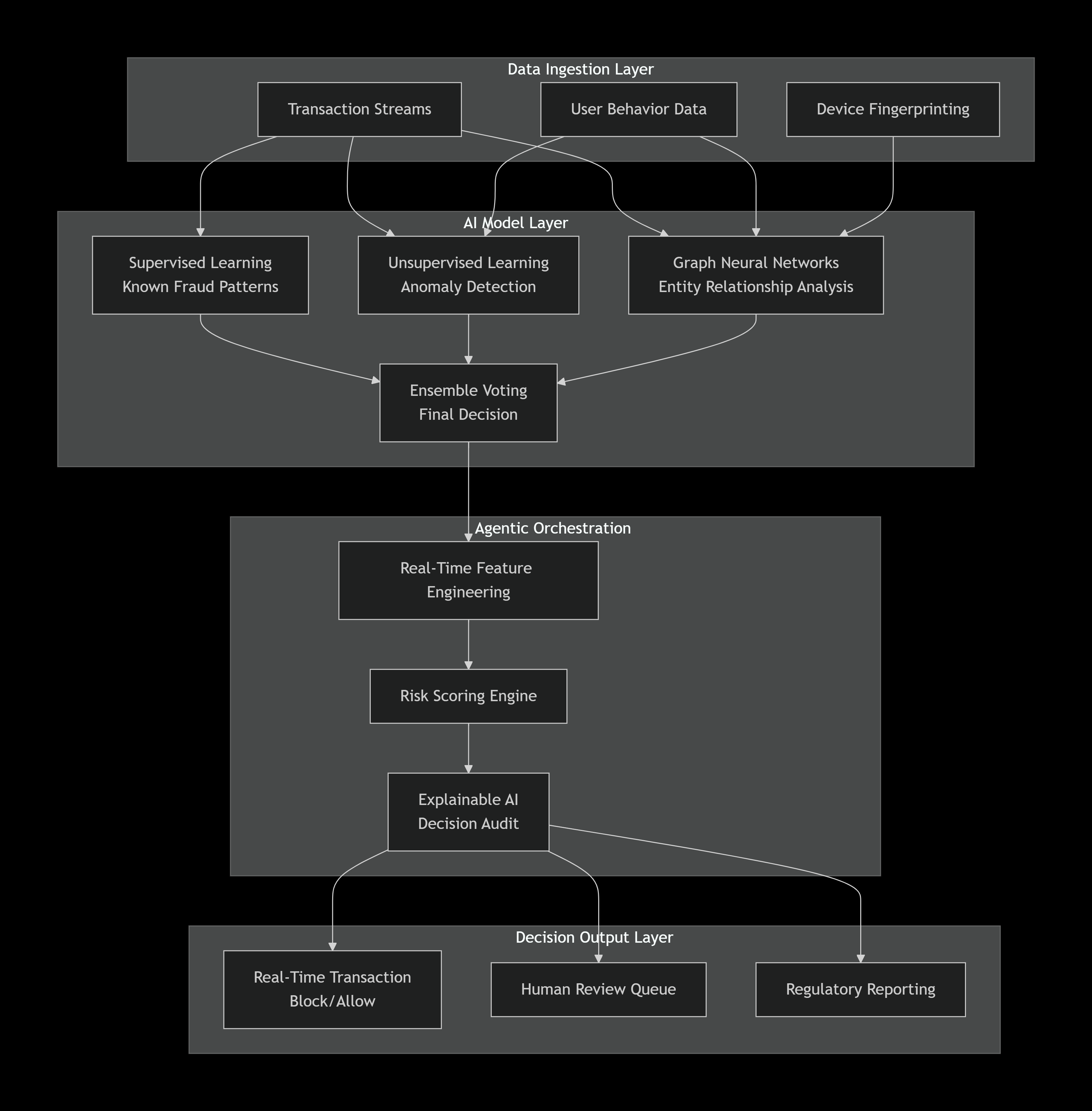
A modern AI-powered financial system operates on a layered architecture that combines real-time transaction ingestion, intelligent model execution, and automated decision orchestration. The technical architecture typically includes:
Data Ingestion Layer.
Financial institutions process millions of transactions daily, each requiring sub-second validation. Cloud-native, event-driven architectures using microservices and serverless computing enable scalable, resilient data intake. Modern systems employ Apache Kafka or similar streaming platforms to capture transaction events in real time.
AI Model Layer.
This serves as the analytical nucleus of the system, integrating three complementary modeling paradigms: supervised learning for detecting known fraud patterns, unsupervised learning for identifying novel anomalies, and graph neural networks (GNNs) for tracing complex relationships across accounts and entities. Ensemble methods combining multiple techniques achieve precision rates exceeding 98% while reducing false positives by up to 54%.
Agentic Orchestration Layer.
Unlike traditional automation that executes isolated tasks, agentic AI systems can reason, act, and orchestrate multistep processes with minimal human intervention. These agents access data, execute workflows, and adapt to new conditions—turning complex financial workflows from multi-day processes into minutes-long operations.
Decision Output Layer.
Results flow into automated execution systems (payment blocks, alert generation) and human review queues. Explainable AI (XAI) techniques ensure regulatory compliance by providing audit trails for why specific decisions were made.
Fraud Detection: The Ultimate Real-Time Use Case Financial fraud detection exemplifies the transformative potential of AI automation. Traditional rule-based systems, constrained by predetermined patterns, achieve roughly 94% accuracy and struggle with evolving fraud tactics. Neural networks, by contrast, achieve detection rates of 99.7%.
The difference lies not merely in algorithm sophistication but in architectural approach. AI-driven systems analyze hundreds of transaction attributes simultaneously, learning from historical data to identify subtle anomalies. Hybrid models maintain recall rates above 95% while dramatically reducing operational costs from manual reviews. Moreover, these systems adapt automatically—when fraudsters deploy new techniques, self-learning models update without manual intervention.
Real-time fraud detection platforms now integrate continuous behavioral biometrics, device fingerprinting, and transaction risk scoring into unified defense systems. A single SDK can score every login, payment, payout, loan application, and trading action in real time, creating a holistic security perimeter that evolves with the threat landscape.
Agentic AI in Banking Operations
The emergence of agentic AI represents a paradigm shift from isolated automation to end-to-end workflow orchestration. According to PwC analysis, agentic AI is already delivering value across four primary domains: financial crime detection and prevention, regulatory compliance automation, customer engagement optimization, and lending workflow acceleration.
In lending, for example, agentic systems can automatically collect and verify documentation, run credit assessments, check regulatory compliance, and generate approval recommendations—tasks that previously required dozens of manual steps and several days of processing. The result is not merely faster processing but fundamentally new capabilities. Financial institutions can now dynamically adjust lending parameters based on real-time market conditions, personalize offerings at scale, and respond to regulatory changes as they occur rather than after quarterly reviews.
The top three agentic AI opportunities identified by financial service leaders are working capital optimization (53% of respondents), financial planning and analysis (49%), and sales and profitability management (36%). These are not incremental improvements—they represent strategic repositioning of finance from back-office function to real-time strategic partner.
Part II: Logistics — From Fragmented Operations to Intelligent Networks
The Distributed Logistics Paradigm
For decades, logistics operated on a centralized model: a single control hub managed route planning, inventory allocation, and transport coordination. This approach worked when supply chains were stable and predictable. But as global networks expand and customer expectations shift toward same-day delivery and real-time tracking, centralized systems are reaching fundamental limits.
The challenge is threefold. First, data volumes now outpace update speeds—by the time centralized systems process information, the real-world situation has already changed. Second, scalability becomes exponentially harder as networks grow; adding new warehouses dramatically increases computational complexity. Third, centralized systems create single points of failure—if the central hub goes down, the entire logistics chain can be paralyzed.
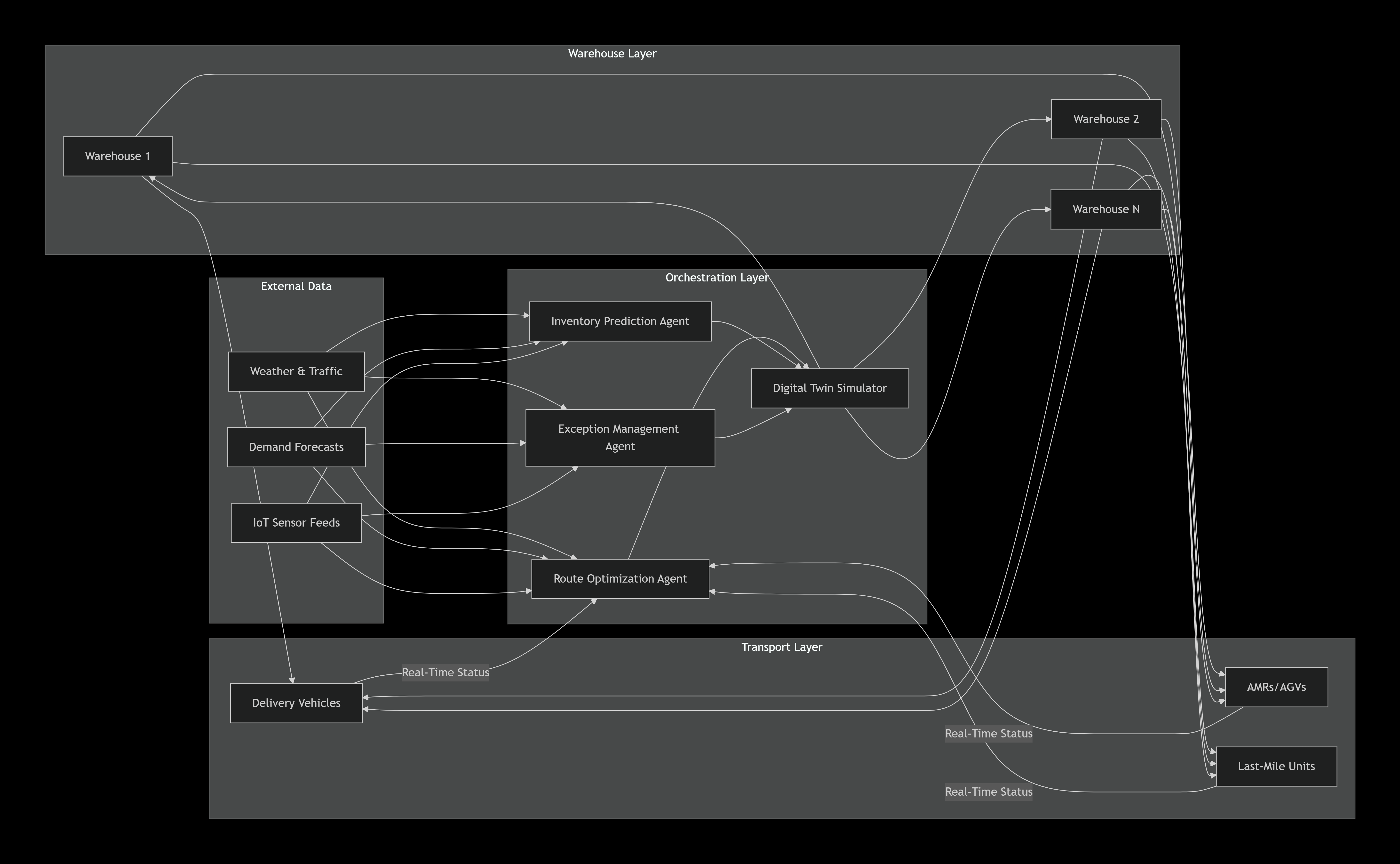
The response is a distributed, multi-agent architecture where decision-making shifts from a single hub to individual nodes: warehouses, transport units, hubs, and even individual orders. In this model, each node operates with autonomy, making local decisions based on real-time data while participating in a coordinated network governed by AI-driven interaction rules.
Multi-Agent Systems and Swarm Intelligence
Multi-agent systems underpin this transformation. Each agent—whether a warehouse, a delivery vehicle, an order, or even a cargo unit—has its own objectives and constraints, and the ability to interact with others through machine learning-optimized protocols. Vehicles reroute around congestion without waiting for central approval. Warehouses reprioritize shipments based on changing demand. Distribution centers adapt schedules in real time.
Swarm intelligence takes this concept further. Inspired by biological systems—ants finding optimal paths, bees allocating foraging resources—swarm algorithms enable logistics networks to self-organize toward optimal states. As one analysis notes, AI development is moving logistics from strict management to coordination and rule-based models, where the system’s intelligence emerges from local interactions rather than top-down commands.
Warehouse Automation: From Reactive to Predictive
Warehouse operations represent the front line of logistics automation. Warehouse picking alone consumes up to 50% of working hours in a typical fulfillment operation. According to industry data, 55% of supply chain leaders are increasing technology investments, and 45% plan automation equipment purchases within the next three years. The message is clear: warehouses still relying primarily on manual labor are falling behind.
What makes 2026 different from previous years is not merely the volume of robots being deployed but how those robots are managed. Real-time orchestration of robotics fleets—where a central system dynamically assigns tasks across multiple automated units—delivers far greater efficiency than standalone machines working independently.
The technical stack includes autonomous mobile robots (AMRs) guided by orchestration software, computer vision systems performing zero-touch quality checks, AI-powered exception management that prioritizes urgent tasks, automated returns processing, and predictive labor scheduling based on order volume forecasts. Together, these capabilities enable warehouses to move from reactive inventory management to predictive control, aligning stock levels with actual demand across all channels.
Generative AI and Demand Forecasting
Generative AI is reshaping supply chain management across multiple dimensions. Applied to demand forecasting, generative models analyze large quantities of historical data to identify patterns, streamline predictions, and accelerate informed decision-making—reducing the twin risks of overstocking and stockouts.
In last-mile route optimization, generative AI scours news and weather conditions in real time to calculate the most efficient routes while accounting for delivery priority, traffic patterns, and potential disruptions. The result is not merely cost savings but fundamentally improved customer satisfaction—packages arrive when promised, with fewer exceptions and delays.
The Autonomous Supply Chain Vision
The long-term vision is a fully autonomous supply chain where AI agents not only execute tasks but anticipate and respond to disruptions before they impact operations. Early implementations demonstrate the feasibility of this approach. One autonomous supply chain orchestrator deploys an AI agent that proactively monitors global news and weather feeds to identify threats before cargo reaches bottlenecks, effectively building self-healing resilience into the logistics network.
When combined with real-time digital twins—virtual representations of physical warehouses that update continuously from sensor and robot data—these systems achieve unprecedented visibility. Autonomous robots can now scan over 10,000 pallet locations per hour, feeding real-time inventory data into digital twins that optimize space utilization, traffic flow, and labor allocation. The warehouse becomes a continuously aware environment rather than a space that reacts after issues arise.
Part III: Healthcare — From Reactive Care to Intelligent Clinical Systems
The Transformation Imperative
Healthcare presents both the greatest opportunity and the most significant challenge for AI automation. The stakes are unlike those in finance or logistics: errors can literally cost lives. Yet the inefficiencies are staggering. Clinicians spend as much as half their time on documentation rather than patient care. Diagnostic errors remain a leading cause of morbidity. Administrative bottlenecks delay critical care delivery.
AI is addressing these challenges across three primary fronts: clinical documentation and workflow automation, medical imaging and diagnostic support, and patient monitoring and follow-up care. The healthcare segment is expected to grow at the fastest CAGR of any industry—36.0% through 2033—reflecting both the depth of need and the accelerating pace of regulatory approval.
Agentic Documentation and Clinical Reasoning
The shift from reactive transcription to agentic AI represents a fundamental change in how clinical work gets done. Traditional medical documentation systems are passive—they transcribe, structure, and store information after clinical events occur. Agentic AI, by contrast, introduces systems that can set goals, perform multi-step reasoning, and take autonomous actions within defined clinical and regulatory constraints.
Modern agentic documentation systems maintain contextual memory across time, systems, and clinical events. Rather than operating on isolated prompts, these systems continuously update internal memory through a perceive-reason-act loop, allowing each clinical action to refine subsequent reasoning. The result is a system that can synthesize longitudinal patient data, real-time operational constraints, and clinical guidelines into case-specific insights.
The market reflects this momentum. Agentic AI in healthcare reached $538.5 million in 2024 and is projected to expand at a CAGR of 45.56% through 2030. For healthcare leaders, this represents a strategic opportunity to deliver faster, safer, and more personalized care without adding operational burden to clinicians.
FHIR-Native Integration Architecture
A critical enabler of healthcare AI is the emergence of FHIR-native architectures. Health information exchanges built on FHIR (Fast Healthcare Interoperability Resources) provide standardized data models and APIs that AI systems can leverage without custom integration.
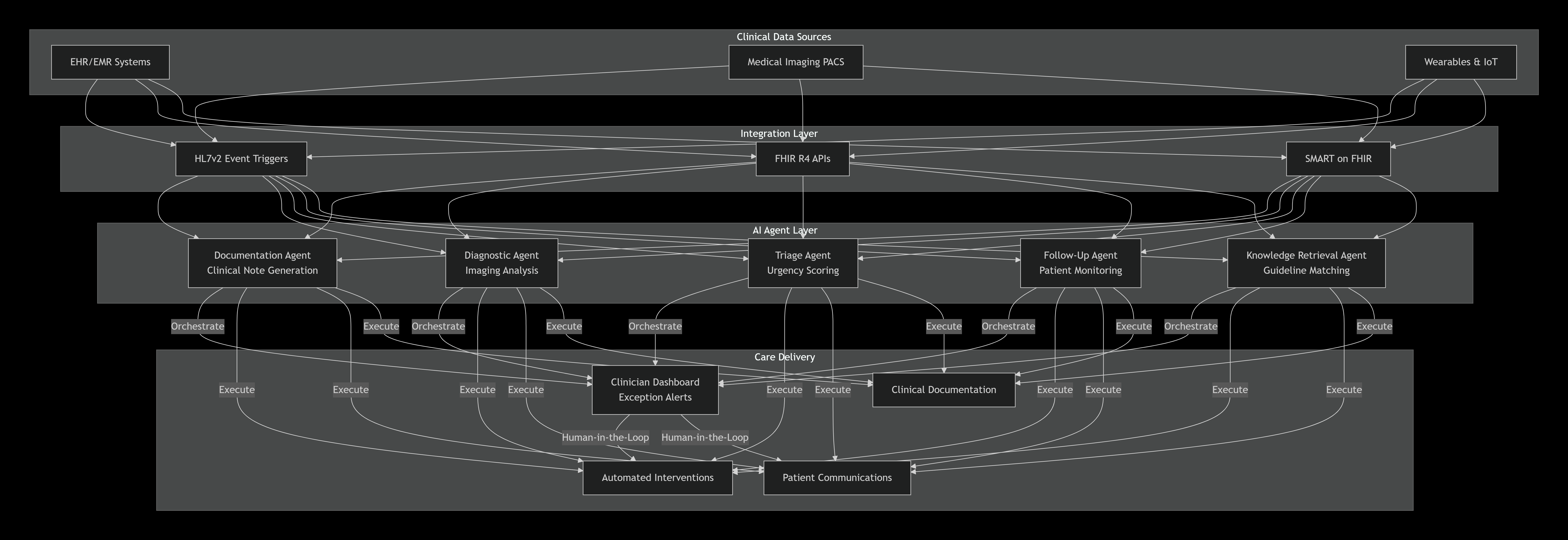
One mature example illustrates the architecture. A voice AI platform for automated patient follow-up integrates with Epic (the leading electronic health record system) through three standard protocols. HL7v2 event triggers provide real-time clinical notifications—when a patient is discharged, the system knows immediately. FHIR R4 APIs retrieve patient context including diagnoses, procedures, and active medications. And SMART on FHIR delivers an embedded clinician interface that requires no additional login or system switching.
This three-layer architecture enables fully autonomous post-discharge follow-up workflows. The backend engine receives discharge events, retrieves patient data, initiates automated calls or messages, and writes structured clinical notes back into the patient chart—all without any clinician action. When exceptions arise, alerts appear directly in the clinician’s existing Epic dashboard, ensuring human oversight at the appropriate points.
Medical Imaging: The FDA-Approval Frontier
Medical imaging represents the most mature and heavily regulated application of AI in healthcare. By mid-2025, the FDA had added 115 radiology AI algorithms to its approved list, bringing the total to approximately 873 cleared tools across all specialties. Medical imaging is the single largest AI target among medical specialties.
The clinical impact is measurable.
Deep learning-based AI enhances diagnostic performance across multiple domains, with particularly significant benefits for less experienced radiologists. In one study of Parkinson’s disease detection using MRI, AI assistance improved specificity from 0.86 to 0.94 in the least experienced reader group, while inter-reader agreement increased from kappa 0.73 to 0.87. The net reclassification index demonstrated improvement of 12.8% for less experienced readers, compared to 0.8% for experienced readers—suggesting that AI serves as a powerful leveling tool, bringing less-experienced clinicians up to near-expert performance.
Beyond diagnostic accuracy, AI enables workflow transformation.
Automated triage platforms prioritize urgent cases, reducing stroke treatment response time by an average of 66 minutes in one platform study. AI-powered bone health assessment tools can identify undiagnosed osteoporosis patients from standard X-rays, while fetal ultrasound analysis platforms automate real-time identification of standard views, enhancing diagnostic accuracy and efficiency.
Experts emphasize, however, that AI is augmenting rather than replacing radiologists. Human oversight remains essential for complex cases, error detection, and legal accountability.
Multi-Agent Clinical Systems
The most advanced healthcare AI implementations employ multi-agent architectures rather than single-model approaches. Consider a pocket clinical co-pilot that combines specialized agents for different tasks. One agent extracts clinical concepts from patient descriptions. Another scores urgency using PubMedBERT classifiers. A third performs local vector search of WHO and CDC guidelines. A fourth provides medical reasoning synthesis. Together, these agents orchestrate a comprehensive triage workflow that would be impossible for any single model to perform reliably.
This multi-agent approach addresses a fundamental challenge in healthcare AI: the need for hallucination-free, grounded clinical intelligence. By separating knowledge retrieval from reasoning generation, and by sourcing medical guidelines from authoritative databases rather than general web content, these systems provide recommendations that are both intelligent and clinically trustworthy.
Part IV: Cross-Industry Architecture and Future Trajectories
The Common Architectural Patterns
Despite their domain differences, finance, logistics, and healthcare AI systems share common architectural principles:
Event-Driven, Real-Time Processing.
Across all three industries, batch processing is giving way to real-time event streams. Financial transactions, logistics events, and clinical notifications all require immediate response. Cloud-native, event-driven architectures using streaming platforms and serverless computing have become the standard foundation.
Multi-Agent Orchestration.
Single-model systems are being replaced by multi-agent architectures where specialized agents handle different sub-tasks while maintaining shared context. This pattern appears in fraud detection (supervised + unsupervised + GNN agents), logistics (warehouse + vehicle + order agents), and healthcare (triage + retrieval + reasoning agents).
Explainability and Governance.
Regulatory compliance demands transparency. Explainable AI techniques, audit trails, and human-in-the-loop safeguards are not optional—they are foundational requirements. In finance, regulators need to understand why a transaction was blocked. In healthcare, clinicians need confidence in diagnostic recommendations. In logistics, operators need to trace decision provenance.
Human-AI Collaboration.
None of these systems aims to eliminate human workers. Instead, they automate routine tasks while escalating exceptions and complex judgments to human experts. The most successful deployments recognize that AI augments rather than replaces human expertise.
Challenges and Implementation Barriers
Despite rapid progress, significant barriers remain. High implementation costs—including software, hardware, infrastructure, and skilled workforce—remain prohibitive for many organizations, particularly small and medium enterprises. Integrating AI into existing business processes often requires tailored solutions and extensive training.
Regulatory and compliance challenges also represent a major threat.
Governments worldwide are implementing stringent rules on data privacy, AI ethics, and automated decision-making. Financial institutions face compliance demands that vary across jurisdictions. Healthcare AI must navigate FDA approval processes that can take years. Logistics companies must comply with customs regulations and cross-border data transfer restrictions.
Data quality and integration present additional hurdles.
AI systems are only as good as the data they consume. Organizations with fragmented legacy systems, siloed data, or poor data governance will struggle to derive value from AI automation.
Future Trajectories
Looking toward 2033, several trajectories are clear:
Agentic AI will become pervasive.
Organizations will shift from experimenting with individual use cases to redesigning how work gets done across the enterprise. The question will shift from “Where can we apply AI?” to “What parts of our workflow should remain human-executed?”
Edge AI will reduce latency.
As 5G and edge computing mature, more AI processing will move to the point of action. Fraud detection will happen on payment terminals. Route optimization will occur within delivery vehicles. Clinical decision support will run on portable devices without cloud dependency.
Regulatory frameworks will mature.
The EU AI Act, FDA pre-certification programs, and emerging international standards will create clearer pathways for compliant AI deployment. Organizations that build governance into their AI architectures from the start will have significant advantages.
Cross-industry convergence will accelerate.
Techniques developed in finance for real-time fraud detection will inform logistics security systems. Logistics route optimization algorithms will improve healthcare patient flow. Healthcare diagnostic reasoning models will enhance financial risk assessment. The boundaries between industries will blur as foundational AI capabilities become commoditized.
Conclusion
AI-powered automation is not a future prediction—it is the present reality. Finance, logistics, and healthcare are all in the midst of transformation driven by intelligent systems that can reason, learn, and act with minimal human intervention. The organizations leading this transformation share common characteristics: they have invested in modern, cloud-native data architectures; they have embraced multi-agent workflows over single-model approaches; and they have built governance and explainability into their systems from the ground up.
The gap between leaders and laggards is widening. Organizations that delay AI adoption risk not merely incremental inefficiency but fundamental competitive disadvantage. As the 10x Banking report notes, 2026 won’t be about small steps—it will be about structural shifts that redefine how industries compete. The choices institutions make in the coming years will set the trajectory for the next era of their industries.
For finance leaders, the imperative is clear: move beyond incremental improvements to full workflow redesign. For logistics operators, the opportunity lies in distributed, self-organizing networks that adapt in real time. For healthcare providers, the promise is faster, safer, more personalized care delivered without adding burden to overstretched clinicians.
AI-powered automation delivers measurable value today. The question is no longer whether to adopt it—but how quickly and how comprehensively.
References
10x Banking. (2026). Trends Report 2026: Banking in Real Time.
Stratistics MRC. (2025). Global AI-Driven Automation Market Forecasts to 2032.
Grand View Research. (2025). AI Automation Market Size Report 2026-2033.
Deloitte. (2025). Finance Trends 2026: Financial Services Perspective.
PwC. (2026). Unlocking Tomorrow: Agentic AI for Financial Services.
Penaganti, R. (2025). “AI-Driven Fraud Detection in Financial Systems: A Technical Deep Dive.” Journal of Information Systems Engineering and Management.
Aloul, F. (2025). “AI-Driven Cloud-Native Enterprise Architecture for Secure Financial Systems.” IJCTECE.
ParcelPlanet. (2026). Logistics Trends in 2026: The E-Commerce Manager’s Guide.
PixelBurn. (2026). “AI in Logistics: How Distributed Algorithms Transform Supply Chains.”
Mantis Group. (2026). “How AI Will Shape the Future of Warehouse Management Systems.”
Sunasterisk Global. (2026). “AI Agents in Healthcare: How Agentic Documentation Powers Clinical Reasoning.”
Tucuvi. (2026). “How AI Integrates with Epic: Automated Post-Discharge Follow-Up.”
Kim et al. (2025). “Effect of Deep Learning-Based AI on Radiologists’ Performance.” Korean Journal of Radiology.
Laurent, A. (2025). “AI in Radiology: 2025 Trends, FDA Approvals & Adoption.”
IntuitionLabs. (2025). AI in Radiology: 2025 Trends, FDA Approvals & Adoption.
MediAI Devpost. (2026). “MediAI: Pocket Clinical Co-pilot.”