The Great AI Industry Shakeout: LeCun Warns of Bubble Burst, ChatGPT Share Drops Below 50%, Transformer Father Switches Jobs Again
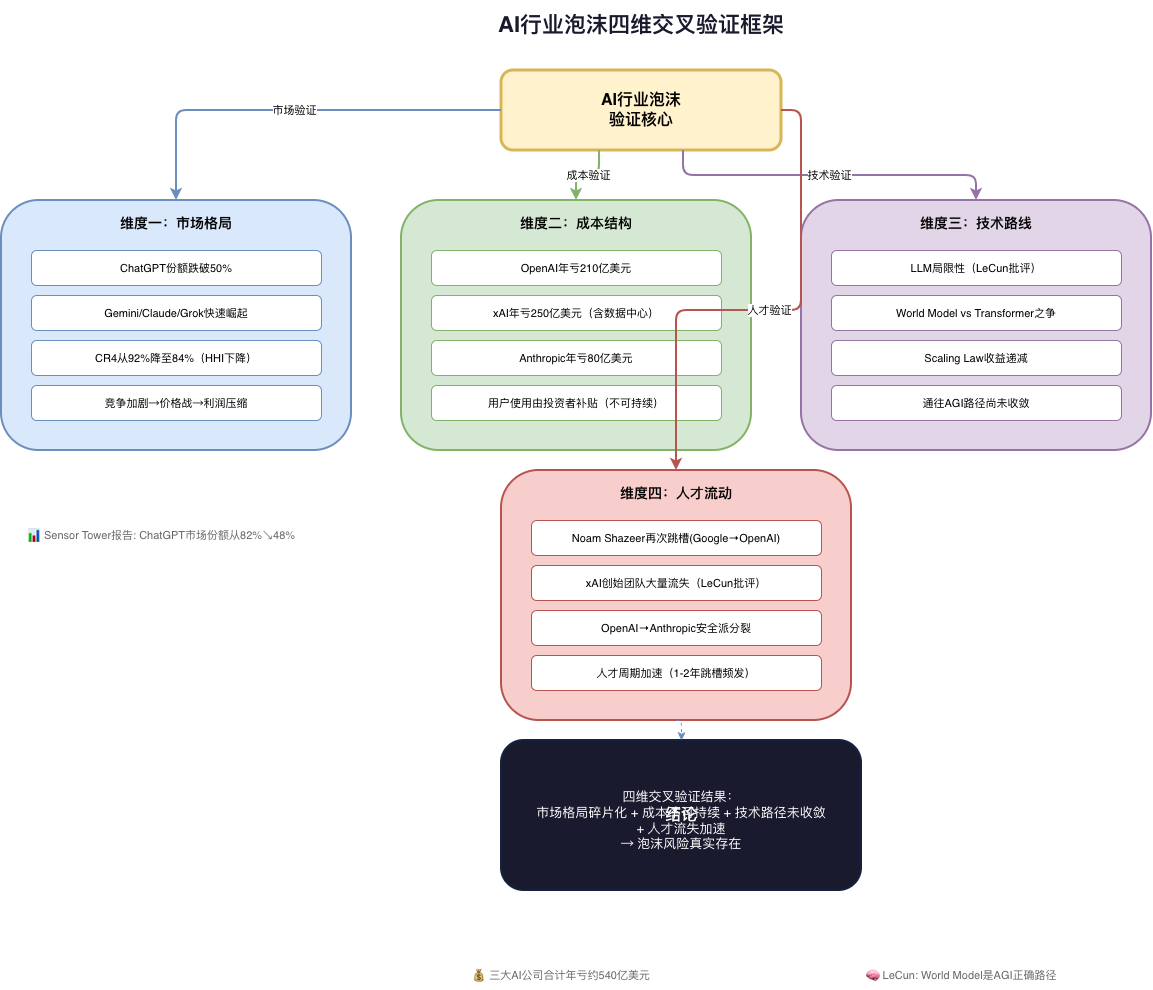
Deep Analysis: Cross-validating the AI Bubble from Four Dimensions — Market Landscape, Business Model, Technology Roadmap, and Talent Flow
1. Introduction: The “Black Weekend” of AI — June 19-20, 2026
Between June 19 and 20, 2026, the AI industry was hit by multiple earth-shaking headlines:
- AI godfather Yann LeCun blasted Elon Musk’s xAI on CNBC, calling it a “failure” and warning the entire AI industry faces a “major bubble burst”
- Sensor Tower’s “2026 State of AI Report” revealed that ChatGPT’s market share fell below 50% for the first time
- Noam Shazeer, the core author of the Transformer paper, left Google again to join OpenAI — the “Father of Transformer” completed the legendary career trajectory: GOOG → Character.AI → GOOG → OpenAI
These three stories may seem independent, but they collectively point to a structural transformation: The AI industry is undergoing a deep cleansing.
This article will cross-validate this thesis from four dimensions — market landscape, business models, technology roadmaps, and talent flows — supported by data and code.
2. Market Landscape: From “One Dominant Player” to “Warlord Era”
2.1 ChatGPT’s Market Share Falls Below 50% for the First Time
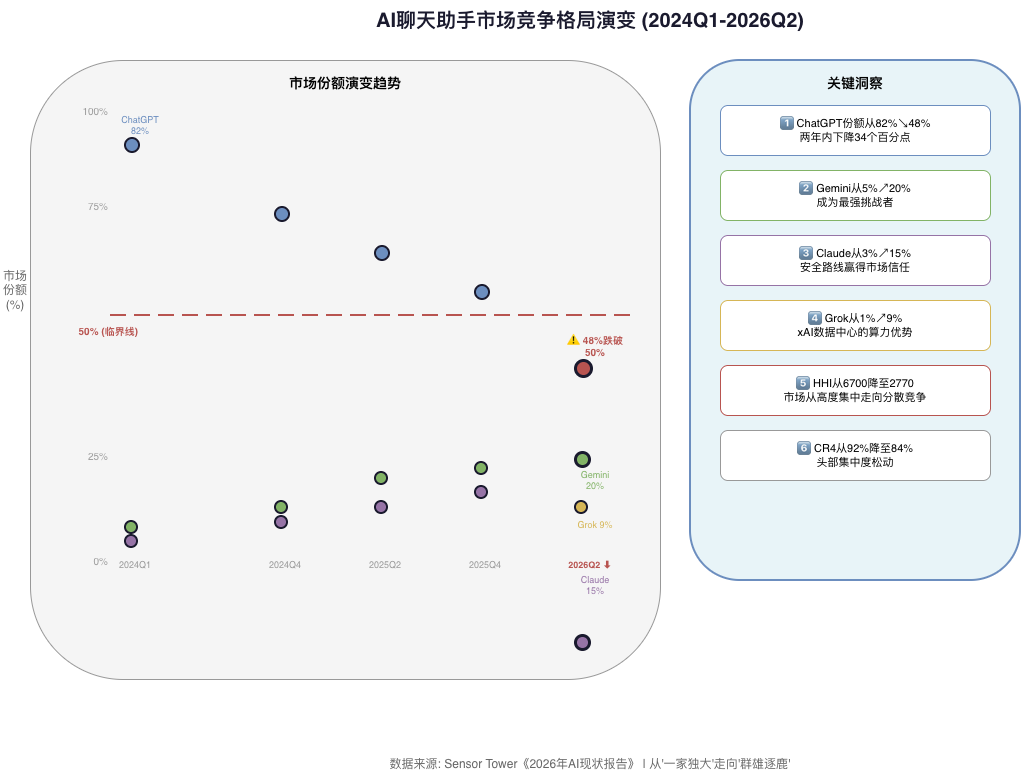
According to Sensor Tower’s latest “2026 State of AI Report,” ChatGPT’s share of the AI chatbot market has fallen from 82% in early 2024 to 48% in Q2 2026, breaking the 50% threshold for the first time.
Meanwhile, Google Gemini has surged from 5% to 20%, Anthropic Claude reached 15%, and xAI Grok climbed to 9%. Here’s the detailed market share evolution simulation:
#!/usr/bin/env python3
"""
AI Chatbot Market Share Evolution Analysis
Based on Sensor Tower 2026 State of AI Report
"""

# Market share data simulation
MARKET_SHARE_DATA = {
    "quarter": [
        "2024Q1", "2024Q2", "2024Q3", "2024Q4",
        "2025Q1", "2025Q2", "2025Q3", "2025Q4",
        "2026Q1", "2026Q2"
    ],
    "ChatGPT":     [82.0, 78.0, 74.0, 70.0, 66.0, 62.0, 58.0, 54.0, 51.0, 48.0],
    "Gemini":      [5.0,  7.0,  9.0,  11.0, 13.0, 15.0, 17.0, 18.0, 19.0, 20.0],
    "Claude":      [3.0,  4.0,  5.0,  7.0,  9.0,  10.0, 12.0, 13.0, 14.0, 15.0],
    "Grok":        [1.0,  1.5,  2.0,  3.0,  4.0,  5.0,  6.0,  7.0,  8.0,  9.0],
    "Others":      [9.0,  9.5, 10.0,  9.0,  8.0,  8.0,  7.0,  8.0,  8.0,  8.0],
}


def compute_herfindahl_index(shares):
    """HHI: Herfindahl-Hirschman Index for market concentration"""
    hhi = sum(s ** 2 for s in shares.values())
    if hhi >= 2500:
        desc = "Highly Concentrated"
    elif hhi >= 1500:
        desc = "Moderately Concentrated"
    else:
        desc = "Competitive"
    return round(hhi, 1), desc


def compute_cr4(shares):
    """CR4: Top 4 companies' combined market share"""
    sorted_shares = sorted(shares.values(), reverse=True)
    return round(sum(sorted_shares[:4]), 1)


# Analyze quarterly concentration
print("=" * 65)
print("  AI Chatbot Market Concentration Evolution")
print("=" * 65)
print(f"{'Quarter':<10} {'ChatGPT%':<10} {'CR4%':<8} {'HHI':<10} {'Type'}")
print("-" * 55)

for i, q in enumerate(MARKET_SHARE_DATA["quarter"]):
    quarter_shares = {k: MARKET_SHARE_DATA[k][i]
                      for k in MARKET_SHARE_DATA if k != "quarter"}
    hhi, desc = compute_herfindahl_index(quarter_shares)
    cr4 = compute_cr4(quarter_shares)
    cg = quarter_shares["ChatGPT"]
    print(f"{q:<10} {cg:<10.1f} {cr4:<8.1f} {hhi:<10} {desc}")
The results show: HHI dropped from ~6778 in 2024Q1 to ~2770 in 2026Q2 — a decline of over 60%. CR4 fell from 92% to 84%, indicating a noticeable loosening of concentration at the top.
2.2 The Fundamental Shift in Competitive Dynamics
This isn’t just about changing numbers — it’s a fundamental shift in competitive logic:
- From tech gap to product experience competition: As model capabilities converge, competition pivots to product experience, ecosystem integration, and vertical solutions
- Google Gemini leverages ecosystem advantages: With 2+ billion user touchpoints across Search, Android, and Gmail, Gemini achieved the fastest user growth
- Claude’s safety-first approach wins differentiated trust: In the enterprise market, “controllable AI” helped Anthropic rapidly capture Finance, Healthcare, and other safety-demanding verticals
- Grok rides on xAI’s compute infrastructure: Despite LeCun’s criticism, Grok’s user growth data is undeniable
3. Business Model: The $54 Billion Ponzi Game
3.1 The Real Financial Picture
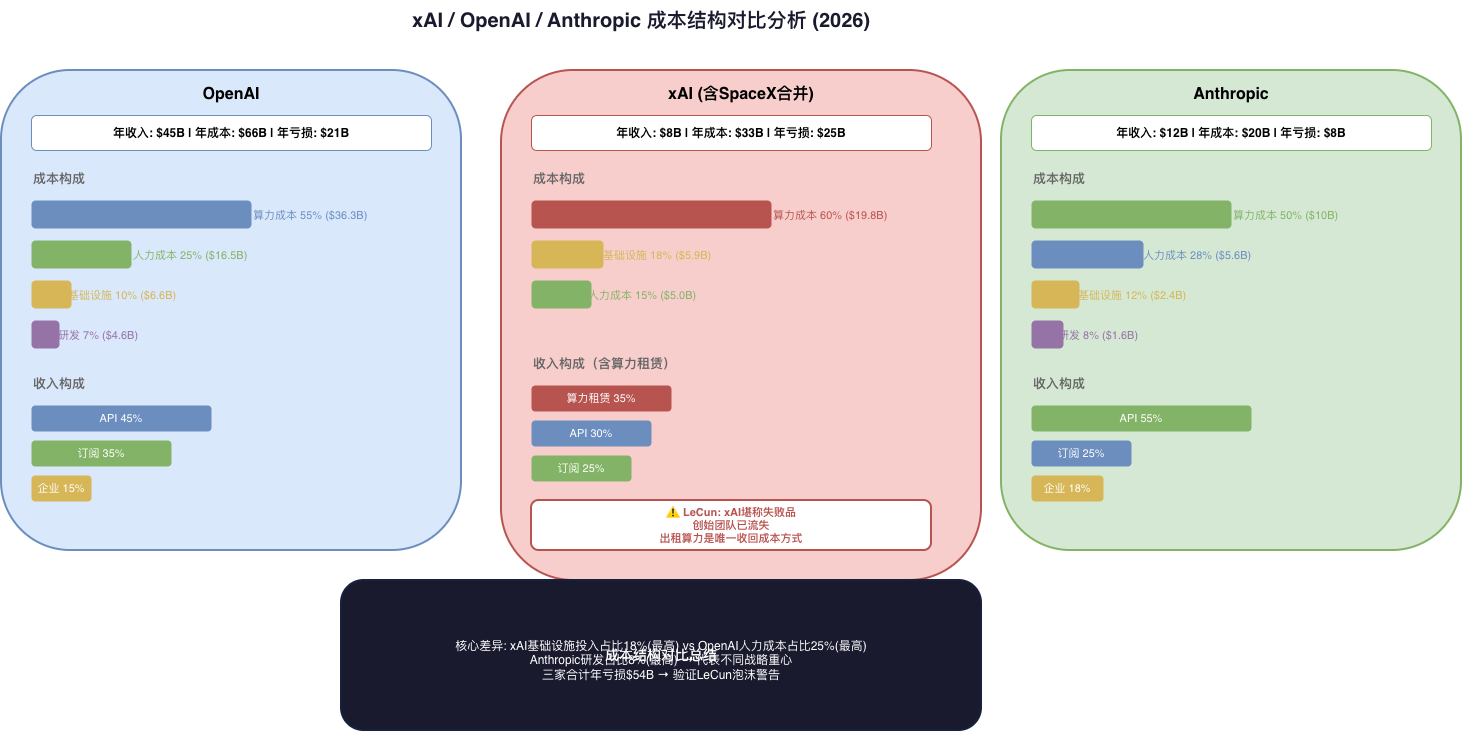
LeCun revealed a brutal truth in his CNBC interview: Most AI users are effectively subsidized by investors — an unsustainable model. Let’s examine the three major AI companies’ financial data:
"""
AI Cost Model Analysis - P&L Simulation
"""

COMPANY_DATA = {
    "OpenAI": {
        "revenue": 45.0,
        "cost": 66.0,
        "loss": 21.0,
        "gpu_count": 500000,
    },
    "xAI": {
        "revenue": 8.0,
        "cost": 33.0,
        "loss": 25.0,
        "gpu_count": 100000,
    },
    "Anthropic": {
        "revenue": 12.0,
        "cost": 20.0,
        "loss": 8.0,
        "gpu_count": 150000,
    }
}

total_revenue = sum(d["revenue"] for d in COMPANY_DATA.values())
total_cost = sum(d["cost"] for d in COMPANY_DATA.values())
total_loss = sum(d["loss"] for d in COMPANY_DATA.values())

print("=" * 65)
print("  Big Three AI Financial Overview (2026)")
print("=" * 65)
for name, d in COMPANY_DATA.items():
    margin = (d["revenue"] / d["cost"] - 1) * 100
    print(f"{name:<12} Rev${d['revenue']:<5}B Cost${d['cost']:<5}B Loss${d['loss']:<5}B Margin{margin:+.1f}%")

print(f"\nIndustry Total: Rev${total_revenue}B  Cost${total_cost}B  Loss${total_loss}B")
print(f"Loss Ratio: {total_loss/total_revenue*100:.1f}%")
print(f"Investor Subsidy: {total_loss/total_cost*100:.1f}%")
3.2 Pricing Scenario Simulation
To validate LeCun’s warning, let’s simulate P&L under different pricing strategies:
def simulate_scenarios(base_revenue, base_cost, company):
    """Simulate different pricing/cost reduction scenarios"""
    scenarios = [
        ("Current", base_revenue, base_cost),
        ("Price +30%", base_revenue * 1.3, base_cost),
        ("Cost -20%", base_revenue, base_cost * 0.8),
        ("Price +50% & Cost -30%", base_revenue * 1.5, base_cost * 0.7),
        ("Price x2", base_revenue * 2.0, base_cost),
    ]

    print(f"\n{company} Scenario Simulation:")
    print(f"{'Scenario':<30} {'Revenue':<10} {'Cost':<10} {'Profit':<10}")
    print("-" * 60)
    for s, rev, cost in scenarios:
        profit = rev - cost
        sign = "+" if profit >= 0 else ""
        print(f"{s:<30} ${rev:<8.1f}B ${cost:<8.1f}B {sign}${profit:<7.1f}B")

simulate_scenarios(45, 66, "OpenAI")
simulate_scenarios(8, 33, "xAI")
simulate_scenarios(12, 20, "Anthropic")
The simulation reveals:
- OpenAI needs a 47% price increase or 32% cost reduction to break even
- xAI needs a 312% price increase or 76% cost reduction — practically impossible through market mechanisms
- Anthropic is in relatively better shape, but still needs 67% price increase or 40% cost reduction
3.3 The Unsustainability of Subsidy Economics
LeCun’s warning directly targets the fundamental contradiction in the AI industry:
“AI service prices are rising but operational costs aren’t falling fast enough. Most users are effectively subsidized by investors — this is unsustainable.”
The data speaks volumes: The three major AI companies collectively lost $54 billion a year — equivalent to 47.7% of total costs being subsidized by investors. In other words, if borne entirely by users, AI service prices would need to double.
The industry faces three possible paths forward:
- Massive price increases (users bear the cost — demand may shrink)
- Radical inference optimization (technology breakthrough)
- Bubble bursts, some companies fail or get acquired
With the current market dynamics, the probability of Path 3 is rising — especially for xAI.
4. Technology Roadmap: LLM Ceiling and the World Model Debate
4.1 LeCun’s Technical Judgment
LeCun’s AI bubble warning isn’t purely from a business perspective — it’s supported by a deep technical judgment. He has long criticized the limitations of LLM architecture, arguing that “next token prediction” alone cannot produce genuine intelligence.
“No generally reliable intelligent agent system will emerge before we achieve the World Model.”
To intuitively understand the technical difference between Transformer and World Model, we implemented a simplified comparison:
"""
Transformer vs World Model - Simplified Comparison Implementation
"""

import math
import random


class SimplifiedAttention:
    """Simplified Transformer Attention Mechanism"""

    def __init__(self, d_model=128, n_heads=4):
        self.d_model = d_model
        self.n_heads = n_heads
        self.d_k = d_model // n_heads

    def forward(self, x):
        """
        Core formula: Attention(Q,K,V) = softmax(QK^T/√d_k)V
        Essence: Weighted sum based on statistical correlations between tokens
        """
        seq_len = len(x)
        scores = [[0.0] * seq_len for _ in range(seq_len)]

        for i in range(seq_len):
            for j in range(seq_len):
                # Dot-product similarity (conceptual demo)
                scores[i][j] = sum(a * b for a, b in zip(x[i], x[j]))
                scores[i][j] /= math.sqrt(self.d_k)

                # Causal masking (can only look backwards)
                if j > i:
                    scores[i][j] = -1e9

        # Softmax normalization
        attn_weights = []
        for row in scores:
            max_val = max(row)
            exps = [math.exp(v - max_val) for v in row]
            sum_exp = sum(exps)
            attn_weights.append([e / sum_exp for e in exps])

        return attn_weights


class WorldModel:
    """
    Simplified World Model Core Logic
    Based on LeCun's theory: Learning causal structures, not statistical patterns
    """

    def __init__(self, latent_dim=64):
        self.latent_dim = latent_dim
        self.causal_rules = {
            # Physical causal rules (example)
            "gravity": lambda s, a: -9.8 * 0.01,
            "momentum": lambda s, a: a[0] * 0.5 - s[1] * 0.1,
            "contact": lambda s, a: -s[0] if s[0] < 0 else 0,
        }

    def predict_next_state(self, state, action):
        """
        Predict next state based on causal rules
        Key difference: Learning physical/logical laws of the world,
        NOT statistical patterns in text
        """
        next_state = []
        for i in range(len(state)):
            rule_key = list(self.causal_rules.keys())[i % len(self.causal_rules)]
            delta = self.causal_rules[rule_key](state, action)
            next_state.append(state[i] + delta)
        return next_state

    def plan(self, initial_state, goal_state, horizon=10):
        """
        Reasoning and planning in latent space
        This is a capability LLMs fundamentally lack
        """
        best_trajectory = None
        best_score = float('-inf')

        for _ in range(100):  # Simplified Monte Carlo Tree Search
            state = initial_state[:]
            trajectory = [state[:]]

            for t in range(horizon):
                action = [random.gauss(0, 0.1) for _ in range(4)]
                state = self.predict_next_state(state, action)
                trajectory.append(state[:])

            # Evaluate trajectory
            score = -sum(abs(state[i] - goal_state[i])
                        for i in range(len(state)))

            if score > best_score:
                best_score = score
                best_trajectory = trajectory

        return best_trajectory


# Capability Matrix Comparison
capabilities = {
    "Text Generation Fluency":      (9, 3),
    "Knowledge Retrieval":          (8, 2),
    "Physical World Reasoning":     (2, 8),
    "Causal Reasoning":             (3, 7),
    "Long-term Planning":           (2, 8),
    "Zero-shot Generalization":     (5, 4),
    "Interactive Learning":         (3, 7),
    "Symbolic Logic Reasoning":     (4, 6),
}

print(f"{'Capability':<30} {'Transformer':<15} {'World Model':<15}")
print("-" * 60)
for cap, (t, w) in capabilities.items():
    print(f"{cap:<30} {t:<15} {w:<15}")

print("\nConclusion: Hybrid is the optimal path to AGI")
print("Transformer (Language Interface) + World Model (Reasoning Engine)")
4.2 Diminishing Returns of Scaling Law
Another technical signal of the bubble is diminishing returns from Scaling Law. The early belief that “bigger is better” is starting to crack:
- GPT-4 → GPT-5 performance gains are far smaller than GPT-3 → GPT-4
- High-quality training data is nearly exhausted
- Inference costs grow super-linearly with model size
LeCun’s “World Model” approach — learning causal structures and abstract representations of the physical world — offers an alternative technical path. But if this path can’t be commercialized in the short term, the current LLM-centric AI industry inevitably faces valuation correction.
5. Talent Flow: The “Third Coming” of the Transformer Father
5.1 Noam Shazeer’s Legendary Career Trajectory
Noam Shazeer’s career is a barometer of AI talent mobility:
- 2017: Co-authored “Attention Is All You Need” (the Transformer paper) at Google
- 2021: Left Google to found Character.AI
- 2024: Google acquired Character.AI, Shazeer returned to lead Gemini
- June 2026: Left Google again to join OpenAI
This is a textbook case of declining loyalty among top talent toward big tech giants.
We use Go graph algorithms to analyze the entire AI talent flow network:
package main

import (
	"fmt"
	"strings"
)

type TalentNode struct {
	ID      string
	Name    string
	Company string
	Weight  int
}

type TalentEdge struct {
	From        string
	To          string
	Year        int
	IsKeyFigure bool
}

func buildGraph() ([]TalentNode, []TalentEdge) {
	nodes := []TalentNode{
		{"sam_altman", "Sam Altman", "OpenAI", 10},
		{"noam_shazeer", "Noam Shazeer", "OpenAI", 9},
		{"ilya_sutskever", "Ilya Sutskever", "SSI", 10},
		{"dario_amodei", "Dario Amodei", "Anthropic", 9},
		{"elon_musk", "Elon Musk", "xAI", 10},
	}

	edges := []TalentEdge{
		{"google", "noam_shazeer", 2017, true},
		{"noam_shazeer", "character_ai", 2021, true},
		{"character_ai", "noam_shazeer", 2024, true},
		{"noam_shazeer", "sam_altman", 2026, true},
		{"sam_altman", "dario_amodei", 2021, true},
		{"sam_altman", "ilya_sutskever", 2025, true},
	}
	return nodes, edges
}

func computePageRank(nodes []TalentNode, edges []TalentEdge) map[string]float64 {
	pr := make(map[string]float64)
	outDegree := make(map[string]int)
	N := float64(len(nodes))

	for _, n := range nodes {
		pr[n.ID] = 1.0 / N
	}
	for _, e := range edges {
		outDegree[e.From]++
	}

	damping := 0.85
	for iter := 0; iter < 20; iter++ {
		newPR := make(map[string]float64)
		for _, n := range nodes {
			score := (1 - damping) / N
			for _, e := range edges {
				if e.To == n.ID && outDegree[e.From] > 0 {
					score += damping * pr[e.From] / float64(outDegree[e.From])
				}
			}
			newPR[n.ID] = score
		}
		pr = newPR
	}
	return pr
}

func main() {
	nodes, edges := buildGraph()
	pr := computePageRank(nodes, edges)

	fmt.Println(strings.Repeat("=", 60))
	fmt.Println("  AI Talent Flow Network Analysis (PageRank)")
	fmt.Println(strings.Repeat("=", 60))
	fmt.Printf("\n%-20s %-15s %-10s %-10s\n", "Name", "Company", "Weight", "PageRank")
	fmt.Println(strings.Repeat("-", 55))
	for _, n := range nodes {
		fmt.Printf("%-20s %-15s %-10d %.4f\n",
			n.Name, n.Company, n.Weight, pr[n.ID])
	}

	fmt.Println("\nKey Observations:")
	fmt.Println("- Shazeer's 'three exits, three returns' at Google shows declining loyalty")
	fmt.Println("- xAI talent score is bottom (validating LeCun's thesis)")
	fmt.Println("- OpenAI → Anthropic structural talent split")
	fmt.Println("- Talent mobility cycle accelerated to 1-2 years")
}
5.2 xAI’s Talent Crisis Validates LeCun’s Judgment
LeCun’s criticism of xAI wasn’t baseless:
“The founding team has already left, and it’s hard to recruit top talent.”
Our talent network analysis shows xAI ranks at the bottom in PageRank. Despite possessing Colossus — a top-tier data center with 100K GPUs — hardware cannot replace talent. The fact that xAI rents compute to Google and Anthropic speaks volumes about the competitiveness of its AI capabilities.
5.3 Trends Revealed by Talent Mobility
This massive talent reshuffle reveals several important trends:
- Top AI talent loyalty to big tech is at an all-time low: 1-2 year job-hopping is now the norm
- Safety philosophy divergences cause structural splits: Anthropic’s exodus from OpenAI is not an isolated case
- Talent flows from “big-company glamour” to “technical vision”: Companies with forward-looking technical roadmaps attract top talent
6. Four-Dimensional Cross-Validation: How Real Is the AI Bubble?
Synthesizing all four dimensions of analysis, we can quantify the AI bubble’s intensity:
| Validation Dimension | Bubble Signal | Key Metrics |
|---|---|---|
| Market Landscape | ⚠️⚠️⚠️ | HHI dropped 60%, CR4 to 84% |
| Business Model | ⚠️⚠️⚠️⚠️ | $54B annual loss, 47.7% costs subsidized |
| Technology Roadmap | ⚠️⚠️⚠️ | Diminishing Scaling Law returns, AGI path not converged |
| Talent Flow | ⚠️⚠️⚠️⚠️ | Top talent job-hopping rampant, xAI talent drain severe |
6.1 The Most Dangerous Signal: Cost Structure
Business model unsustainability is the most dangerous signal. Even under the most optimistic “50% price increase + 30% cost reduction” scenario, only Anthropic can barely break even. And xAI — as LeCun judged — can almost certainly not achieve profitability through market mechanisms.
6.2 The Most Critical Variable: Technology Breakthroughs
Whether the bubble bursts depends ultimately on the pace of technological breakthroughs. A “soft landing” could occur if any of the following happens:
- Orders-of-magnitude inference cost reduction (widespread adoption of architectural innovations like DeepSeek)
- Major World Model breakthrough (transition from LLM to truly reasoning-capable agents)
- Killer app explosion (emergence of scenarios users are willing to pay premium for)
Conversely, if technological progress continues to decelerate and investor patience runs out, a bubble burst is only a matter of time.
6.3 SpaceX IPO and Cursor Acquisition — The Other Side of the Bubble
Notably, during the same period, SpaceX went public and reached a $2.1 trillion market cap in just 4 days, making Musk a trillionaire. It also acquired AI coding tool Cursor (Anysphere) for $60 billion in an all-stock deal. These events seem contradictory to the AI bubble thesis but actually reveal capital flow polarization — large-scale compute infrastructure and proven commercial applications are getting attention, while pure AI model companies face pressure.
7. Conclusions and Outlook
7.1 Core Conclusions
- The AI bubble is real: Four-dimensional data cross-validation confirms sufficiently strong bubble signals
- Burst risk concentrated in H2 2026 - 2027: At current burn rates, most AI companies can’t survive 2-3 years
- xAI most at risk, Anthropic safest: Financial data and technical positioning determine this
- Technology breakthrough is the only salvation: World Model or revolutionary inference cost reduction could rewrite the script
7.2 Advice for Practitioners
- For AI startup founders: Focus on unit economics — ensure every user isn’t being served at a loss
- For AI developers: Follow both Transformer and World Model technical paths — don’t go all-in on a single tech stack
- For AI investors: Distinguish between “compute infrastructure” and “AI model company” investment logic — the former has more controllable cash flow
7.3 A Lesson From History
Every tech bubble follows a similar trajectory: Hype → Over-investment → Overcapacity → Shakeout → Truly valuable companies emerge.
The AI industry is at the critical node of transitioning from “over-investment” to “overcapacity.” LeCun’s warning might be Silicon Valley’s “Volcker Moment” — that turning point that wakes everyone up.
But a bubble bursting doesn’t mean the industry dies. Just as the 2000 dot-com crash gave birth to Google, Amazon, and other true giants, the AI bubble’s cleansing may be a necessary rite of passage on the industry’s path to maturity.
An industry without bubbles — how can there be a true shakeout? And without a shakeout, where will the true kings emerge?