The Era of AI Spending Money Has Arrived — Deep Dive into CAICT's 2026 Top 10 Agent Keywords and Agent Payment Protocols
When AI agents stop just “adding items to your cart” and actually pull out their wallet to pay for you — what does that mean?
1. Introduction: A Historic Signal
On June 18, 2026, the China Academy of Information and Communications Technology (CAICT) released its “2026 Top 10 Agent Keywords”, with “Agent Payment Protocol” appearing on the list for the first time, ranked 8th. This is not just another industry report entry — it signals that AI agents are evolving from information relay nodes into transaction execution entities.
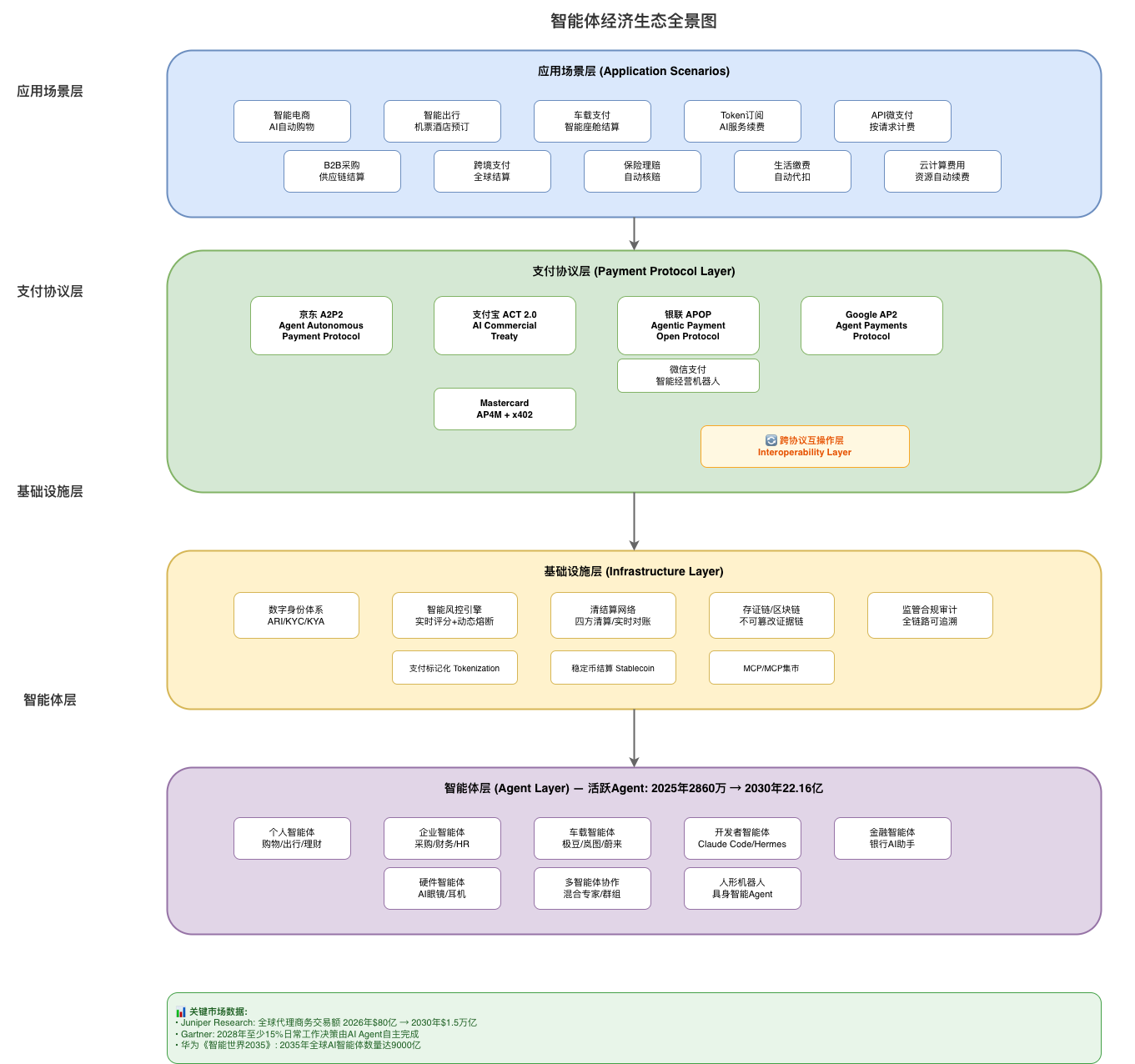
On the same day, Alipay’s “Abao” AI-native application officially launched, allowing users to invoke thousands of services with a single sentence. JD.com’s A2P2 protocol had been released just one week prior, and UnionPay’s APOP framework had already expanded to 19 domestic and international institutions. The payment giants are laying out their strategies almost simultaneously — not to capture a product category, but to pave the last mile of the AI economy.
This article provides an in-depth analysis of:
- A panoramic view of CAICT’s 2026 Top 10 Agent Keywords
- Technical architecture deep dive into the three major agent payment protocols
- Core code implementations (Go + Python)
- Market landscape and future outlook
2. CAICT 2026 Top 10 Keywords: Agents from “Usable” to “Excellent”
The 2026 Top 10 Agent Keywords are:
| # | Keyword | Core Meaning |
|---|---|---|
| 1 | Agent Infrastructure | Compute, storage, sandbox, dev-deploy integration |
| 2 | Agent Interconnection & Collaboration | Multi-agent swarm coordination via standard interfaces |
| 3 | Agent Engineering | Full lifecycle “production-grade engine” |
| 4 | Agent Learning & Evolution | From command-driven to self-growing capability leap |
| 5 | Agent Memory | Cross-session, cross-task context and experience management |
| 6 | Agent Skills | Callable, composable, reusable “capability atom library” |
| 7 | Agent Product Innovation | From dialog entry to diverse product systems |
| 8 | Agent Payment Protocol | New rule system for autonomous transactions |
| 9 | Agent Trustworthiness | Reliable generation, controllable execution, transparent decisions |
| 10 | Agent Full-Stack Evaluation | Capability-value-efficiency tripartite assessment |
These ten keywords trace a clear evolutionary path: Standalone operation → Swarm collaboration → Trusted value exchange. The “Agent Payment Protocol”, positioned at the closure of this loop, is the critical hub converting agent capabilities into economic value.
Definition and Characteristics
According to CAICT’s official interpretation, the Agent Payment Protocol is:
A new rule system designed for agent autonomous transactions, service invocation, and value exchange, significantly reducing the barriers and costs of automated payments while addressing the limitations of traditional payment systems in agent scenarios — restricted subject eligibility, ambiguous responsibility attribution, and inadequate dynamic term adaptation.
Its characteristics: Flexible rule configuration, transparent process, verifiable outcomes, and traceable accountability.
The revolutionary nature of this definition: Payment is no longer merely a technical optimization of “human pressing the confirm button”, but empowers agents to become genuine transaction subjects.
3. Three Major Payment Protocol Standards: A2P2 vs ACT 2.0 vs APOP
As of June 2026, China has formed three major agent payment protocol standards, each approaching this emerging domain from different dimensions.
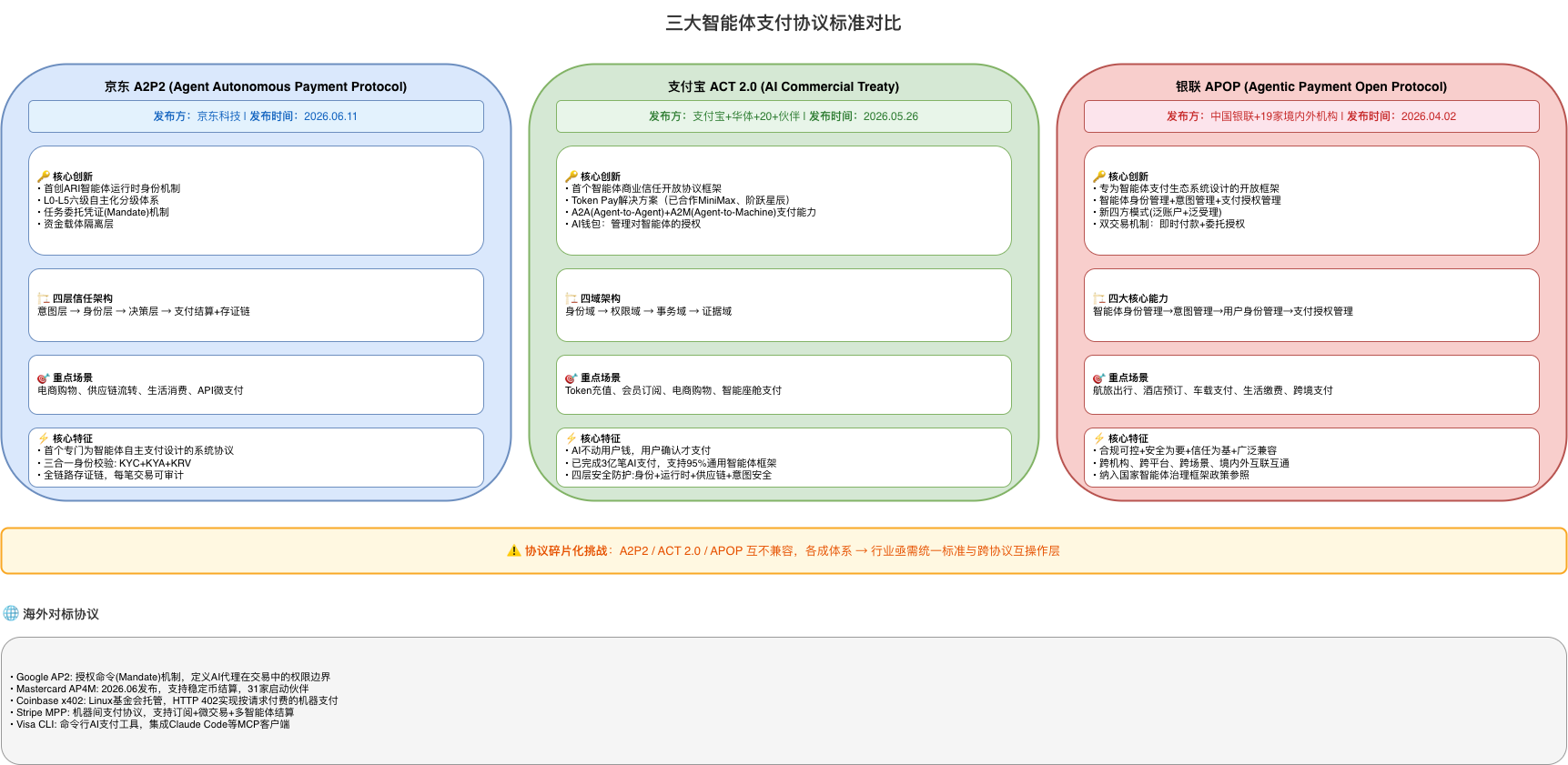
3.1 JD.com A2P2: China’s First Agent Autonomous Payment Protocol
Released: June 11, 2026
JD.com’s A2P2 (Agent Autonomous Payment Protocol) is China’s first systematic protocol specifically designed for agent autonomous payment. Its core technical innovations include:
L0-L5 Six-Level Autonomy Classification
Inspired by autonomous driving taxonomy, A2P2 divides agent payment autonomy into six levels:
| Level | Name | Description |
|---|---|---|
| L0 | Full Manual Confirmation | Every payment confirmed by user (current mainstream) |
| L1 | AI-Assisted Ordering | AI helps select, user confirms payment |
| L2 | Rule-Based Auto-Fill | AI fills info within preset rules, user confirms |
| L3 | Single-Task Autonomous | Agent initiates payment within task, system adjudicates |
| L4 | Range-Authorized Autonomous | Auto-payment when amount/scene/user within preset range |
| L5 | Full Autonomous Payment | Theoretical form, full fund discretion to AI |
JD.com focuses on the practical L3 and L4 levels.
Pioneering ARI (Agent Runtime Identity) Mechanism
The ARI mechanism binds three parties in real-time at payment moment:
- KYC (Know Your Customer): Confirm funds are borne by the user
- KYA (Know Your Agent): Confirm it’s the user’s authorized agent version
- KRV (Know Runtime Verification): Confirm the agent runs on a trusted device
All three conditions must be satisfied for payment to proceed.
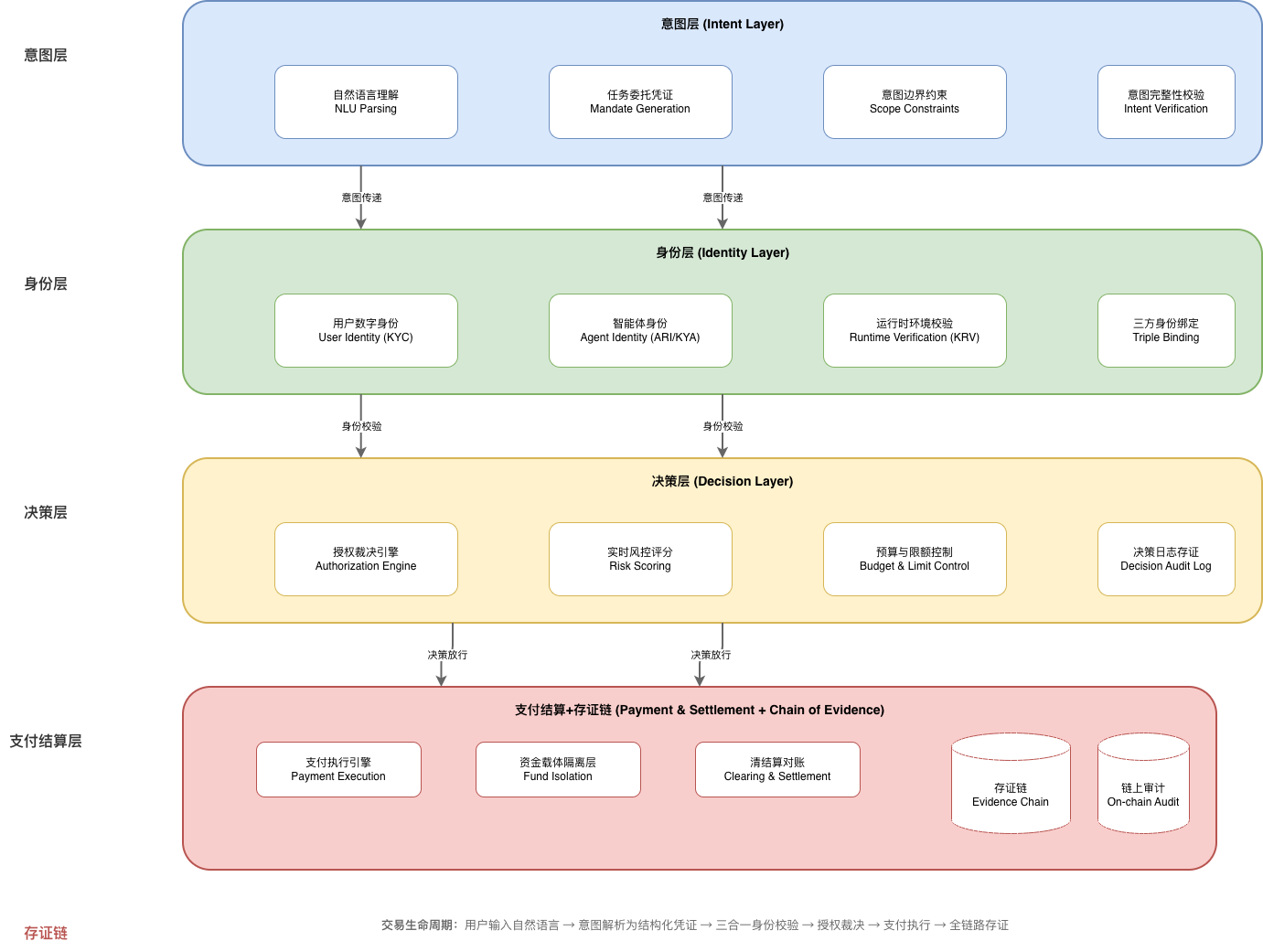
Four-Layer Trust Architecture
Intent Layer → Identity Layer → Decision Layer → Payment & Settlement + Evidence Chain
3.2 Alipay ACT 2.0: China’s First Agent Commercial Trust Protocol
Released: May 26, 2026
Alipay’s ACT 2.0 (AI Commercial Treaty) is an open protocol framework for agent commercial trust, co-developed with 20+ ecosystem partners.
Core Principle: “AI Doesn’t Touch User Money”
Alipay draws a clear red line: AI never touches user funds, every payment requires user confirmation. This contrasts sharply with JD.com’s A2P2 — the former emphasizes safety and control, the latter pursues autonomy and efficiency.
Token Pay Solution
Token Pay is the world’s first payment solution designed for AI Token consumption, already in deep collaboration with MiniMax and Jiequ Star, covering Token top-ups, membership subscriptions, and more.
Key Metrics
- 300 million AI payments processed
- Supports 95% of general agent frameworks
- Passed CAICT Teledyne Lab’s two highest-level security certifications
- AI Wallet enables user management of agent authorization
3.3 UnionPay APOP: Agentic Payment Open Protocol
Released: April 2, 2026
UnionPay’s APOP (Agentic Payment Open Protocol) is the earliest released and most “foundational” of the three frameworks.
Four Core Capabilities
- Agent Identity Management: Identity identification and full lifecycle management
- Intent Management: Converting natural language requests into structured bounded instructions
- User Identity Management: Establishing the relationship between users and agents
- Payment Authorization Management: Authorization activation, deduction, and consent verification
New Four-Party Model
UnionPay extends the traditional four-party model (Merchant → Acquirer → Card Organization → Issuing Bank) to:
- Pan-Account Side: Including wallet institutions, industry institutions
- Pan-Acceptance Side: Including new acquirers, payment aggregators
- Agent Provider: Positioning based on whether account services are provided
Dual Transaction Mechanisms
- Instant Payment Mode: User present, real-time confirmation
- Delegated Authorization Mode: User presets conditions, agent pays autonomously within scope
Initial partners include Umetrip, iFLYTEK, Geedoo, Voyah, etc., with production system verification transactions completed.
4. Core Code Implementation: Agent Payment Protocol Technical Deep Dive
⚠️ The following code demonstrates the core logic of agent payment protocols and is not production-grade.
4.1 Core Agent Payment Protocol Implementation (Go) — ARI Identity Binding
package agentpayment

import (
	"crypto/ecdsa"
	"crypto/rand"
	"crypto/sha256"
	"crypto/x509"
	"encoding/hex"
	"encoding/json"
	"errors"
	"fmt"
	"time"
)

// Autonomy Level Enum
type AutonomyLevel int

const (
	L0_ManualConfirm AutonomyLevel = iota
	L1_AIAssisted
	L2_RuleAutoFill
	L3_SingleTaskAuto
	L4_RangeAuto
	L5_FullAuto
)

func (l AutonomyLevel) String() string {
	return [...]string{"L0_Manual", "L1_AIAssisted", "L2_AutoFill",
		"L3_SingleTask", "L4_RangeAuto", "L5_FullAuto"}[l]
}

// Agent Runtime Identity (ARI)
type AgentRuntimeIdentity struct {
	UserID       string    `json:"user_id"`       // KYC
	AgentID      string    `json:"agent_id"`      // KYA
	AgentVersion string    `json:"agent_version"`
	DeviceID     string    `json:"device_id"`
	RuntimeHash  string    `json:"runtime_hash"`  // KRV
	Timestamp    time.Time `json:"timestamp"`
	Signature    string    `json:"signature"`
}

// Payment Mandate
type Mandate struct {
	ID            string        `json:"id"`
	UserID        string        `json:"user_id"`
	AgentID       string        `json:"agent_id"`
	ActionType    string        `json:"action_type"`
	AmountLimit   float64       `json:"amount_limit"`
	CategoryLimit []string      `json:"category_limit"`
	PayeeList     []string      `json:"payee_list"`
	TimeWindow    time.Duration `json:"time_window"`
	AutonomyLevel AutonomyLevel `json:"autonomy_level"`
	CreatedAt     time.Time     `json:"created_at"`
	ExpiresAt     time.Time     `json:"expires_at"`
	Signature     string        `json:"signature"`
}

// ARI Validator — Triple Identity Verification
type ARIValidator struct {
	privateKey *ecdsa.PrivateKey
	publicKey  *ecdsa.PublicKey
}

func (v *ARIValidator) ValidateARI(ari *AgentRuntimeIdentity, mandate *Mandate) error {
	if ari.UserID != mandate.UserID {
		return errors.New("KYC failed: user identity mismatch")
	}
	if ari.AgentID != mandate.AgentID {
		return errors.New("KYA failed: agent identity mismatch")
	}
	if ari.RuntimeHash == "" {
		return errors.New("KRV failed: runtime hash is empty")
	}
	if mandate.AutonomyLevel < L3_SingleTaskAuto {
		return fmt.Errorf("autonomy level %s too low", mandate.AutonomyLevel)
	}
	if time.Now().After(mandate.ExpiresAt) {
		return errors.New("mandate expired")
	}
	return nil
}

// Payment Adjudication
func (v *ARIValidator) Adjudicate(mandate *Mandate, amount float64, category string, payee string) (bool, error) {
	if amount > mandate.AmountLimit {
		return false, fmt.Errorf("amount %.2f exceeds limit %.2f", amount, mandate.AmountLimit)
	}
	categoryAllowed := false
	for _, c := range mandate.CategoryLimit {
		if c == category || c == "*" {
			categoryAllowed = true
			break
		}
	}
	if !categoryAllowed {
		return false, fmt.Errorf("category %s not in mandate", category)
	}
	return true, nil
}

// Fund Carrier Isolation
type FundCarrier struct {
	CarrierID  string    `json:"carrier_id"`
	UserID     string    `json:"user_id"`
	AgentID    string    `json:"agent_id"`
	Balance    float64   `json:"balance"`
	DailyLimit float64   `json:"daily_limit"`
	UsedToday  float64   `json:"used_today"`
	SceneLimit []string  `json:"scene_limit"`
	ValidUntil time.Time `json:"valid_until"`
}
4.2 Multi-Agent Collaborative Payment Flow (Python)
"""
Multi-Agent Collaborative Payment Flow
Demonstrates three agents (Shopping, Arbitration, Risk Control)
collaborating to complete a payment
"""
import json
import time
import hashlib
from enum import Enum
from dataclasses import dataclass, field
from typing import Optional, List


class AutonomyLevel(Enum):
    L0_MANUAL = 0
    L1_ASSISTED = 1
    L2_AUTOFILL = 2
    L3_SINGLE_TASK = 3
    L4_RANGE_AUTO = 4
    L5_FULL_AUTO = 5


@dataclass
class PaymentRequest:
    request_id: str
    agent_id: str
    user_id: str
    amount: float
    payee: str
    category: str
    mandate_id: str
    timestamp: float = field(default_factory=time.time)
    intent: str = ""


@dataclass
class PaymentDecision:
    request_id: str
    approved: bool
    autonomy_level: AutonomyLevel
    reason: str
    evidence_hash: str
    timestamp: float = field(default_factory=time.time)


class ShoppingAgent:
    """Shopping Agent — Understands user intent, selects products, compares prices"""

    def __init__(self, agent_id: str, user_id: str, mandate: dict):
        self.agent_id = agent_id
        self.user_id = user_id
        self.mandate = mandate

    def process_intent(self, user_input: str) -> PaymentRequest:
        intent_info = self._parse_intent(user_input)
        return PaymentRequest(
            request_id=f"req_{int(time.time_ns())}",
            agent_id=self.agent_id,
            user_id=self.user_id,
            amount=intent_info["amount"],
            payee=intent_info["payee"],
            category=intent_info["category"],
            mandate_id=self.mandate["id"],
            intent=user_input,
        )

    def _parse_intent(self, text: str) -> dict:
        if "flower" in text.lower() or "gift" in text.lower():
            return {"amount": 199.0, "payee": "FlowerShop", "category": "gift"}
        elif "ticket" in text.lower():
            return {"amount": 89.0, "payee": "Cinema", "category": "ticket"}
        elif "subscribe" in text.lower():
            return {"amount": 29.9, "payee": "VIPService", "category": "subscription"}
        return {"amount": 0, "payee": "unknown", "category": "unknown"}


class PaymentArbitrationAgent:
    """Arbitration Agent — Validates identity and authorization rules"""

    def __init__(self, validator_id: str):
        self.validator_id = validator_id

    def validate_request(self, request: PaymentRequest, mandate: dict) -> Optional[PaymentDecision]:
        if request.amount > mandate.get("amount_limit", 0):
            return PaymentDecision(
                request_id=request.request_id, approved=False,
                autonomy_level=AutonomyLevel.L2_AUTOFILL,
                reason=f"Amount {request.amount} exceeds limit {mandate['amount_limit']}",
                evidence_hash=self._compute_hash(request),
            )
        allowed_categories = mandate.get("category_limit", [])
        if "*" not in allowed_categories and request.category not in allowed_categories:
            return PaymentDecision(
                request_id=request.request_id, approved=False,
                autonomy_level=AutonomyLevel.L2_AUTOFILL,
                reason=f"Category {request.category} not authorized",
                evidence_hash=self._compute_hash(request),
            )
        if time.time() > mandate.get("expires_at", 0):
            return PaymentDecision(
                request_id=request.request_id, approved=False,
                autonomy_level=AutonomyLevel.L1_ASSISTED,
                reason="Authorization expired",
                evidence_hash=self._compute_hash(request),
            )
        return None

    def _compute_hash(self, request: PaymentRequest) -> str:
        raw = f"{request.request_id}|{request.amount}|{request.payee}|{time.time()}"
        return hashlib.sha256(raw.encode()).hexdigest()


class RiskControlAgent:
    """Risk Control Agent — Real-time risk assessment"""

    def __init__(self):
        self.fraud_patterns = {
            "high_frequency": {"threshold": 5, "window": 60},
            "amount_anomaly": {"threshold": 5000},
        }
        self.transaction_history: List[dict] = []

    def evaluate(self, request: PaymentRequest) -> dict:
        risk_score = 0.0
        reasons = []

        if request.amount > self.fraud_patterns["amount_anomaly"]["threshold"]:
            risk_score += 0.4
            reasons.append("large_amount")

        recent_count = sum(
            1 for t in self.transaction_history
            if t["agent_id"] == request.agent_id
            and time.time() - t["timestamp"] < self.fraud_patterns["high_frequency"]["window"]
        )
        if recent_count >= self.fraud_patterns["high_frequency"]["threshold"]:
            risk_score += 0.3
            reasons.append("high_frequency")

        self.transaction_history.append({
            "request_id": request.request_id,
            "agent_id": request.agent_id,
            "amount": request.amount,
            "timestamp": time.time(),
        })

        return {"risk_score": min(risk_score, 1.0), "reasons": reasons}


def multi_agent_payment_flow(user_input, mandate, shopping_agent,
                              arbitration_agent, risk_agent, autonomy_level):
    """Complete multi-agent payment workflow"""
    print(f"\n{'='*60}")
    print(f"🛒 Multi-Agent Collaborative Payment")
    print(f"User Input: '{user_input}'")
    print(f"Auth Level: {autonomy_level.name}")
    print(f"{'='*60}")

    # Step 1: Shopping Agent parses intent
    request = shopping_agent.process_intent(user_input)
    print(f"\n[1/4] Intent Parsed: {request.payee} | ${request.amount} | {request.category}")

    # Step 2: Arbitration Agent validates mandate
    rejection = arbitration_agent.validate_request(request, mandate)
    if rejection:
        print(f"  ❌ Rejected: {rejection.reason}")
        return rejection

    # Step 3: Risk Control Agent evaluates
    risk_result = risk_agent.evaluate(request)
    print(f"\n[3/4] Risk Score: {risk_result['risk_score']:.2f}")

    # Step 4: Final Decision
    if risk_result["risk_score"] < 0.3:
        decision = PaymentDecision(
            request_id=request.request_id, approved=True,
            autonomy_level=autonomy_level,
            reason="Auto-approved: all checks passed",
            evidence_hash=hashlib.sha256(b"demo").hexdigest(),
        )
        print(f"\n[4/4] ✅ Approved: {decision.reason}")
    elif risk_result["risk_score"] < 0.7:
        decision = PaymentDecision(
            request_id=request.request_id, approved=False,
            autonomy_level=AutonomyLevel.L3_SINGLE_TASK,
            reason="Escalated: medium risk, needs user confirmation",
            evidence_hash="",
        )
        print(f"\n[4/4] ⚠️ Escalated: {decision.reason}")
    else:
        decision = PaymentDecision(
            request_id=request.request_id, approved=False,
            autonomy_level=AutonomyLevel.L0_MANUAL,
            reason="Rejected: high risk transaction",
            evidence_hash="",
        )
        print(f"\n[4/4] 🚫 Rejected: {decision.reason}")

    print(f"\n📋 Final Decision: {'✅ Approved' if decision.approved else '❌ Rejected'}")
    print(f"{'='*60}\n")
    return decision


if __name__ == "__main__":
    mandate = {
        "id": "mandate_001",
        "user_id": "user_123",
        "agent_id": "agent_shopping_v1",
        "amount_limit": 500.0,
        "category_limit": ["gift", "ticket", "subscription"],
        "payee_list": ["FlowerShop", "Cinema", "VIPService"],
        "expires_at": time.time() + 86400,
    }

    shopping = ShoppingAgent("agent_shopping_v1", "user_123", mandate)
    arbitration = PaymentArbitrationAgent("arbitrator_v1")
    risk = RiskControlAgent()

    # Test: L4 autonomous payment
    multi_agent_payment_flow(
        "Buy a bouquet of flowers for my friend under 200",
        mandate, shopping, arbitration, risk,
        AutonomyLevel.L4_RANGE_AUTO,
    )
4.3 Four-Layer Trust Architecture Validation (Go)
package trustlayers

import (
	"crypto/sha256"
	"encoding/hex"
	"fmt"
	"time"
)

// Layer 1: Intent Layer
type IntentLayer struct {
	RawInput    string  `json:"raw_input"`
	ParsedIntent Intent `json:"parsed_intent"`
	Constraints []string `json:"constraints"`
	Verified    bool    `json:"verified"`
}

type Intent struct {
	Action   string  `json:"action"`
	Target   string  `json:"target"`
	Amount   float64 `json:"amount"`
	Category string  `json:"category"`
	Payee    string  `json:"payee"`
}

// Layer 2: Identity Layer
type IdentityLayer struct {
	UserIdentity  UserIdentity  `json:"user_identity"`
	AgentIdentity AgentIdentity `json:"agent_identity"`
	RuntimeProof  RuntimeProof  `json:"runtime_proof"`
	TripleBound   bool          `json:"triple_bound"`
}

// Layer 3: Decision Layer
type DecisionLayer struct {
	Authorization Authorization `json:"authorization"`
	RiskScore     float64       `json:"risk_score"`
	BudgetCheck   BudgetCheck   `json:"budget_check"`
	Decision      string        `json:"decision"`
}

// Layer 4: Payment Settlement + Evidence Chain
type PaymentSettlementLayer struct {
	PaymentRef    string          `json:"payment_ref"`
	FundCarrierID string          `json:"fund_carrier_id"`
	EvidenceChain []EvidenceBlock `json:"evidence_chain"`
	FinalStatus   string          `json:"final_status"`
}

type EvidenceBlock struct {
	Index     int       `json:"index"`
	Timestamp time.Time `json:"timestamp"`
	DataHash  string    `json:"data_hash"`
	PrevHash  string    `json:"prev_hash"`
	BlockHash string    `json:"block_hash"`
}

type TrustChainValidator struct{}

func (v *TrustChainValidator) ValidateFullChain(userInput string) error {
	fmt.Println("=== Four-Layer Trust Architecture Validation ===")

	// Layer 1
	fmt.Println("\n[Layer 1] Intent Layer: Parsing & Boundary Constraints")
	intent := Intent{Action: "buy", Target: "flowers", Amount: 199.00, Category: "gift", Payee: "FlowerShop"}
	fmt.Printf("  Parsed: %s %s $%.2f\n", intent.Action, intent.Target, intent.Amount)

	// Layer 2
	fmt.Println("\n[Layer 2] Identity Layer: ARI Triple Verification")
	fmt.Println("  ✅ KYC | ✅ KYA | ✅ KRV — Triple Identity Bound")

	// Layer 3
	fmt.Println("\n[Layer 3] Decision Layer: Authorization & Risk Assessment")
	riskScore := 0.15
	fmt.Printf("  Risk Score: %.2f\n", riskScore)
	fmt.Printf("  Decision: %s\n", "APPROVE")

	// Layer 4
	fmt.Println("\n[Layer 4] Payment Settlement + Evidence Chain")
	block := EvidenceBlock{
		Index:     1,
		Timestamp: time.Now(),
		DataHash:  hex.EncodeToString(sha256.New().Sum([]byte("payment_data"))),
		PrevHash:  "0",
		BlockHash: hex.EncodeToString(sha256.New().Sum([]byte("block_data"))),
	}
	fmt.Printf("  Payment Ref: pay_%d\n", time.Now().UnixNano())
	fmt.Printf("  Evidence Block: index=%d, hash=%s\n", block.Index, block.BlockHash[:16])

	fmt.Println("\n=== Four-Layer Trust Validation Complete ===")
	return nil
}
4.4 Token Payment Settlement Demo (Python)
"""
Token Payment Settlement System
Demonstrates the core flow of agent micropayments using Tokens
"""
import time
import hashlib
import hmac
from dataclasses import dataclass, field
from typing import Dict, List
from enum import Enum


class TokenType(Enum):
    COMPUTE = "compute"
    API = "api"
    DATA = "data"
    SERVICE = "service"


@dataclass
class TokenBucket:
    agent_id: str
    total_tokens: int
    used_tokens: int = 0
    daily_limit: int = 10000

    @property
    def available(self) -> int:
        return self.total_tokens - self.used_tokens

    def consume(self, amount: int) -> bool:
        if self.available >= amount:
            self.used_tokens += amount
            return True
        return False


@dataclass
class TokenPaymentRequest:
    agent_id: str
    service_id: str
    token_type: TokenType
    amount: int
    timestamp: float = field(default_factory=time.time)
    signature: str = ""

    def sign(self, secret_key: str):
        message = f"{self.agent_id}|{self.service_id}|{self.token_type.value}|{self.amount}|{self.timestamp}"
        self.signature = hmac.new(
            secret_key.encode(), message.encode(), hashlib.sha256
        ).hexdigest()


class TokenPaymentService:
    def __init__(self):
        self.buckets: Dict[str, TokenBucket] = {}
        self.transactions: List[dict] = []
        self.rates = {
            TokenType.COMPUTE: 0.001,
            TokenType.API: 0.01,
            TokenType.DATA: 0.05,
            TokenType.SERVICE: 1.0,
        }

    def register_agent(self, agent_id: str, initial_tokens: int):
        self.buckets[agent_id] = TokenBucket(agent_id, initial_tokens)

    def process_payment(self, request: TokenPaymentRequest, secret_key: str) -> dict:
        expected_sig = hmac.new(
            secret_key.encode(),
            f"{request.agent_id}|{request.service_id}|{request.token_type.value}|{request.amount}|{request.timestamp}".encode(),
            hashlib.sha256,
        ).hexdigest()
        if request.signature != expected_sig:
            return {"status": "rejected", "reason": "Signature verification failed"}

        bucket = self.buckets.get(request.agent_id)
        if not bucket:
            return {"status": "rejected", "reason": "Agent not registered"}
        if not bucket.consume(request.amount):
            return {"status": "rejected", "reason": f"Insufficient tokens (available: {bucket.available})"}

        fiat_value = request.amount * self.rates[request.token_type]
        tx = {
            "tx_id": f"tx_{int(time.time_ns())}",
            "agent_id": request.agent_id,
            "service_id": request.service_id,
            "token_type": request.token_type.value,
            "token_amount": request.amount,
            "fiat_value": round(fiat_value, 4),
            "timestamp": request.timestamp,
            "status": "settled",
        }
        self.transactions.append(tx)
        return {"status": "settled", "tx_id": tx["tx_id"], "fiat_value": fiat_value}


if __name__ == "__main__":
    service = TokenPaymentService()
    service.register_agent("agent_alice", 50000)
    secret = "agent_secret_key_demo"

    req = TokenPaymentRequest(
        agent_id="agent_alice",
        service_id="gpt_api_v2",
        token_type=TokenType.API,
        amount=100,
    )
    req.sign(secret)

    result = service.process_payment(req, secret)
    print(f"Token Payment Result: {result}")

    print(f"\nTotal Transactions: {len(service.transactions)}")
    for tx in service.transactions:
        print(f"  {tx['tx_id']}: {tx['agent_id']} → {tx['service_id']} | {tx['token_amount']}{tx['token_type']} = ${tx['fiat_value']}")
5. Market Landscape and Key Data
5.1 Market Size Forecasts
| Source | Metric | Value |
|---|---|---|
| IDC | Global Active Agents | 28.6M (2025) → 2.216B (2030) — 80x growth |
| Juniper Research | Global Agent Commerce Volume | $8B (2026) → $1.5T (2030) |
| Gartner | AI Agent Autonomous Decisions | At least 15% of daily work decisions by 2028 |
| Huawei “Intelligent World 2035” | Global AI Agents | 900 billion by 2035 |
| Ant Group Research | Token Consumption Growth | 300x current by 2030 |
| Ant Group Research | Annual Tasks by Active Agents | 400 quadrillion by 2030 |
5.2 Industry Landscape
- Alipay “Abao” AI Edition (Jun 16, 2026): One sentence invokes thousands of services
- WeChat Pay “Smart Business Robot”: Partnered with 40+ auto companies
- UnionPay International APOP: 19 domestic and international institutions onboard
- JD.com A2P2: Building ecosystem with Agent platforms, merchants, open-source communities
- Global Counterparts:
- Google AP2 + FIDO Alliance Verifiable Intent
- Mastercard AP4M (June 2026, 31 launch partners)
- Coinbase x402 (Linux Foundation stewardship)
- Stripe MPP (Machine Payments Protocol)
- AWS AgentCore Payments
5.3 Protocol Fragmentation Challenge
The biggest challenge facing the industry is protocol fragmentation: A2P2 / ACT 2.0 / APOP are incompatible with each other, each defining its own identity management, authorization rules, and settlement mechanisms. This results in:
- Inability for agents across platforms to interoperate
- Developers needing to adapt to each protocol separately
- Inability for the industry to achieve economies of scale
The industry urgently needs a cross-protocol interoperability layer or unified national/industry standard.
6. Future Outlook
Near Term (2026-2027): Scenario Validation
- Small-amount, high-frequency, standardized scenarios (API calls, cloud billing, Token consumption) go live first
- L3-L4 autonomous payment trials in controlled environments
- Each protocol accumulates practical data in vertical scenarios
Mid Term (2028-2029): Ecosystem Integration
- Cross-protocol interoperability standards drive ecosystem convergence
- Agent payment extends from consumer scenarios to B2B supply chains
- Regulatory frameworks mature, agent digital identity systems take shape
Long Term (2030+): Mass Adoption
- AI Agent autonomous payment becomes a mainstream payment method
- Agent economy ecosystem fully matures
- Payment-as-a-Service becomes fundamental infrastructure
7. Conclusion
The inclusion of “Agent Payment Protocol” in CAICT’s 2026 Top 10 Agent Keywords is no accident. It signals that AI agents are evolving from “information assistants” into “digital citizens” capable of independently participating in economic activities.
When your AI assistant can automatically renew your cloud services, book flights and hotels for your trip, and purchase daily necessities within your budget — these scenarios are no longer science fiction. JD.com A2P2, Alipay ACT 2.0, UnionPay APOP, along with Google AP2, Mastercard AP4M, and Coinbase x402 globally, are collaboratively building the infrastructure for this transformation from different angles.
Just as mobile payments reshaped the internet economy, agent payments will reshape the AI economy.
The era of AI spending money has arrived.
Sources: CAICT, IT Home, People’s Daily Online, JD.com Technology, Alipay, China UnionPay, FIDO Alliance, Juniper Research, IDC, Gartner